QATARGATE: THE PRICE OF INFLUENCE IN BRUSSELS

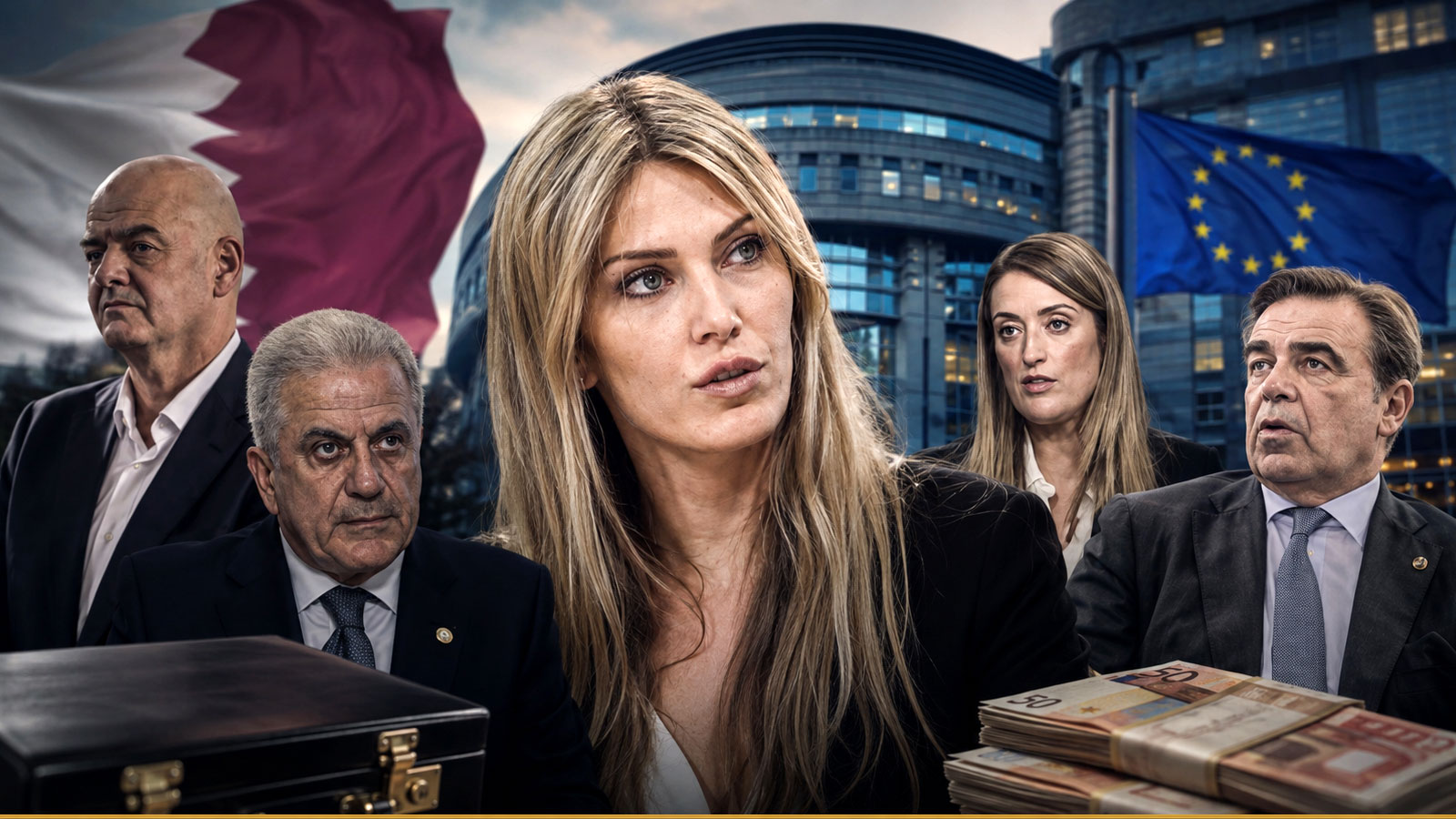
- On 9 December 2022, Belgian investigators launched raids in connection with what became known globally as Qatargate.
- Belgian authorities seized more than €1.5 million in cash during the initial operation, according to subsequent reporting on the case.
- The core allegation was politically explosive:
- The European Parliament itself acknowledged the seriousness of the allegations almost immediately.
- But the scandal presented Kleptik with a deeper question than whether individual politicians accepted improper payments.
EXECUTIVE FINDING
On 9 December 2022, Belgian investigators launched raids in connection with what became known globally as Qatargate.
The investigation concerned suspected corruption, money laundering and participation in a criminal organisation involving current and former members of the European Parliament, parliamentary staff and individuals associated with organisations operating around the Parliament.
Belgian authorities seized more than €1.5 million in cash during the initial operation, according to subsequent reporting on the case.
Among those drawn into the investigation were former European Parliament Vice-President Eva Kaili, former MEP Pier Antonio Panzeri, parliamentary assistant Francesco Giorgi, and former or serving politicians including Marc Tarabella and Andrea Cozzolino.
The core allegation was politically explosive:
that foreign interests connected principally in the investigation to Qatar and Morocco had sought to influence political activity within the European Parliament through a network of intermediaries.
The European Parliament itself acknowledged the seriousness of the allegations almost immediately.
On 15 December 2022, Parliament adopted a resolution noting the Belgian investigation into allegations of money laundering, corruption and participation in a criminal organisation and called for major reforms involving lobbying, asset declarations, foreign influence and third-country access.
But the scandal presented Kleptik with a deeper question than whether individual politicians accepted improper payments.
The question was structural:
HOW DOES FOREIGN INFLUENCE ACQUIRE POLITICAL LEGITIMACY BEFORE IT EVER LOOKS LIKE CORRUPTION?
The Qatargate allegations revealed an ecosystem in which influence could potentially pass through:
- former politicians
- parliamentary assistants
- NGOs
- informal parliamentary groups
- consultants
- business relationships
- foreign representatives
and personal networks.
Each layer can be entirely legitimate.
Together, those layers can also create distance between the ultimate sponsor of an influence effort and the political outcome being pursued.
For Kleptik, that is the real story.
Not simply cash.
Not simply Qatar.
Not simply one vice-president.
The investigation is about the beneficial ownership of political influence.
THE FINDING
Europe developed some of the world’s most sophisticated rules for financial transparency.
Banks are expected to know:
- who owns a company
- who ultimately controls an account
- whether the customer is politically exposed
- where wealth originated
- whether a transaction makes economic sense
and who ultimately benefits.
But political influence historically operated under a different philosophy.
A lobbyist might declare a client.
An NGO might publish donors.
An MEP might disclose certain interests.
A former official might become an adviser.
A friendship group might maintain political relationships with another country.
Each mechanism had rules.
The Qatargate scandal raised the question of whether those rules collectively identified the ultimate principal behind political activity.
Kleptik calls this:
INFLUENCE BENEFICIAL OWNERSHIP
The person speaking to the politician is not always the person whose interests are ultimately being advanced.
THE ALLEGED INFLUENCE ARCHITECTURE
The allegations can be analysed through a generic influence chain:
The significance of each intermediary is distance.
If a foreign ministry directly offered money to an elected official, the risk would be obvious.
If support instead moves through:
- an NGO
- a former MEP
- a conference
- a consultant
- an assistant
- or a political friendship group,
the relationship becomes more difficult for ordinary transparency systems to understand.
That does not make intermediaries inherently improper.
It makes the funding chain essential.
THE PEOPLE
PIER ANTONIO PANZERI
Former position: Member of the European Parliament.
Panzeri became one of the central figures in the Belgian investigation.
He was also associated with the Brussels-based NGO Fight Impunity, which became prominent in reporting concerning the case.
In its 15 December 2022 resolution, the European Parliament specifically noted that Fight Impunity had not been registered in the EU Transparency Register at that time.
Panzeri later entered into a cooperation arrangement with Belgian prosecutors under which he agreed to provide information in exchange for a reduced sentencing framework, according to reporting on the investigation.
His statements subsequently became an important component of the prosecutorial case.
That development also generated significant defence challenges concerning his credibility.
As of 2026, the evidentiary use of Panzeri’s cooperation remains one of the issues scrutinised by defence teams and Belgian courts.
EVA KAILI
Position at time of arrest: Vice-President of the European Parliament.
Kaili was removed as a vice-president following the eruption of the scandal.
She has consistently denied criminal wrongdoing.
Her defence has challenged aspects of the Belgian investigation, including procedural issues, use of intelligence material and questions concerning parliamentary immunity.
In February 2026, the Brussels Court of Appeal rejected efforts by defendants to invalidate the investigation at that stage and permitted the proceedings to continue. Kaili’s lawyers reiterated her innocence and indicated that further legal avenues remained under consideration.
Kleptik therefore describes Kaili as:
a suspect charged in the Belgian investigation who denies wrongdoing and has not been finally convicted in the Qatargate proceedings.
FRANCESCO GIORGI
Role: Parliamentary assistant and partner of Eva Kaili.
Giorgi became one of the central figures investigated by Belgian authorities.
His position is analytically important because parliamentary assistants can occupy an unusual space between:
- political access
- policy knowledge
- MEP schedules
- committee operations
and external contacts.
That does not create wrongdoing.
It does create potential influence value.
MARC TARABELLA
Role: Belgian political figure and former MEP.
Tarabella became a subject of the investigation and has contested wrongdoing.
His involvement illustrates that an influence inquiry can extend beyond one office or one political group.
ANDREA COZZOLINO
Role: Former Italian MEP.
Cozzolino was also drawn into the investigation and has denied wrongdoing.
Together, the various political figures illustrate that the investigation concerned an alleged network, rather than a single bilateral relationship.
FOLLOW THE CASH
The visual power of Qatargate came from the cash.
Images and descriptions of large quantities of banknotes transformed what might otherwise have looked like an opaque influence inquiry into an instantly understandable corruption scandal.
But cash is only one analytical layer.
Kleptik should ask four different questions:
1. ORIGIN
Where did the money originate?
2. TRANSMISSION
How did it reach Brussels or the relevant recipients?
3. CUSTODY
Who physically or legally controlled it?
4. PURPOSE
What political or institutional result was allegedly expected in return?
Without the fourth answer, money alone does not establish political corruption.
A financial trail must be connected to a quid pro quo, influence objective or corrupt agreement.
That is why this dossier must distinguish the existence of cash from the legal proof of bribery.
CASH IS NOT THE WHOLE INFLUENCE SYSTEM
A sophisticated foreign-influence strategy may involve no suitcase of banknotes.
Value can instead be transmitted as:
- consultancy work
- paid travel
- employment
- research grants
- board appointments
- honoraria
- conference sponsorship
- charitable funding
- business opportunities
- family employment
- media support
or post-office career opportunities.
None of those benefits is inherently corrupt.
The investigative question is whether the economic benefit is connected to an expectation of political action.
THE POLITICAL PRODUCT
What does a foreign principal actually buy if political influence succeeds?
Not necessarily a vote.
Influence can produce:
ACCESS
Meetings with officials or lawmakers.
AGENDA
Getting an issue discussed or suppressed.
LANGUAGE
Changing wording in a parliamentary document.
LEGITIMACY
Obtaining favourable public comments from credible European politicians.
DELAY
Slowing legislation or criticism.
PROCEDURE
Changing committee handling.
VOTES
Supporting or opposing a resolution.
REPUTATION
Improving the international image of a government.
This matters because corruption analysis often searches only for the final vote.
The more valuable intervention may occur months earlier.
FOLLOW THE POLICY
Kleptik should reconstruct any alleged influence operation using synchronized timelines.
For example:
Temporal proximity alone does not prove causation.
But it can identify where documentary investigation should concentrate.
THE NGO LAYER
The role of NGOs around political institutions deserves particular scrutiny.
NGOs perform essential democratic functions.
They advocate.
Research.
Campaign.
Monitor governments.
Defend human rights.
But the credibility associated with civil society can also make an NGO valuable as an influence intermediary.
The central questions should therefore be:
- Who founded it?
- Who controls its board?
- Who funds it?
- Who are its principal donors?
- Does it disclose those donors?
- Does it employ former politicians?
- Does it have parliamentary access?
- Does it organise events attended by lawmakers?
- Does it produce policy material?
- Does it act on behalf of a foreign government or commercial interest?
The European Parliament’s December 2022 resolution explicitly highlighted Fight Impunity’s absence from the Transparency Register at the time, reinforcing the significance of this gap.
THE REVOLVING DOOR
Former politicians occupy an especially valuable position in influence networks.
They possess:
- relationships
- institutional knowledge
- credibility
- access
- knowledge of procedure
and understanding of political personalities.
This creates the classic revolving-door problem.
The European Parliament’s December 2022 response called for a cooling-off period for former MEPs specifically to reduce these risks.
Kleptik’s test should be:
Again, movement from public service into private work is not inherently improper.
The issue is whether the former official monetises privileged access that exists because of public service.
THE ASSISTANT PROBLEM
Parliamentary staff can be overlooked by compliance systems because they may not possess the public profile of elected officials.
But staff can have extraordinary practical influence.
They may:
- manage diaries
- prepare briefings
- draft amendments
- coordinate committees
- screen meeting requests
- maintain external relationships
and communicate directly with political stakeholders.
A sophisticated influence operation may therefore focus upon the people surrounding the politician rather than the politician personally.
This creates another Kleptik principle:
PEP screening that identifies the officeholder but ignores the officeholder’s operating network is incomplete.
THE FRIENDSHIP-GROUP PROBLEM
Informal parliamentary friendship groups can serve legitimate diplomatic functions.
They also create channels through which foreign interests may obtain access outside formal committee structures.
Following the scandal, Parliament itself called for stronger regulation and monitoring of friendship groups and for an accessible register of such activities.
The relevant investigative questions include:
- Who participates?
- Who funds travel?
- Who hosts events?
- Which embassies interact with the group?
- Are staff involved?
- Does the group take positions on matters before Parliament?
- Are foreign representatives registered?
QATAR
Qatar became the shorthand label for the scandal because Belgian authorities were examining suspected Qatari influence.
The European Parliament’s 15 December 2022 resolution explicitly referred to suspicions of corruption involving Qatar and called for suspension of parliamentary access for Qatari interest representatives while investigations proceeded.
But Kleptik should avoid reducing the investigation to:
Qatar paid European politicians.
That statement exceeds what has been finally adjudicated against several central defendants.
Instead, the dossier should distinguish:
- Belgian prosecutorial allegations
- Panzeri’s cooperation evidence
- documentary and financial evidence
- defence denials
- and
final judicial findings, where they eventually emerge.
MOROCCO
Subsequent reporting and proceedings also connected the broader investigation with alleged Moroccan influence.
By 2023, even European Parliament debates referred to the scandal as involving both Moroccogate and Qatargate.
This broadens the significance considerably.
If the alleged architecture involved more than one foreign principal, the relevant question becomes whether an influence infrastructure existed that could serve multiple external interests.
That is potentially more important than any single country’s role.
FROM FOREIGN LOBBYING TO FOREIGN INTERFERENCE
Foreign lobbying is legal in democratic systems when conducted transparently and within applicable rules.
The dividing line between lobbying and improper foreign interference can depend upon:
- disclosure
- funding
- agency
- misrepresentation
- payments
and the conduct requested.
Consider three models.
MODEL A — TRANSPARENT ADVOCACY
This is ordinary political advocacy.
MODEL B — OPAQUE INFLUENCE
This creates transparency concerns.
MODEL C — CORRUPT INFLUENCE
This potentially becomes bribery.
The documentary evidence must determine which model applies.
PARLIAMENT’S INITIAL RESPONSE
The institutional reaction was unusually rapid.
On 15 December 2022, the European Parliament adopted its corruption response resolution by 541 votes in favour, two against and three abstentions.
Its proposals included:
- a ban on donations from third countries to MEPs and political parties
- asset declarations at the beginning and end of parliamentary mandates
- stronger transparency controls
- regulation of friendship groups
- improved legislative footprints
- stronger scrutiny of foreign representatives
and expansion of ethics mechanisms.
The scale of the vote demonstrates that Parliament itself regarded the existing framework as requiring significant reinforcement.
THE 14-POINT REFORM PLAN
European Parliament President Roberta Metsola subsequently advanced a 14-point reform programme.
By September 2023, Parliament had formally amended its Rules of Procedure.
The new measures included:
mandatory publication by MEPs of meetings with interest representatives and representatives of third countries;
- asset declarations
- tighter conflict-of-interest rules
- stronger disclosure of second income
- revised gift rules
and restrictions concerning unofficial groupings.
Parliament described those reforms explicitly as a response to the corruption allegations.
THE LEGISLATIVE FOOTPRINT
One of the most important concepts arising from the reforms is the legislative footprint.
Financial investigators reconstruct:
who touched the money.
Political investigators should reconstruct:
who touched the legislation.
For every significant amendment or policy intervention, a legislative footprint could identify:
- meetings
- submitted language
- external recommendations
- lobbying contacts
- expert input
- foreign representatives
and organisations seeking particular outcomes.
That allows investigators to move beyond asking:
Who voted for this?
and ask:
WHO HELPED WRITE IT?
ASSET DECLARATIONS
Parliament’s reforms also strengthened requirements surrounding declarations of assets and interests.
This is central to corruption investigation because unexplained changes in wealth can provide a powerful investigative lead.
Kleptik should compare declarations across time:
- START OF MANDATE
- ↓
- assets
- income
- company interests
- outside work
- income
- company interests
- outside work
- debts
Where a material unexplained change exists, the next step is source-of-wealth analysis.
That is standard practice in banking.
It should also be standard investigative practice for public officials.
THE TRANSPARENCY REGISTER
The EU Transparency Register is designed to identify organisations and individuals attempting to influence policymaking.
The Qatargate scandal demonstrated the problem created when politically active organisations exist outside that ecosystem.
Parliament’s 2022 resolution called for strengthening the register through additional staffing and resources and expanding its scope to representatives of non-EU countries.
But registration itself answers only:
Who says they are lobbying?
It does not necessarily answer:
Who ultimately funds the lobbying?
For Kleptik, the better register would include:
- organisation
- direct client
- ultimate funder
- foreign-government connection
- subcontractors
- former officials employed
- issues lobbied
- meetings
and amount spent.
That is political beneficial ownership.
THE INSTITUTIONAL CONTRADICTION
European financial institutions routinely ask customers:
- Who ultimately owns this company?
- Who supplied these funds?
- Why did this payment occur?
- Is the customer politically exposed?
- Who is the real beneficiary?
The Qatargate allegations exposed the possibility that political institutions were not always asking equivalent questions about influence.
Consider an NGO receiving money.
The legal recipient is the NGO.
- But who funds it?
- Who directed the project?
- Who selected the policy subject?
- Who requested the meetings?
- Whose geopolitical position ultimately benefited?
That is why the useful question is not:
Who is the lobbyist?
It is:
WHO IS THE ULTIMATE BENEFICIAL OWNER OF THE LOBBYING?
FOLLOW THE INFLUENCE
Kleptik should build a permanent investigative dataset covering:
PERSONS
MEPs.
Former MEPs.
Assistants.
Political advisers.
Consultants.
ORGANISATIONS
NGOs.
Think tanks.
Lobby firms.
Consultancies.
Foundations.
Friendship groups.
FOREIGN ACTORS
Embassies.
Government ministries.
State-owned enterprises.
Sovereign funds.
Government-connected businesses.
MONEY
Donations.
Consulting fees.
Travel.
Hospitality.
Employment.
Sponsorship.
POLITICAL OUTPUT
Speeches.
Amendments.
Votes.
Committee interventions.
Resolutions.
Letters.
Diplomatic delegations.
Each database is useful alone.
Their intersection produces the investigation.
THE BELGIAN INVESTIGATION
The criminal case has proved more legally complicated than the initial public scandal suggested.
Defendants challenged:
- the use of Belgian intelligence material
- parliamentary immunity questions
- alleged leaks
- the handling of the investigation
- the impartiality of the original investigating judge
and the reliability of evidence supplied by Panzeri.
In February 2026, the Brussels Court of Appeal concluded that, at the current stage, the challenged irregularities did not justify invalidating the prosecution and permitted the investigation to continue.
The ruling is significant.
But it is not a conviction of the suspects.
It principally concerned the procedural validity of the investigation.
WHY THE DISTINCTION MATTERS
There are three separate legal questions:
QUESTION 1
Was the investigation lawfully conducted?
QUESTION 2
Is there sufficient evidence to prosecute a particular defendant?
QUESTION 3
Does that evidence prove guilt beyond the applicable criminal standard?
The February 2026 ruling principally addressed the first category.
It should not be written as if it answered the third.
THE DEFENCE POSITION
Eva Kaili continues to maintain her innocence.
Following the February 2026 appellate ruling, her lawyers stated that she remained determined to demonstrate that she had committed no criminal offence and criticised the court’s handling of several alleged procedural issues.
Other individuals implicated in the investigation have also denied wrongdoing or challenged aspects of the prosecution.
CHRONOLOGY
July 2022
Belgian investigators reportedly begin examining suspected foreign influence involving European political figures.
9 December 2022
Belgian police conduct raids and arrests in Brussels in connection with suspected corruption, money laundering and criminal-organisation offences.
More than €1.5 million in cash is ultimately reported seized from locations connected with the operation.
12 December 2022
European Parliament President Roberta Metsola addresses the scandal, describing European democracy as under attack.
13 December 2022
Eva Kaili is removed as a vice-president of the European Parliament.
15 December 2022
Parliament passes a sweeping resolution demanding stronger transparency, ethics and foreign-influence controls.
January 2023
Panzeri enters into a cooperation arrangement with Belgian prosecutors.
February 2023
Parliament advances further institutional reforms and ethics proposals.
13 September 2023
European Parliament adopts substantial amendments to its internal integrity and transparency rules by 505 votes to 93, with 52 abstentions.
December 2023
Parliament debates the scandal one year later, expressly discussing both Qatargate and alleged Moroccan influence.
September 2024
A judicial review of alleged irregularities in the Belgian investigation begins at the request of suspects.
December 2025
Parties make extensive submissions to the Brussels appellate chamber concerning the legality of the investigation.
20 February 2026
The Brussels Court of Appeal’s review becomes public. The court finds no basis at that stage to invalidate the investigation and permits it to proceed.
DOCUMENTARY RECORD
EUROPEAN PARLIAMENT — 15 DECEMBER 2022
Parliament’s formal resolution is a key primary source because it records the institution’s immediate understanding of the Belgian investigation and identifies transparency weaknesses Parliament itself believed required reform.
EUROPEAN PARLIAMENT — SEPTEMBER 2023
The amended Rules of Procedure demonstrate which vulnerabilities Parliament subsequently attempted to address:
- meetings
- third-country representatives
- assets
- conflicts
- outside income
- gifts
and unofficial groupings.
PARLIAMENTARY REFORM RECORD
European Parliament material updated through 2026 confirms that integrity and accountability reforms initiated after 2022 continued beyond the immediate scandal.
BELGIAN JUDICIAL REVIEW — FEBRUARY 2026
Reporting on the Brussels Court of Appeal’s decision establishes the current procedural position: challenges to the legality of the investigation did not terminate the case, and the inquiry may continue.
WHAT PARLIAMENT SAYS
The European Parliament’s institutional response has consistently treated the scandal as demonstrating the need for stronger integrity controls.
Its December 2022 resolution demanded reforms.
Its September 2023 vote implemented major changes.
Parliament’s own updated materials continue to describe post-2022 measures as part of a broader effort to strengthen integrity, accountability and transparency.
This is significant because the scandal’s institutional impact exists independently from the eventual criminal outcome.
A criminal prosecution asks whether particular people committed offences.
Institutional reform asks whether the system contained exploitable weaknesses.
Parliament effectively answered the second question itself:
yes, safeguards required strengthening.
WHAT THIS DOSSIER DOES NOT ESTABLISH
This dossier does not establish that:
- Qatar successfully purchased European Parliament decisions
- Morocco successfully purchased European Parliament decisions
- every person investigated committed a crime
- every NGO interacting with Parliament is an influence vehicle
- every former MEP working as a consultant is engaged in improper lobbying
- every parliamentary friendship group is compromised
- every foreign-funded political initiative is improper
cash seized by investigators necessarily represented a bribe to every person connected to it;
or every political position favourable to Qatar or Morocco resulted from improper influence.
Those would require evidence specific to each claim.
Kleptik does not substitute correlation for proof.
RIGHT OF REPLY
Before publication, Kleptik should seek comment from:
- Eva Kaili and counsel
- Pier Antonio Panzeri and counsel
- Francesco Giorgi and counsel
- Marc Tarabella and counsel
- Andrea Cozzolino and counsel
- European Parliament
Mission of the State of Qatar to the European Union
Kingdom of Morocco / relevant diplomatic mission
Fight Impunity or its responsible legal representatives
Any additional NGO, consultancy, lobby organisation or individual identified in Kleptik’s independent financial or corporate investigation should receive a specific right-of-reply request.
Questions must distinguish between:
- material contained in Belgian prosecution files
- public reporting
- Kleptik’s independent findings
and analytical questions.
UNANSWERED QUESTIONS
The scandal generated enormous publicity.
But many of the most important investigative questions remain documentary.
1. SOURCE OF CASH
Can each significant quantity of seized cash be traced to a documented origin?
2. DISTRIBUTION
Who was intended to receive which funds?
3. POLITICAL OBJECTIVES
What specific parliamentary outcomes were allegedly sought?
4. POLICY TIMELINE
Did benefits precede identifiable political interventions?
5. NGOs
Which organisations around Parliament received material foreign-government-linked funding during the relevant period?
6. BENEFICIAL FUNDING
Can the ultimate source of major NGO and think-tank donations be identified?
7. FORMER MEPS
Which former parliamentarians subsequently represented foreign governments or government-linked businesses?
8. ASSISTANTS
Which foreign representatives maintained repeated relationships with parliamentary staff rather than registered political representatives?
9. TRAVEL
Who financed foreign travel undertaken by MEPs and parliamentary personnel?
10. FRIENDSHIP GROUPS
Which unofficial parliamentary groups had significant foreign-government interaction before reform?
11. LEGISLATIVE FOOTPRINT
Can specific amendments or parliamentary texts be traced to proposals originally supplied by external actors?
12. QATAR
Which specific policy outcomes did Belgian investigators allege Qatar sought?
13. MOROCCO
Which specific policy outcomes were allegedly sought by Moroccan interests?
14. CORPORATE NETWORK
Were companies used to move funds between alleged foreign principals and intermediaries?
15. POST-2023 EFFECTIVENESS
Do the new transparency rules actually reveal foreign influence that would have remained hidden under the old system?
The final question deserves its own future dossier.
KLEPTIK INTELLIGENCE ASSESSMENT
ASSESSMENT: HIGH CONFIDENCE
The Qatargate investigation exposed significant weaknesses in the European Parliament’s pre-2023 framework governing political transparency, outside interests and foreign access.
Parliament’s own immediate and subsequent reform programme strongly supports this conclusion.
ASSESSMENT: HIGH CONFIDENCE
Foreign-influence risk cannot be effectively assessed by examining elected politicians alone.
Former politicians, assistants, NGOs, consultants and unofficial groupings can all provide meaningful political access.
ASSESSMENT: HIGH CONFIDENCE
The identity of an intermediary does not necessarily reveal the identity of the ultimate foreign or commercial principal behind an influence campaign.
This creates a political analogue to beneficial ownership.
ASSESSMENT: MODERATE CONFIDENCE
The reforms adopted after Qatargate materially increased formal transparency around meetings, interests, gifts and external relationships.
Whether these rules are sufficiently enforced to expose sophisticated indirect influence remains a separate question.
ASSESSMENT: OPEN
The full criminal scope of the alleged foreign-influence network remains unresolved as of February 2026.
The Belgian investigation has survived significant procedural challenges, but continued investigation is not equivalent to final proof of the substantive allegations.
THE KLEPTIK VIEW
Qatargate became famous because investigators found cash.
That may ultimately prove to be the least sophisticated part of the story.
Cash is visible.
The more difficult form of political influence is the influence that arrives already wearing legitimate clothes.
A policy conference.
An NGO report.
A former parliamentarian making an introduction.
A consultant requesting a meeting.
An assistant circulating language.
A diplomatic visit.
A friendship group.
A sponsored event.
A policy amendment.
Each is ordinary.
Each can be legitimate.
And each can become part of an influence operation if the ultimate sponsor, financial relationship or expected political return is concealed.
This is why existing anti-money-laundering concepts provide an unexpectedly useful model for investigating democratic institutions.
Banks ask:
Who sent the money?
Political investigators must ask:
Who sent the argument?
Banks ask:
Who owns the company?
Political investigators must ask:
Who owns the influence campaign?
Banks ask:
Who ultimately benefits?
Democracies should ask exactly the same question.
Because the most effective foreign influence is not the influence everyone can see.
It is the influence that appears to originate from somewhere else.
FOLLOW THE MONEY. THEN FOLLOW THE MESSAGE.
KLEPTIK METHODOLOGY
Kleptik treats political-corruption investigations with a heightened evidentiary threshold because inaccurate allegations concerning bribery, foreign agency or corruption can cause substantial reputational harm.
For this dossier, Kleptik relies principally upon:
- official European Parliament resolutions
- Parliamentary Rules of Procedure and reform materials
- public information concerning Belgian criminal proceedings
- judicial reporting regarding the February 2026 Brussels appellate review
- and
statements attributable to defendants or their legal representatives.
The report distinguishes carefully between:
- institutional fact
- prosecutorial allegation
- judicial ruling
- defence position
- and
Kleptik analysis.
An individual’s presence in the Belgian investigation is not treated as proof of guilt.
A financial connection is not described as a bribe unless the evidence supports a corrupt exchange.
A policy position favourable to a foreign government is not treated as evidence of foreign influence merely because it benefits that government.
A meeting with a foreign representative is not inherently suspicious.
An NGO receiving foreign funding is not inherently compromised.
Former politicians are not presumed to be improperly lobbying merely because they continue to work around European institutions.
Kleptik looks for convergence of evidence, including:
- funding
- agency
- communications
- timing
- undisclosed relationships
- political action
and demonstrable benefit.
Where possible, money trails should be reconstructed from:
- banking evidence disclosed in proceedings
- company registries
- accounting records
- financial declarations
- property records
and court exhibits.
Political influence trails should be reconstructed separately using:
- parliamentary calendars
- committee records
- meeting declarations
- amendment histories
- voting records
- speeches
- travel disclosures
- Transparency Register records
- NGO filings
and contemporaneous communications.
Only after those two datasets are independently constructed should they be compared.
This reduces the risk of building a theory first and selecting facts afterward.
EVIDENTIARY LABELS
ESTABLISHED
Supported by authoritative records, uncontested institutional facts or judicial findings.
OFFICIAL ALLEGATION
Claim made by Belgian prosecutors or other competent authorities but not finally adjudicated.
CHARGED / INVESTIGATED
Indicates formal criminal-process status and does not mean guilt.
DEFENCE POSITION
Material assertion made by a suspect or legal representative contesting allegations or procedure.
KLEPTIK VERIFIED
Independently established by Kleptik through primary documentation.
KLEPTIK ASSESSMENT
Analytical conclusion derived from identified evidence.
INFLUENCE INDICATOR
Relationship, payment or political action relevant to analysis but insufficient by itself to establish improper influence.
INVESTIGATIVE LEAD
Matter warranting further documentary examination.
UNVERIFIED
Information Kleptik has been unable to corroborate independently.
DOCUMENT STATUS
KLTK-2022-003
Subject: Qatargate / European Parliament Foreign Influence
Archive date: 15 December 2022
Current status: Active investigation dossier
Last substantive review: 20 February 2026
Next review trigger: Belgian charging/trial decision / material judgment / new Panzeri evidence / EU Court ruling concerning immunity / further parliamentary transparency reforms
© KLEPTIK — Investigations into Power, Money and the Systems Designed to Hide Both