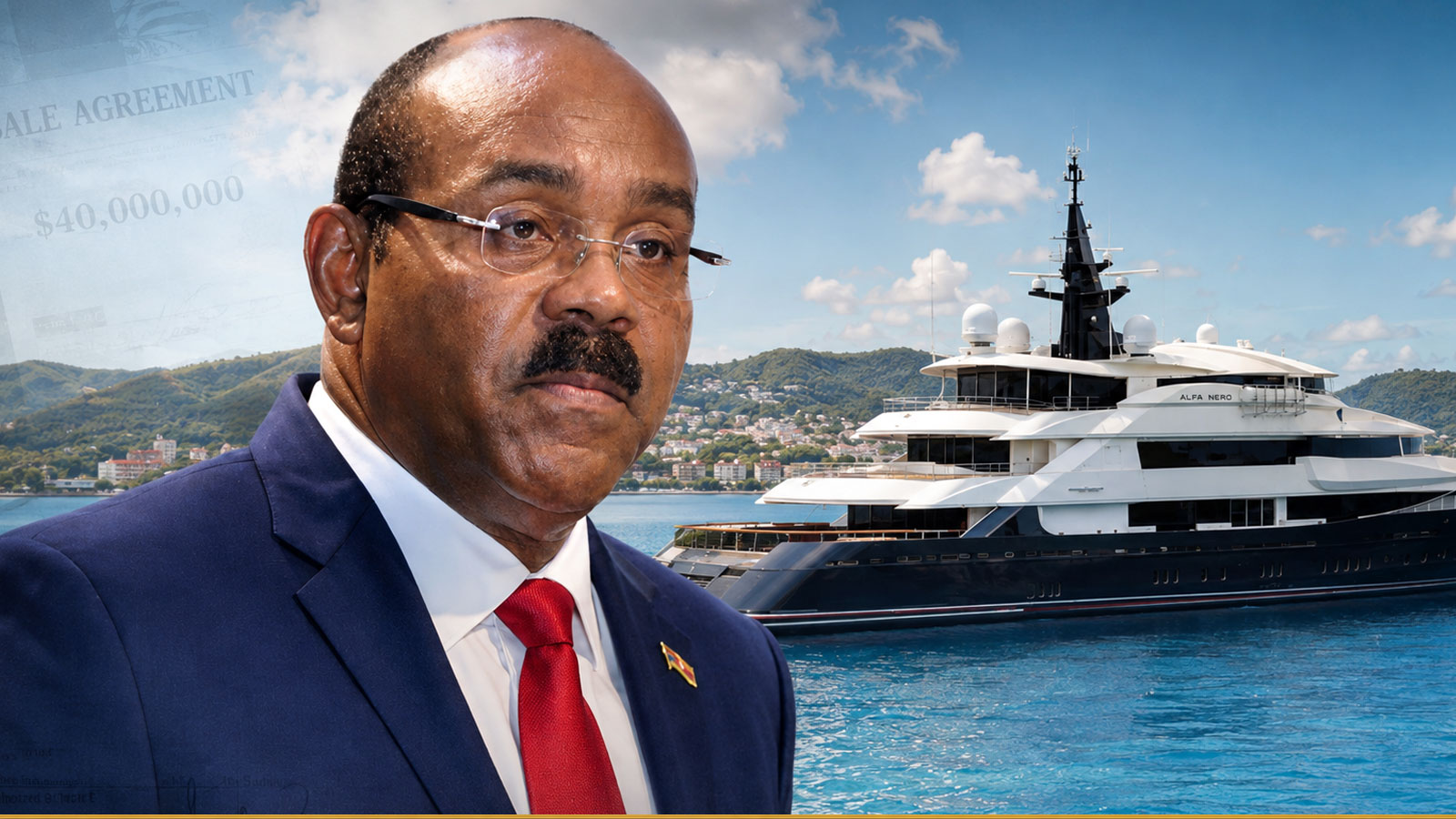
THE ENVOY, THE ISLAND BANKS AND THE MIAMI MONEY-LAUNDERING CASE

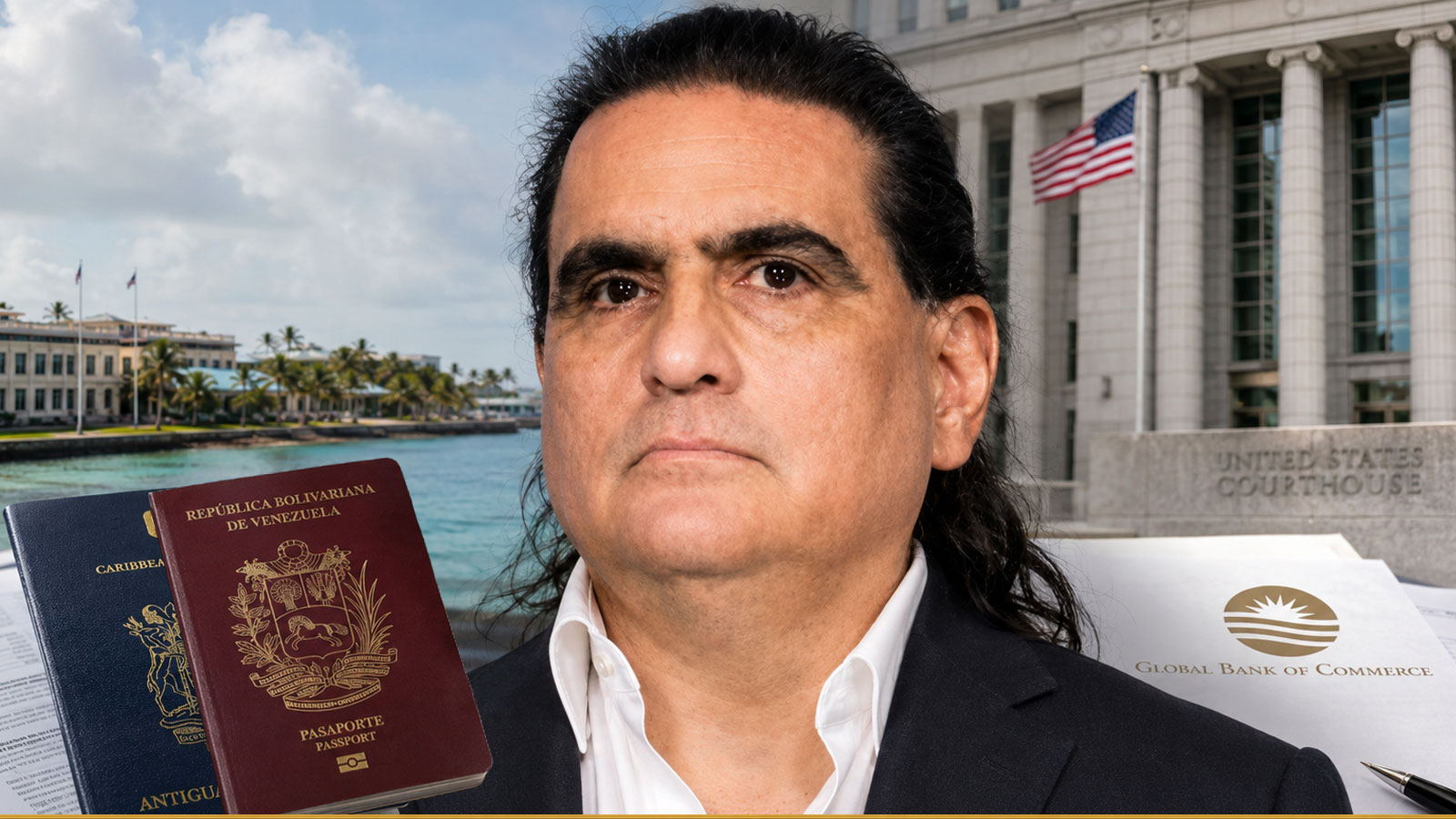
- Alex Nain Saab Moran’s legal history is not one prosecution.
- In 2014, Saab was publicly linked to Antigua and Barbuda as a Special Economic Envoy to Venezuela and was issued an Antiguan diplomatic passport.
- The proposed Antigua factory did not materialise.
- The diplomatic passport and related accreditation were later revoked after international scrutiny intensified.
- Antigua’s relevance did not stop with diplomatic status.
EXECUTIVE FINDING
Alex Nain Saab Moran’s legal history is not one prosecution.
It is a transnational architecture connecting Venezuelan public contracts, offshore and correspondent banking, diplomatic credentials, extradition litigation, presidential clemency and a renewed U.S. criminal case.
In 2014, Saab was publicly linked to Antigua and Barbuda as a Special Economic Envoy to Venezuela and was issued an Antiguan diplomatic passport.
Antigua media reported that he had also received economic citizenship and had been brought into the government’s orbit to attract investment, including a proposed factory to manufacture prefabricated housing panels.
The proposed Antigua factory did not materialise.
The diplomatic passport and related accreditation were later revoked after international scrutiny intensified.
Antigua’s relevance did not stop with diplomatic status.
FinCEN Files reporting published in 2020 identified transactions involving companies linked to Saab and his business network that moved through Global Bank of Commerce in Antigua and Barbuda.
ICIJ reported that banks began filing suspicious-activity reports with U.S. authorities from 2016 concerning transactions originating from Global Bank of Commerce.
Partner reporting also linked the Saab network to North International Bank in Antigua and Barbuda in connection with CLAP-related financial activity.
Suspicious-activity reports are not proof of money laundering or wrongdoing by a bank.
They are compliance reports flagging transactions considered unusual or potentially suspicious.
Global Bank of Commerce told reporters that, at the time of the 2020 inquiry, it had no current banking relationships with the names supplied and said banking confidentiality rules prevented disclosure of customer information.
The bank itself is an Antiguan-regulated international financial institution and is not charged in Saab’s U.S. criminal cases.
Saab’s first major U.S. prosecution began with an eight-count indictment filed in Miami on 25 July 2019.
Prosecutors alleged that Saab and business partner Alvaro Pulido used a Venezuelan low-income housing contract and the government-controlled exchange system to generate corrupt proceeds.
The indictment alleged false import documentation, bribery of Venezuelan officials and movement of approximately US$350 million out of Venezuela through U.S. and overseas bank accounts.
Saab was arrested on 12 June 2020 in Cabo Verde while his aircraft stopped to refuel en route from Venezuela to Iran.
The United States sought extradition.
Saab fought extradition through Cabo Verde’s courts, arguing in part that he was a Venezuelan special envoy entitled to diplomatic protection.
Cabo Verde’s Supreme Court approved extradition and its Constitutional Court later rejected Saab’s final challenges.
He was surrendered to U.S. custody and arrived in Miami on 16 October 2021.
Seven of the eight U.S. counts were later dismissed without prejudice to comply with assurances connected to extradition, leaving one conspiracy-to-launder-money count.
In December 2022, U.S. District Judge Robert Scola rejected Saab’s claim that diplomatic immunity required dismissal of the case.
Saab denied wrongdoing and maintained that he had been travelling on an official Venezuelan mission.
The case never reached a merits trial.
On 20 December 2023, President Joe Biden granted Saab a full pardon conditioned on his departure from the United States and remaining outside U.S. territory.
Saab was returned to Venezuela as part of a prisoner exchange involving Americans detained by the Maduro government.
The pardon ended the 2019 prosecution against him.
Then the legal story restarted.
In May 2026, Venezuela deported Saab to the United States.
On 18 May, the Justice Department unsealed a new Southern District of Florida indictment charging him with conspiracy to launder monetary instruments.
The new case is different from the pardoned 2019 case.
Prosecutors now allege a broader laundering conspiracy tied to the CLAP food programme beginning around 2015 and to Venezuelan oil transactions from 2019 through at least January 2026.
The government alleges bribery of Venezuelan officials, shell companies, fraudulent invoices, falsified shipping records and use of U.S. bank accounts to move or conceal proceeds.
Saab faces a maximum statutory penalty of 20 years if convicted.
As of the archive date, he had not been convicted in the 2026 case.
The new indictment is an allegation.
The Antigua chapter is therefore not a claim that the island government or its banks participated in Saab’s alleged crimes.
It is a due-diligence and financial-network question:
how did a businessman already facing scrutiny elsewhere acquire citizenship, diplomatic credentials and access to an offshore financial centre that later appeared in suspicious-transaction reporting connected to his network?
THE STORY IS NOT ONE OF EXTRADITION. IT IS A STORY OF HOW POLITICAL ACCESS, DIPLOMATIC CREDENTIALS AND FINANCIAL INFRASTRUCTURE CAN TRAVEL WITH THE SAME BUSINESS NETWORK ACROSS JURISDICTIONS.
The central Kleptik question is therefore:
WHAT DID ANTIGUA AND BARBUDA KNOW ABOUT ALEX SAAB WHEN IT MADE HIM AN ECONOMIC ENVOY — AND WHAT DUE DILIGENCE FOLLOWED WHEN HIS COMPANIES AND ASSOCIATES BEGAN APPEARING IN INTERNATIONAL MONEY-LAUNDERING SCRUTINY?
THE FINDING
Saab’s Antigua ties are significant but must be reported carefully.
Diplomatic access is established through contemporary reporting and later revocation.
Banking relationships are supported by FinCEN Files reporting and transaction records described by investigative journalists.
Neither fact proves Antigua’s government or the named banks knowingly joined a laundering conspiracy.
The legitimate investigation is about access, due diligence, KYC, correspondent banking and institutional response.
ALEX SAAB
Saab is a Colombian-born businessman who became one of the most prominent commercial intermediaries associated with Nicolás Maduro’s government.
His businesses operated across housing, food supply, trade and later oil.
THE ANTIGUA APPOINTMENT
Antigua Observer reported that Saab was granted economic citizenship, appointed Special Economic Envoy to Venezuela and issued a diplomatic passport in 2014.
The passport was issued on 18 November 2014.
THE PURPOSE
Antigua’s government said Saab had been engaged to attract investment and facilitate economic relations with Venezuela.
A proposed factory for prefabricated housing panels was among the expected projects.
THE FACTORY THAT DID NOT OPEN
The promised Antigua manufacturing project did not materialise.
Failure of an investment promise is not by itself evidence of fraud, but it matters to the due-diligence history of the appointment.
THE DIPLOMATIC PASSPORT
A diplomatic passport can provide prestige, access and apparent governmental legitimacy.
It does not automatically create immunity from criminal prosecution in every jurisdiction.
REVOCATION
Antigua later revoked Saab’s diplomatic passport and associated accreditations after mounting scrutiny.
The revocation showed the relationship was not permanent.
GASTON BROWNE
Prime Minister Gaston Browne was publicly associated with the decision to use Saab as an economic envoy.
Reporting quoted Browne as describing Saab as a friend.
That does not establish Browne’s knowledge of or participation in Saab’s alleged financial conduct.
DUE DILIGENCE
The key governance question is what checks were performed before citizenship and diplomatic credentials were granted.
Saab’s business activity had already attracted scrutiny in other jurisdictions before 2014.
THE GLOBAL BANK OF COMMERCE NODE
FinCEN Files reporting identified multiple companies associated with Saab or his wider network as having accounts or transaction activity through Global Bank of Commerce in Antigua and Barbuda.
THE US$5.5 MILLION CLAP TRANSFER
Investigative reporting identified a 2 March 2017 transfer of US$5.5 million from Group Grand Limited through Global Bank of Commerce to Mexican company Jaifar Comercial for food packages.
The transaction appeared in suspicious-activity reporting and in a later Mexican financial-intelligence complaint.
A suspicious transaction report is not a criminal finding.
GROUP GRAND LIMITED
Group Grand Limited became one of the most prominent corporate vehicles associated with the CLAP food business.
The 2026 U.S. indictment concerns alleged laundering linked to the CLAP programme but must be assessed according to the allegations actually charged.
NORTH INTERNATIONAL BANK
FinCEN Files partner reporting also connected Saab’s CLAP network to North International Bank in Antigua and Barbuda.
The public record reviewed by Kleptik does not establish criminal liability by the bank.
CORRESPONDENT BANKING
Dollar transfers from small offshore banks often require correspondent access to larger financial institutions.
Crown Agents Bank acknowledged a former correspondent relationship with Global Bank of Commerce while denying that the Saab-linked companies themselves were its clients.
CORRESPONDENT ≠ CUSTOMER
A correspondent bank processes payments for another bank.
That does not necessarily mean it has a direct customer relationship with the underlying account holder.
SARS
Suspicious Activity Reports are filed by financial institutions when transactions raise compliance concerns.
They are intelligence leads, not evidence that the customer or bank committed a crime.
THE ANTIGUA FINANCIAL-CENTRE QUESTION
Antigua and Barbuda has long operated an international financial-services sector.
The Saab story raises the narrower question of how politically exposed foreign clients and government-linked traders were screened during the relevant period.
THE 2019 U.S. INDICTMENT
On 25 July 2019, a Miami federal grand jury charged Saab and Alvaro Pulido in an eight-count money-laundering indictment.
The indictment was an allegation and Saab pleaded not guilty.
THE HOUSING CONTRACT
The first U.S. case alleged a bribery and foreign-exchange scheme connected to a Venezuelan low-income housing contract signed in 2011.
Prosecutors said false import documentation was used to obtain U.S. dollars at Venezuela’s favourable official exchange rate.
THE US$350 MILLION ALLEGATION
The Justice Department alleged approximately US$350 million moved out of Venezuela through U.S. and overseas accounts.
That figure was an indictment allegation and never resulted in a merits conviction because the case ended by pardon.
MIAMI NEXUS
U.S. prosecutors alleged meetings concerning bribe payments occurred in Miami and that related transfers passed through accounts in the Southern District of Florida.
That financial and territorial nexus supported U.S. jurisdiction.
THE CABO VERDE ARREST
Saab was arrested on 12 June 2020 while his aircraft stopped in Cabo Verde to refuel.
The United States had sought his arrest through international law-enforcement channels.
THE IRAN MISSION
Saab maintained that he was travelling to Iran as a Venezuelan special envoy to obtain fuel and humanitarian supplies.
That claim later became central to his diplomatic-immunity defence.
EXTRADITION
Cabo Verde’s courts approved extradition after prolonged litigation.
Its Constitutional Court ultimately rejected Saab’s remaining challenges.
THE 16 OCTOBER 2021 TRANSFER
Saab arrived in U.S. custody on 16 October 2021 and made his first Miami appearance on 18 October.
This was extradition, not deportation.
EXTRADITION ASSURANCES
Seven of the eight original counts were dismissed without prejudice after extradition.
The U.S. government had represented that Saab would face only one count carrying a maximum punishment consistent with the extradition framework.
THE ONE REMAINING COUNT
The remaining charge was conspiracy to commit money laundering.
Saab pleaded not guilty.
DIPLOMATIC IMMUNITY
Saab argued that he was immune because he had been appointed a Venezuelan special envoy and was travelling on official business.
The U.S. government disputed that he qualified for immunity.
THE DECEMBER 2022 RULING
U.S. District Judge Robert Scola rejected Saab’s diplomatic-immunity claim and refused to dismiss the indictment.
The judge concluded Saab had not established an immunity basis that barred the prosecution.
ANTIGUA DIPLOMATIC STATUS ≠ VENEZUELAN IMMUNITY CLAIM
Saab’s earlier Antiguan diplomatic credentials and his later Venezuelan special-envoy claim are separate episodes.
The Miami immunity litigation concerned his asserted Venezuelan status at the time of the Cabo Verde arrest.
THE CASE THAT NEVER REACHED TRIAL
Although the 2022 ruling set the stage for trial, the 2019 prosecution did not reach a jury verdict or guilty plea.
That distinction matters because Saab was never convicted in the first U.S. case.
THE DECEMBER 2023 PARDON
President Joe Biden granted Saab a full pardon for the 2019 case.
The clemency warrant was conditioned on Saab leaving the United States and remaining outside U.S. territory.
THE PRISONER EXCHANGE
Saab was returned to Venezuela as part of a broader exchange involving Americans detained there.
The executive branch treated his release as part of a diplomatic negotiation rather than a merits resolution of guilt.
PARDON ≠ ACQUITTAL
A pardon eliminates criminal liability for the covered federal offences.
It does not constitute a judicial finding that the indictment was false.
PARDON ≠ CONVICTION
Saab had not been convicted before the pardon.
It is therefore equally wrong to describe the pardon as erasing a conviction that never occurred.
THE 2026 RETURN
In May 2026, Saab was deported from Venezuela to the United States and returned to federal custody.
This was a new legal event, separate from the 2021 Cabo Verde extradition.
THE NEW INDICTMENT
On 18 May 2026, the Justice Department unsealed a new indictment charging Saab with conspiracy to launder monetary instruments.
The new indictment is not barred merely because an earlier, different case was pardoned if the charged conduct falls outside the pardon’s scope.
THE CLAP THEORY
The new prosecution alleges that Saab and others bribed Venezuelan officials to secure lucrative contracts under the CLAP food programme.
Prosecutors say the group used fraudulent documentation concerning the nature and origin of imported food.
SHELL COMPANIES
The Justice Department alleges that shell companies, false invoices and falsified shipping records were used to siphon or conceal proceeds.
Those allegations remain unproven at the archive date.
THE OIL EXPANSION
The 2026 indictment alleges that from 2019 through at least January 2026 the conspiracy expanded into Venezuelan oil.
Prosecutors say Saab and co-conspirators obtained access to billions of dollars’ worth of PDVSA oil and sold it under false pretenses.
SANCTIONS CONTEXT
The government alleges the oil arrangement developed as U.S. sanctions constrained Venezuela’s normal export revenues and ability to meet obligations.
Sanctions context does not itself establish the alleged laundering conduct.
U.S. BANK ACCOUNTS
The indictment says proceeds were transferred to and through U.S. bank accounts to promote or conceal the scheme.
That creates the U.S. financial-system nexus for the new charge.
THE MAXIMUM PENALTY
The single conspiracy count carries a maximum statutory penalty of 20 years if Saab is convicted.
Maximum sentence is not a prediction of eventual punishment.
NO TRIAL YET
As of 21 May 2026, the new prosecution had only reached the initial federal-court stage.
Saab remained presumed innocent.
THE MADURO CONNECTION
U.S. authorities have repeatedly described Saab as a close financial operator for Nicolás Maduro’s government.
Political proximity is contextual; criminal responsibility must be proved transaction by transaction.
THE 'BAG MAN' LABEL
Media and officials have often used labels such as 'bag man' or 'front man.'
Kleptik avoids using those labels as evidentiary conclusions unless attributed.
THE ANTIGUA-VENEZUELA POLITICAL RELATIONSHIP
Antigua and Barbuda maintained close political and economic relations with Venezuela through Petrocaribe and regional diplomacy.
That relationship explains why an economic envoy to Venezuela could appear useful to Antigua without proving any corrupt purpose.
CARIBBEAN DIPLOMATIC ACCESS
For a commercially connected intermediary, a Caribbean diplomatic credential can increase perceived legitimacy in banking, travel and government access.
Whether Saab actually used his Antiguan credentials to facilitate specific transactions requires documentary proof.
THE PASSPORT QUESTION
The date of issue, legal basis, scope of accreditation and cancellation file should all be public-interest records.
Those documents can show what Antigua believed it was appointing Saab to do.
THE CITIZENSHIP QUESTION
If Saab received citizenship through an economic or discretionary route, the due-diligence file is central.
Citizenship status should be distinguished from diplomatic accreditation.
THE BANK-KYC QUESTION
If Saab-linked companies held accounts in Antigua, the relevant inquiry is beneficial ownership, source of funds, PEP classification, transaction monitoring and correspondent disclosures.
None of those questions can be answered by a SAR alone.
THE FSRC QUESTION
Global Bank of Commerce states that it is licensed and regulated by Antigua and Barbuda’s Financial Services Regulatory Commission.
The regulatory question is what supervisory information the FSRC received during the period of Saab-linked transaction activity.
THE NORTH INTERNATIONAL BANK QUESTION
Reporting linked North International Bank to Saab-related CLAP business.
Kleptik has not identified a public criminal judgment against the bank tied to Saab and does not infer one.
THE CORRESPONDENT-BANK QUESTION
Small international banks rely on larger correspondent institutions for U.S.-dollar clearing.
This creates multiple AML control points but can also spread responsibility across institutions.
THE FINCEN FILES LIMIT
The FinCEN Files are leaked suspicious-activity reports and related reporting.
SARs reflect suspicion by financial institutions, not government adjudication of criminality.
THE US$5.5M TRANSACTION AS LEAD
The Group Grand-to-Jaifar transfer is a concrete transaction worth investigating because it connects a CLAP-linked company, an Antiguan bank, a Mexican supplier and U.S.-linked compliance scrutiny.
Its presence in a suspicious report is a lead, not proof.
THE ANTIGUA GOVERNMENT LIABILITY LIMIT
No U.S. indictment reviewed for this dossier charges Antigua and Barbuda, Prime Minister Gaston Browne or the Antiguan government with Saab’s alleged money-laundering conspiracy.
Questions about due diligence must not be rewritten as allegations of complicity.
THE BANK LIABILITY LIMIT
Neither Global Bank of Commerce nor North International Bank is a defendant in Saab’s 2026 federal indictment.
Their role belongs to a financial-network and compliance analysis unless separate evidence supports more.
THE DUE-DILIGENCE STANDARD
A small state granting economic citizenship and diplomatic credentials to a foreign businessman should understand litigation, regulatory, source-of-wealth and reputational risk.
The standard becomes especially high when the appointee is expected to represent the country abroad.
THE REVOCATION LESSON
Antigua eventually ended Saab’s diplomatic role.
The governance question is whether warning signs were identified only after foreign scrutiny made the relationship politically costly.
THE REPUTATIONAL EXTERNALITY
A diplomatic appointment creates reputational exposure for the issuing state even if the official later acts outside the state’s knowledge or mandate.
The credential itself associates the country with the individual.
THE SMALL-STATE PROBLEM
Small states often compete aggressively for investment, banking and diplomatic access.
That can increase dependence on politically connected intermediaries who promise capital or international relationships.
THE GATEKEEPER PROBLEM
Citizenship officials.
foreign ministry.
financial regulator.
bank compliance.
correspondent bank.
Each gatekeeper sees only part of the network unless information is shared.
THE 2026 PROSECUTION AS SECOND CHANCE
The new Miami case gives prosecutors another opportunity to present a merits case against Saab.
It also creates a fresh opportunity for defense counsel to challenge jurisdiction, evidence and the scope of conduct after the 2023 pardon.
PARDON-SCOPE QUESTION
The 2023 pardon expressly covered the offences charged in the 2019 indictment.
The 2026 indictment alleges additional and later conduct, including activity through January 2026.
Any double-jeopardy or pardon-scope challenge must be assessed against the actual charges and factual overlap.
THE TRIAL QUESTION
The user-facing shorthand 'trial in the U.S.' should be used carefully.
The first case never reached trial.
The second case had only begun as of the archive date.
THE SAAB LEGAL-STATUS MATRIX
| Episode | Status | Kleptik treatment |
|---|---|---|
| 2019 Miami indictment | Charges only; later pardoned | ALLEGED / NO CONVICTION |
| 2021 Cabo Verde transfer | Extradition completed | ESTABLISHED — EXTRADITION |
| 2022 diplomatic-immunity claim | Rejected by U.S. district court | ESTABLISHED — PROCEDURAL ORDER |
| 2023 Biden pardon | Full pardon of 2019 case; departure condition | ESTABLISHED — EXECUTIVE CLEMENCY |
| 2026 deportation from Venezuela | Returned to U.S. custody | ESTABLISHED — DEPORTATION / TRANSFER |
| 2026 new money-laundering indictment | Pending | CRIMINALLY CHARGED / PRESUMED INNOCENT |
THE ANTIGUA CONNECTION MATRIX
| Connection | Public record | Evidentiary treatment |
|---|---|---|
| Special Economic Envoy | Reported appointment in 2014 | ESTABLISHED THROUGH CONTEMPORARY REPORTING |
| Diplomatic passport | Issued Nov 2014; later revoked | ESTABLISHED THROUGH CONTEMPORARY REPORTING |
| Economic citizenship | Reported by Antigua media | REPORTED GOVERNMENT RELATIONSHIP |
| Housing-panel factory | Promised / proposed; did not open | ESTABLISHED PROJECT OUTCOME |
| Global Bank of Commerce | FinCEN Files transactions linked to network | COMPLIANCE / FINANCIAL-NETWORK INDICATOR |
| North International Bank | Investigative reporting linked to CLAP network | INVESTIGATIVE LEAD |
| Antigua government complicity | No such finding identified | DO NOT INFER |
THE MONEY-MOVEMENT MATRIX
| Layer | Function | Risk |
|---|---|---|
| Venezuelan public contract | Generates State payment entitlement | Overpricing / bribery |
| Trading / shell company | Receives or invoices | Beneficial ownership opacity |
| Antiguan bank account | Holds / sends funds | PEP + source-of-funds risk |
| Correspondent bank | Clears international payment | AML monitoring |
| U.S. bank account | Creates U.S. jurisdictional nexus | Money-laundering exposure |
| Offshore beneficiary | Receives final value | Asset concealment / recovery risk |
CHRONOLOGY
2011
Saab and Alvaro Pulido obtain a Venezuelan low-income housing contract later central to the first U.S. indictment.
2013
Saab-linked business activity is already attracting scrutiny in Ecuador and elsewhere, according to later reporting.
18 November 2014
Antigua and Barbuda issues Saab a diplomatic passport in connection with his role as economic representative / envoy to Venezuela.
2014-2019
Saab maintains political and commercial ties across Venezuela and Antigua; proposed Antigua housing-panel factory does not materialise.
2016-2017
Banks file suspicious-activity reports concerning transactions associated with Saab-linked entities moving from Global Bank of Commerce in Antigua, according to FinCEN Files reporting.
2 March 2017
Group Grand Limited transfers US$5.5m from Global Bank of Commerce to Jaifar Comercial in Mexico for food packages; transaction later appears in suspicious-activity reporting.
2019
Antigua revokes Saab’s diplomatic accreditation and passport after mounting international scrutiny, according to Antigua media.
25 July 2019
U.S. federal grand jury indicts Saab and Pulido in Miami on eight money-laundering counts.
12 June 2020
Saab is arrested in Cabo Verde while his aircraft refuels en route from Venezuela to Iran.
20 September 2020
FinCEN Files investigations publish new details concerning Saab-linked transactions through Antigua.
16 March 2021
Cabo Verde Supreme Court approves extradition.
30 August 2021
Cabo Verde Constitutional Court dismisses Saab’s appeal.
13 October 2021
Cabo Verde Constitutional Court denies final reconsideration request.
16 October 2021
Saab is extradited to the United States.
18 October 2021
Saab makes his first federal court appearance in Miami.
2021-2022
Seven counts are dismissed without prejudice; one money-laundering conspiracy count remains.
23 December 2022
Judge Robert Scola rejects Saab’s diplomatic-immunity claim.
20 December 2023
President Joe Biden pardons Saab and he is returned to Venezuela in a prisoner exchange.
2024-2025
Saab holds senior roles in Venezuela, including Minister of Industry and National Production.
May 2026
Venezuela deports Saab to the United States.
18 May 2026
New Southern District of Florida indictment is unsealed; Saab makes initial appearance on a new money-laundering conspiracy charge tied to CLAP food contracts and oil.
21 May 2026
Archive date: new U.S. case pending; no conviction entered.
DOCUMENTARY RECORD
U.S. DEPARTMENT OF JUSTICE — 18 OCTOBER 2021
DOJ records the 2019 indictment, the alleged US$350m housing / exchange-control laundering scheme, Cabo Verde extradition path and Saab’s arrival in Miami.
ELEVENTH CIRCUIT — 2 MAY 2022
The appellate record confirms the Cabo Verde arrest, Saab’s special-envoy immunity claim and procedural history before extradition and U.S. litigation.
U.S. DISTRICT COURT / CONTEMPORARY REPORTING — 23 DECEMBER 2022
Judge Robert Scola rejected Saab’s claim that diplomatic immunity required dismissal of the remaining money-laundering charge.
PRESIDENTIAL CLEMENCY WARRANT — 20 DECEMBER 2023
President Biden granted Saab a full pardon for the offences charged in the 2019 Southern District of Florida case, conditioned on departure from and continued absence from U.S. territory.
U.S. DEPARTMENT OF JUSTICE — 18 MAY 2026
The new indictment alleges a money-laundering conspiracy involving CLAP food contracts, shell companies, fraudulent documents and Venezuelan oil proceeds moving through U.S. accounts.
ICIJ / FINCEN FILES — SEPTEMBER 2020
ICIJ reported that banks began flagging Saab-linked transactions from Global Bank of Commerce in Antigua from 2016 onward. ICIJ stresses that SARs are not proof of wrongdoing.
ANTIGUA OBSERVER
Contemporary Antiguan reporting documents Saab’s diplomatic passport, envoy role, proposed investment project and eventual revocation of credentials.
GLOBAL BANK OF COMMERCE
The bank identifies itself as an Antigua and Barbuda-regulated international financial institution. In FinCEN Files reporting, it said it had no current relationships with the named Saab-linked parties at the time of inquiry.
WHAT IS ESTABLISHED
Saab held an Antiguan diplomatic passport and economic-envoy relationship that was later revoked.
Saab-linked companies or associates appeared in FinCEN Files reporting concerning transactions through Antigua-based financial institutions.
Saab was indicted in the United States in 2019, arrested in Cabo Verde in 2020 and extradited to Miami in 2021.
A U.S. judge rejected his diplomatic-immunity claim in 2022.
President Biden pardoned the 2019 case in 2023 and Saab returned to Venezuela.
Saab was returned to U.S. custody in May 2026 and newly charged with money-laundering conspiracy.
WHAT IS ALLEGED
The 2019 U.S. indictment alleged a US$350m laundering scheme involving Venezuelan housing contracts, exchange controls and bribery.
The 2026 U.S. indictment alleges bribery, fraudulent food documentation, shell companies and laundering of CLAP and oil-related proceeds.
These allegations are not convictions.
Saab is presumed innocent in the 2026 case unless and until guilt is established.
WHAT IS NOT ESTABLISHED
There is no identified U.S. criminal finding that Antigua and Barbuda’s government participated in Saab’s alleged laundering schemes.
There is no identified U.S. criminal finding that Global Bank of Commerce knowingly laundered Saab proceeds.
There is no identified U.S. criminal finding that North International Bank knowingly participated in Saab’s alleged crimes.
The FinCEN Files do not establish criminality merely because a transaction was reported as suspicious.
Saab was not convicted in the 2019 U.S. case before his pardon.
As of 21 May 2026, Saab had not been convicted in the new case.
RIGHT OF REPLY
Alex Saab and his U.S. counsel should be asked to respond to the 2026 indictment and to the historical Antigua banking and diplomatic record.
Prime Minister Gaston Browne and Antigua and Barbuda’s Ministry of Foreign Affairs should be asked what due diligence preceded Saab’s citizenship, envoy appointment and diplomatic passport, and what triggered revocation.
Global Bank of Commerce should be asked whether Saab, Group Grand or identified related entities were customers during the relevant period, subject to applicable confidentiality laws, and what enhanced PEP/AML controls were applied.
North International Bank should be offered the same opportunity regarding CLAP-linked transactions identified in investigative reporting.
The Antigua and Barbuda FSRC should be asked what supervisory reviews, if any, were undertaken after the FinCEN Files reporting.
Crown Agents Bank should be invited to restate or update its position concerning its historical correspondent relationship with Global Bank of Commerce.
UNANSWERED QUESTIONS
1. ANTIGUA CITIZENSHIP
What exact legal route was used to grant Saab Antiguan citizenship, and what due-diligence file supported the decision?
2. DIPLOMATIC PASSPORT
Who approved Saab’s 18 November 2014 diplomatic passport and what mandate was recorded?
3. ENVOY TERMS
Was Saab paid, contracted or formally instructed as Special Economic Envoy to Venezuela?
4. THE FACTORY
What agreements existed for the proposed prefabricated-housing-panel factory, and why did it never open?
5. WARNING SIGNS
What adverse-information checks were conducted concerning Saab’s pre-2014 business history?
6. REVOCATION
What specific information caused Antigua to revoke Saab’s diplomatic credentials?
7. GLOBAL BANK
Which Saab-linked companies maintained accounts at Global Bank of Commerce, if any, and during what periods?
8. BENEFICIAL OWNERSHIP
Who were the declared and ultimate beneficial owners of those accounts?
9. PEP CLASSIFICATION
Was Saab classified as a politically exposed person because of Venezuelan or Antiguan roles?
10. US$5.5M TRANSFER
What KYC and transaction-monitoring records exist for the Group Grand-to-Jaifar payment?
11. NORTH INTERNATIONAL
Which CLAP-linked companies used North International Bank and what due diligence was performed?
12. CORRESPONDENTS
Which correspondent banks cleared Saab-network dollar payments from Antigua?
13. FSRC
Did the Financial Services Regulatory Commission conduct a supervisory review after U.S. or FinCEN scrutiny emerged?
14. SAR FOLLOW-UP
What happened after correspondent institutions filed suspicious-activity reports?
15. 2019 CASE
What assets were traced from the alleged US$350m first-case scheme?
16. DIPLOMATIC IMMUNITY
What documents did Saab rely on to establish Venezuelan special-envoy status, and why did the U.S. court reject them?
17. 2023 PARDON
What precise diplomatic considerations drove the prisoner-exchange decision involving Saab?
18. 2026 INDICTMENT
Which shell companies and U.S. bank accounts are alleged in the new CLAP-and-oil laundering case?
19. PARDON SCOPE
How much factual overlap exists between conduct pardoned in 2023 and the conduct charged in 2026?
20. THE CENTRAL QUESTION
Did Antigua and Barbuda merely provide legitimate diplomatic and banking services to a businessman whose later legal problems were unforeseen — or did the warning signs exist early enough that stronger due diligence should have prevented the relationship from becoming a reputational and financial-risk issue for the country?
KLEPTIK INTELLIGENCE ASSESSMENT
ASSESSMENT: ESTABLISHED — DIPLOMATIC RELATIONSHIP
Saab held Antiguan diplomatic credentials and an economic-envoy role that were later revoked.
ASSESSMENT: KLEPTIK VERIFIED
FinCEN Files reporting places Saab-linked transaction activity through Antigua-based financial institutions, particularly Global Bank of Commerce.
ASSESSMENT: IMPORTANT LIMIT
SARs are not proof of criminal conduct and no bank guilt is inferred.
ASSESSMENT: ESTABLISHED — EXTRADITION
Saab was extradited from Cabo Verde to the United States in October 2021.
ASSESSMENT: ESTABLISHED — PROCEDURAL ORDER
A U.S. judge rejected his diplomatic-immunity claim in December 2022.
ASSESSMENT: ESTABLISHED — EXECUTIVE CLEMENCY
President Biden pardoned the 2019 case and Saab returned to Venezuela in December 2023.
ASSESSMENT: CRIMINALLY CHARGED
Saab was newly charged in May 2026 with conspiracy to launder monetary instruments involving alleged CLAP and oil proceeds.
ASSESSMENT: HIGH CONFIDENCE
Antigua’s most significant exposure is reputational and due-diligence related: citizenship, diplomatic accreditation and banking access created legitimacy around a figure who later became the subject of major transnational criminal allegations.
ASSESSMENT: HIGH CONFIDENCE
The 2026 prosecution is legally distinct from the pardoned 2019 case and must be assessed on its own indictment and evidence.
ASSESSMENT: OPEN
The most important unanswered Antigua question is what officials and financial institutions knew, when they knew it, and what enhanced due diligence followed.
THE KLEPTIK VIEW
Alex Saab’s story is usually told as a Venezuela story.
That misses the infrastructure.
Political intermediaries need jurisdictions.
They need passports.
banks.
companies.
correspondents.
air routes.
diplomatic explanations.
The money does not move through one country.
Neither does legitimacy.
Antigua matters because it gave Saab something Venezuela alone could not:
a second sovereign relationship.
an internationally recognised passport.
a Caribbean financial node.
and the appearance of another government’s confidence.
That does not make Antigua a participant in Saab’s alleged crimes.
It makes Antigua an essential due-diligence chapter.
A DIPLOMATIC PASSPORT IS NOT A MONEY-LAUNDERING CONVICTION.
A SUSPICIOUS BANK TRANSACTION IS NOT A BANK CONVICTION.
BUT BOTH ARE REASONS TO ASK WHO CHECKED THE MAN BEHIND THEM.
The first U.S. case ended politically, not judicially.
The second has only begun.
That makes disciplined evidentiary language essential.
The archive should distinguish the things Saab was accused of, the things courts decided procedurally, and the things no court has yet proven.
FOLLOW THE CONTRACT.
FOLLOW THE PASSPORT.
FOLLOW THE BANK ACCOUNT.
THEN FOLLOW WHY THE SAME NETWORK KEPT FINDING NEW JURISDICTIONS.
KLEPTIK METHODOLOGY
This dossier is dated 21 May 2026, three days after the new Miami indictment was unsealed and Saab made his initial appearance.
It integrates historical records necessary to understand the new case: the Antigua diplomatic and financial relationship, 2019 indictment, Cabo Verde arrest and extradition, immunity litigation, 2023 pardon and 2026 return to U.S. custody.
The principal sources are U.S. Department of Justice releases and clemency records, Eleventh Circuit materials, contemporaneous reporting on the immunity litigation, ICIJ FinCEN Files reporting and Antigua Observer reporting on Saab’s Antiguan credentials.
KLEPTIK EXCLUSIVE ANALYSIS refers to synthesis, network mapping and due-diligence questions, not exclusive possession of public evidence.
CRIMINALLY CHARGED
An indictment allegation not yet proven beyond a reasonable doubt.
ESTABLISHED — EXTRADITION
A completed international surrender to U.S. custody.
ESTABLISHED — PROCEDURAL ORDER
A court ruling on immunity or other legal process that does not determine guilt on the underlying offense.
EXECUTIVE CLEMENCY
A presidential pardon; neither acquittal nor conviction.
SUSPICIOUS-ACTIVITY INDICATOR
A transaction or relationship appearing in SAR-based reporting; not proof of criminality.
PEP / DIPLOMATIC-DUE-DILIGENCE INDICATOR
A relationship requiring enhanced compliance or government scrutiny; not evidence of guilt.
The first 2019 U.S. case is not described as a conviction because it never reached one.
The 2026 case is treated entirely as an allegation as of the archive date.
Antigua’s government and named banks are not accused of participation absent case-specific evidence.
Later developments after 21 May 2026 are excluded from the archive-date legal status.
EVIDENTIARY LABELS
CRIMINALLY CHARGED
Pending indictment; guilt not established.
ESTABLISHED — EXTRADITION
Completed surrender from Cabo Verde to U.S. custody.
ESTABLISHED — PROCEDURAL ORDER
Court ruling on immunity or process rather than guilt.
ESTABLISHED — EXECUTIVE CLEMENCY
Presidential pardon covering specified offences.
SUSPICIOUS-ACTIVITY INDICATOR
SAR or compliance-reporting lead; not proof of money laundering.
PEP-NETWORK INDICATOR
Political or diplomatic relationship requiring enhanced scrutiny.
BANKING-NETWORK INDICATOR
Documented transaction or financial relationship requiring KYC/AML analysis.
KLEPTIK VERIFIED
Fact corroborated through authoritative or multiple reliable sources.
KLEPTIK ASSESSMENT
Analytical conclusion derived from identified evidence.
INVESTIGATIVE LEAD
Matter requiring additional diplomatic, banking, corporate or court records.
DOCUMENT STATUS
KLTK-2026-061
Subject: Alex Saab / Antigua and Barbuda / Venezuela / Global Bank of Commerce / CLAP / Cabo Verde Extradition / Miami Money Laundering
Archive date: 21 May 2026
Status at archive date: Saab in U.S. custody on new 2026 money-laundering conspiracy charge; 2019 case previously pardoned without conviction; Antiguan diplomatic credentials historical and revoked; Antigua banking links documented through investigative / SAR-based reporting but no criminal finding against government or banks
Historical treatment: Fixed to report date
© KLEPTIK — Investigations into Power, Money and the Systems Designed to Hide Both