THE PANDEMIC, THE TEST KITS AND THE BRIBE MACHINE

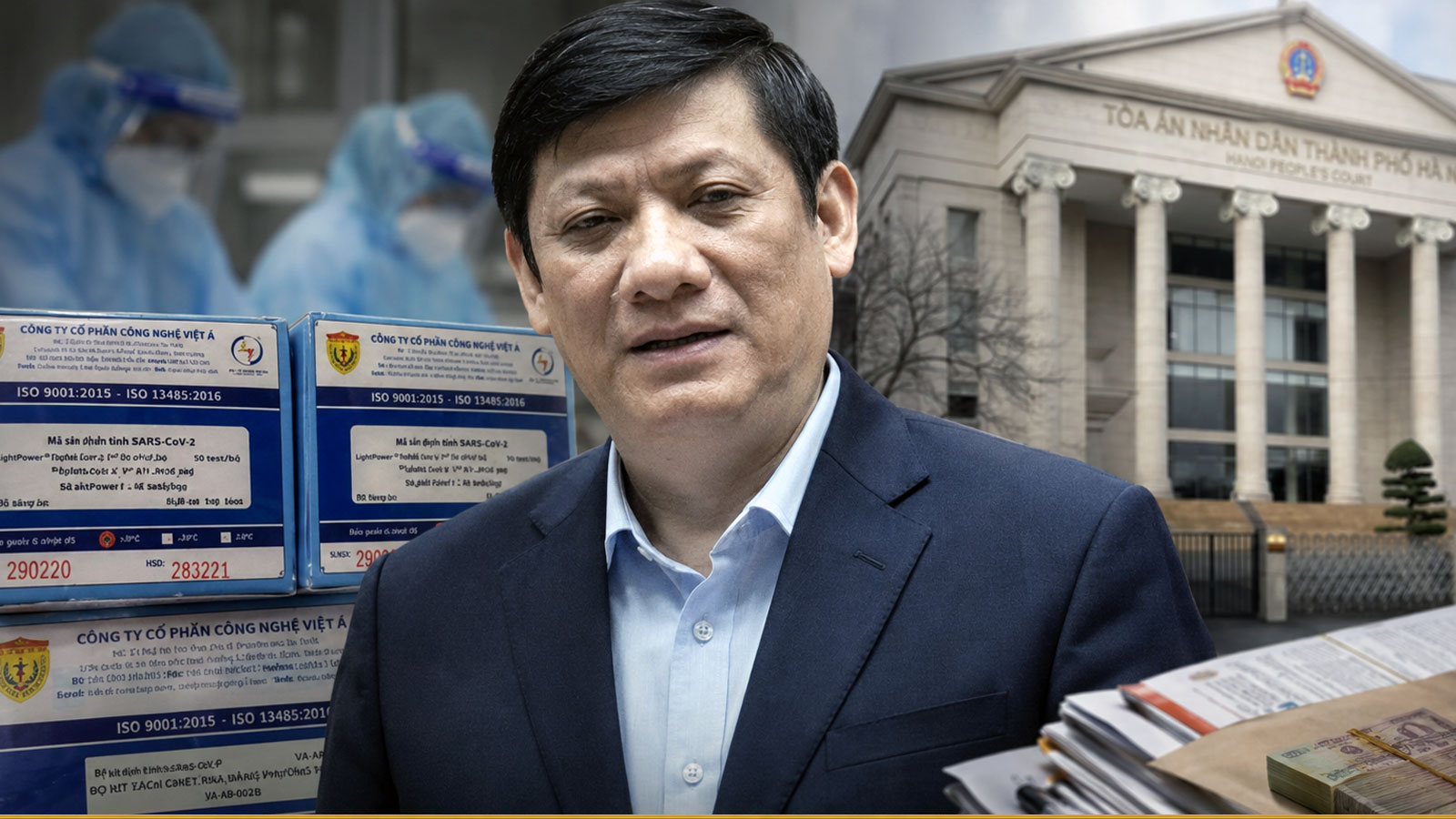
- On 12 January 2024, the Hanoi People’s Court sentenced 38 defendants in the central Viet A COVID-19 test-kit corruption case.
- Former Health Minister Nguyễn Thanh Long received 18 years in prison for accepting bribes totalling more than US$2.25 million.
- Phan Quốc Việt, chairman and general director of Viet A Technology JSC, received 14 years for serious bidding violations and 15 years for giving bribes — an aggregate 29-year sentence.
- The scandal grew out of an emergency research programme financed with State money to develop a domestic COVID-19 test kit.
- Prosecutors calculated losses exceeding VND 1.235 trillion, including approximately VND 402 billion in State-budget loss.
EXECUTIVE FINDING
On 12 January 2024, the Hanoi People’s Court sentenced 38 defendants in the central Viet A COVID-19 test-kit corruption case.
Former Health Minister Nguyễn Thanh Long received 18 years in prison for accepting bribes totalling more than US$2.25 million.
Phan Quốc Việt, chairman and general director of Viet A Technology JSC, received 14 years for serious bidding violations and 15 years for giving bribes — an aggregate 29-year sentence.
The scandal grew out of an emergency research programme financed with State money to develop a domestic COVID-19 test kit.
The court record found that officials helped Viet A through licensing, commercialisation, pricing and public procurement while the company paid bribes and off-contract percentages to public officials.
Viet A sold more than 4.5 million test kits.
Prosecutors calculated losses exceeding VND 1.235 trillion, including approximately VND 402 billion in State-budget loss.
The Ministry of Public Security investigation conclusion described more than VND 106 billion in bribes across the broader scandal.
The principal Hanoi trial described more than VND 72 billion in bribes and so-called thank-you money relevant to the convicted conduct.
The case was not a single bribe. It was a procurement ecosystem in which public funding, regulatory power, price formation, local purchasing and private kickbacks reinforced one another.
THE VIRUS CREATED THE URGENCY. THE URGENCY CREATED THE EXCEPTION. THE EXCEPTION CREATED THE MARKET.
The central Kleptik question is:
WHAT HAPPENS WHEN EMERGENCY PROCUREMENT REMOVES THE TIME, COMPETITION AND SCEPTICISM THAT NORMALLY STAND BETWEEN A PRIVATE COMPANY AND PUBLIC MONEY?
THE FINDING
Emergency procurement changes the risk equation.
Government must move faster.
Hospitals may accept supply before ordinary tender processes are complete.
Shortages reduce bargaining power.
Officials can justify exceptional procedures by pointing to lives at risk.
Those same conditions create exceptional corruption opportunity.
PUBLIC-HEALTH EMERGENCY
↓
STATE-FUNDED RESEARCH
↓
REGULATORY APPROVAL
↓
PRICE FORMATION
↓
PROVINCIAL PROCUREMENT
↓
BRIBES / PERCENTAGE PAYMENTS
↓
INFLATED PUBLIC SPENDING
VIET A TECHNOLOGY JSC
Viet A became the commercial centre of the scandal.
The company participated in developing and producing COVID-19 RT-PCR test kits during the pandemic.
Prosecutors said Viet A later used relationships with officials to obtain approvals, distribute kits and secure public purchases at prices substantially above the calculated production cost.
PHAN QUỐC VIỆT
Phan Quốc Việt was Viet A’s chairman and general director.
The Hanoi court sentenced him to an aggregate 29 years across bidding and bribery offences.
His role linked the commercial strategy, public procurement and improper payments.
NGUYỄN THANH LONG
Nguyễn Thanh Long served as Vietnam’s Health Minister during the central pandemic period.
The court sentenced him to 18 years for receiving bribes.
He received more than US$2.25 million from Phan Quốc Việt in three payments, according to the trial record.
THE STATE-FUNDED RESEARCH PROJECT
The original test-kit research project was financed from the State budget.
Prosecutors argued that the research result was therefore State property.
The court found that officials enabled Viet A to move the product into private commercial exploitation.
FROM PUBLIC RESEARCH TO PRIVATE PROFIT
Public money finances development.
A private company obtains commercial control.
Public institutions then become the customer.
The State can effectively finance both creation and purchase of the same product.
THE REGULATORY GATE
A medical test cannot enter a national market without regulatory approval.
During an emergency, approval becomes a high-value choke point.
If that gate is corrupted, procurement competition later in the chain cannot fully repair the distortion.
THE PRICE GATE
Approval creates market access.
Price determines the economic pool.
The prosecution said Viet A’s cost was approximately VND 143,000 per kit including expenses and a 5% profit margin, while public prices could be much higher.
THE 470,000 VND PRICE
At Hai Duong, prosecutors cited a price of VND 470,000 per kit.
The spread between calculated cost and public price created room for profit, commissions and bribery.
THE CORRUPTION MARGIN
A corrupt procurement market needs economic room.
Inflated price.
Hidden commission.
Bribe payment.
The public ultimately finances all three.
THE 4.5 MILLION KITS
More than 4.5 million kits were sold across the relevant period according to the prosecution record.
Scale transformed a per-unit pricing problem into a national fiscal loss.
THE VND 1.235 TRILLION LOSS
The prosecution calculated losses exceeding VND 1.235 trillion.
Approximately VND 402 billion was described as State-budget loss.
Those figures are not the same as sales revenue or bribe amount.
THE VND 106 BILLION BRIBE FIGURE
The Ministry of Public Security investigation conclusion said Việt spent more than VND 106 billion on bribes across the wider case.
The principal Hanoi trial adjudicated particular payments within that broader total.
BRIBE VERSUS THANK-YOU MONEY
Several defendants argued that payments received after official work were merely gifts of thanks.
The prosecution rejected the proposition that post-event timing automatically neutralises corruption.
Help first, pay later, call it gratitude: the economic relationship can still be corrupt.
OFFICIAL ASSISTANCE
↓
COMPANY SALES
↓
PUBLIC PAYMENT
↓
EXCESS MARGIN
↓
THANK-YOU MONEY
↓
OFFICIAL BENEFIT
THE MINISTRY OF SCIENCE AND TECHNOLOGY
The case also reached senior officials of the Ministry of Science and Technology.
Former minister Chu Ngọc Anh received a three-year sentence for violations involving management of State assets.
His offence was distinct from Long’s bribery conviction.
DIFFERENT OFFENCES, ONE SYSTEM
One official can mismanage State property.
Another can manipulate licensing.
Another can rig procurement.
Another can pay bribes.
A system does not require every participant to perform every step.
THE PROVINCIAL CDC NETWORK
Provincial Centres for Disease Control became major purchasers of Viet A kits.
Officials from several provinces entered the criminal case.
The decentralised purchasing structure allowed the same commercial model to repeat nationally.
HAI DUONG CDC
Hai Duong was one of the most important provincial nodes.
Former CDC director Phạm Duy Tuyến received a 13-year sentence for accepting bribes.
The province shows how national regulatory support translated into local purchasing.
THE ADVANCE-GOODS MODEL
Prosecutors said Viet A often supplied test kits for immediate use before formal procurement and payment procedures were complete.
Paperwork was then regularised later.
That reverses the normal control sequence.
USE FIRST, TENDER LATER
Once a hospital has already consumed the product, competitive procurement becomes largely retrospective.
The supplier has effectively won before the tender file is completed.
THE NATIONAL PRICE ANCHOR
A published or officially accepted price can influence procurement nationwide.
Once a high price becomes the benchmark, provincial buyers may treat it as legitimate rather than testing underlying cost.
THE BID-RIGGING ARCHITECTURE
Prosecutors said Viet A employees colluded with leaders and staff at public health institutions to formalise tender procedures around predetermined purchases.
The tender documented a commercial result already created by emergency supply and relationships.
PAPER COMPETITION
A procurement file can contain bids, minutes and signatures.
That does not prove real competition.
The key question is whether bidders were independent and whether the winner was predetermined.
THE KICKBACK PERCENTAGE
Investigators said Viet A calculated percentages outside formal contracts and paid commissions or bribes to persons at purchasing institutions.
Percentage-based corruption scales automatically with sales.
CORRUPTION AS SALES COMMISSION
A normal salesperson earns from revenue.
A corrupt official can be paid in the same way.
The greater the public purchase, the larger the private reward.
THE PANDEMIC INFORMATION GAP
During COVID-19, fair pricing was difficult for governments and citizens to judge.
Input shortages, changing protocols and urgent demand increased information asymmetry.
That strengthened suppliers able to secure official approval and rapid distribution.
CRISIS GOVERNANCE
Good crisis governance accepts that some controls must move faster.
It does not remove them.
The correct model is accelerated control, not no control.
THE SECOND-LOOK RULE
Every emergency exception should trigger mandatory retrospective audit.
Price. Supplier selection. Conflicts. Delivery. Use. Payment.
Emergency speed should create a later accountability obligation.
THE SUNSET RULE
Exceptional purchasing authority should expire automatically.
Otherwise emergency mechanisms can become normal business practice.
PROCUREMENT ANALYTICS
Compare unit prices across provinces.
Compare supplier concentration.
Compare emergency and competitive purchases.
Anomaly detection can identify corruption before prosecution does.
THE PUBLIC-ASSET CONVERSION
One of the most consequential elements of the case was the movement of a State-funded research result into private commercial exploitation.
That is not only procurement corruption.
It is a public-asset governance problem.
THE REGULATOR-CUSTOMER CONFLICT
The State was simultaneously research funder, regulator and customer.
That concentration of roles magnified the impact of corrupted gatekeepers.
THE SECRETARY NODE
Long’s former secretary Nguyễn Huỳnh received a nine-year sentence.
Senior officials often operate through aides who control access, communication and document flow.
A PEP investigation should map the office around the principal.
THE MIDDLE-MANAGEMENT NODES
Former Health Ministry department heads also received prison sentences.
Top-level political authority required administrative execution underneath.
THE COMPANY-STATE JOINT VENTURE
The result resembled an illicit joint venture.
The company supplied product and money.
Officials supplied regulatory access and procurement.
The public supplied the revenue.
THE PEOPLE PAID TWICE
Taxpayers financed the underlying research.
Public institutions then bought the commercialised product.
Inflated pricing created room for improper payments.
The State absorbed multiple layers of economic loss.
TECHNICAL PERFORMANCE ≠ CLEAN PROCUREMENT
A product can function technically and still be corruptly procured.
Technical quality and procurement integrity are separate questions.
THE HEROISM SHIELD
Companies operating during crisis can gain reputational protection because their products are needed.
Emergency usefulness should not shield pricing and contracting from audit.
THE SENTENCE DIFFERENTIAL
Long received 18 years.
Phan Quốc Việt received 29 years across two offences.
Other defendants received differentiated sentences reflecting offence, role, benefit and mitigation.
THE SYSTEMIC CORRUPTION FINDING
Prosecutors described the case as a typical example of interest groups and systematic collusion between business and persons with authority.
The network evidence supports analysing the scandal as a system rather than a collection of isolated gifts.
THE EMERGENCY-PROCUREMENT LEDGER
For every crisis supplier, investigators should build a ledger of public funding, approvals, contracts, prices, profits, commissions and payments to intermediaries.
Only then can the full economic structure be seen.
THE BANKING QUESTION
Large bribery systems eventually touch accounts, cash withdrawals or intermediaries.
The trial record does not automatically establish misconduct by financial institutions.
Any criticism must be transaction-specific.
THE CORPORATE BOOKS
A company paying large commissions or bribes must generate and classify the cash somewhere.
Sales expenses, advances and false commercial descriptions can preserve the accounting shadow of corruption.
THE AUDITOR QUESTION
Explosive public-sector revenue growth and large cash outflows are audit risks.
Auditors should test whether significant expenses have real commercial substance.
THE SEGREGATION-OF-DUTIES FAILURE
Emergency structures often concentrate authority to move faster.
That also concentrates corruption opportunity.
Independent second review becomes more important, not less.
THE INTERNATIONAL LESSON
Every country used emergency procurement during COVID-19.
The Viet A case is therefore not uniquely Vietnamese in its risk architecture.
It is an unusually well-documented example of what can happen when crisis controls fail at multiple levels.
THE EMERGENCY-PROCUREMENT MATRIX
| Control point | Normal safeguard | Viet A risk pattern |
|---|---|---|
| Research ownership | Clear IP / licensing rules | State-funded research privately commercialised |
| Product approval | Independent regulatory review | Officials intervened to facilitate registration |
| Pricing | Competition / cost comparison | High benchmark price created margin |
| Tender | Competition before purchase | Goods supplied first, paperwork regularised later |
| Payment | Invoice + verified procurement | Off-contract percentages / bribe pool |
THE EVIDENTIARY-STATUS MATRIX
| Issue | Status on 12 Jan 2024 | Kleptik treatment |
|---|---|---|
| Nguyễn Thanh Long bribe receipt | Court conviction | ESTABLISHED — FIRST-INSTANCE JUDGMENT |
| Phan Quốc Việt bribery / bidding offences | Court conviction | ESTABLISHED — FIRST-INSTANCE JUDGMENT |
| More than 4.5m kits sold | Case record | ESTABLISHED CASE FACT |
| VND 1.235tn loss | Prosecution / court record | ESTABLISHED CASE LOSS FIGURE |
| VND 106bn broader bribe figure | Investigation conclusion | OFFICIAL INVESTIGATIVE FINDING |
CHRONOLOGY
Early 2020
Vietnam funds an emergency project to develop a domestic COVID-19 test kit.
2020
Viet A becomes involved in development and commercialisation of the test kit.
2020–2021
Temporary and formal registration, public pricing and provincial procurement expand Viet A’s market.
2020–2021
Provincial CDCs and hospitals purchase large volumes under emergency conditions.
December 2021
Police arrest Phan Quốc Việt and open major proceedings over test-kit pricing and procurement.
2022
Investigations expand into the Health Ministry, Science and Technology Ministry and provincial authorities.
June 2022
Former Health Minister Nguyễn Thanh Long and former Science and Technology Minister Chu Ngọc Anh are arrested and prosecuted.
August 2023
The Ministry of Public Security investigation conclusion describes more than VND 1.235 trillion in losses and more than VND 106 billion in bribes across the broader case.
3 January 2024
The Hanoi People’s Court opens the first-instance trial of 38 defendants.
12 January 2024
The court sentences the defendants, including Long to 18 years and Việt to an aggregate 29 years.
DOCUMENTARY RECORD
HANOI PEOPLE’S COURT — 12 JANUARY 2024
The sentencing record establishes first-instance convictions and prison terms for 38 defendants in the principal Viet A case.
VIETNAM NEWS AGENCY / VIETNAMPLUS
Official reporting records the offence categories, the 18-year sentence for Nguyễn Thanh Long and the 29-year aggregate sentence for Phan Quốc Việt.
MINISTRY OF PUBLIC SECURITY INVESTIGATION CONCLUSION — 2023
The investigation described more than VND 1.235 trillion in losses and more than VND 106 billion in bribes across the wider case.
TRIAL INDICTMENT / PROSECUTION RECORD
The indictment described more than 4.5 million kits sold, approximately VND 402 billion in State-budget loss and procurement in which goods could be supplied before procedures were later formalised.
WHAT THE COURT FOUND
The court found Nguyễn Thanh Long guilty of accepting bribes and imposed an 18-year sentence.
The court found Phan Quốc Việt guilty of giving bribes and violating bidding regulations, imposing an aggregate 29-year sentence.
The court treated the defendants’ conduct as interconnected parts of a chain that caused exceptionally large loss.
The judgment differentiated defendants by offence, role and mitigation.
WHAT THE DEFENDANTS SAID
Several defendants admitted receiving money but argued that post-event payments were thank-you gifts rather than bribes.
Defence submissions also emphasised cooperation, restitution and contributions to pandemic response.
The court nevertheless entered convictions on the relevant offences.
WHAT THIS DOSSIER DOES NOT ESTABLISH
This dossier does not establish wrongdoing by every official, hospital or CDC that purchased Viet A kits.
It does not establish that every Viet A test kit was technically defective.
It does not equate the VND 1.235 trillion loss figure with the State-budget loss of approximately VND 402 billion.
It does not equate the more-than-VND 106 billion broader investigation bribe figure with payments adjudicated against every individual defendant.
It does not infer corruption from emergency procurement alone.
It does not incorporate later appeals or sentence changes after 12 January 2024.
RIGHT OF REPLY
Historical publication should reproduce the substance of defendants’ trial positions and mitigation accurately.
Any company, bank, hospital, CDC or professional adviser criticised beyond adjudicated facts should receive transaction-specific questions.
Viet A should be asked about pricing methodology, cost calculations and internal accounting where original reporting goes beyond the court record.
Government agencies should be offered an opportunity to explain reforms adopted after the scandal.
UNANSWERED QUESTIONS
1. THE IP OWNERSHIP
Exactly what rights did the State retain in the test-kit research it funded?
2. COMMERCIALISATION
Who authorised Viet A to exploit the research output commercially and on what terms?
3. THE TRUE COST
What was the independently audited all-in manufacturing cost per kit?
4. THE PRICE BENCHMARK
Who first approved or published the price that became a national reference point?
5. THE 4.5 MILLION KITS
Which provinces and institutions purchased the largest volumes?
6. ADVANCE SUPPLY
How many purchases occurred before tender and payment formalities were complete?
7. THE BID FILES
How many apparently competing bidders were genuinely independent from Viet A?
8. THE BRIBE LEDGER
Can the full VND 106 billion be reconciled recipient by recipient?
9. CASH GENERATION
How did Viet A generate and account for cash used for improper payments?
10. THE US$2.25 MILLION
What were the exact dates, locations and intermediaries for payments to Nguyễn Thanh Long?
11. INTERNAL CONTROLS
Which officials challenged registration or pricing decisions?
12. CDC PRICES
Why did unit prices vary across provinces?
13. COMMISSION RATE
What percentage of sales revenue was typically reserved for off-contract payments?
14. BANKING
Which accounts processed the largest commercial inflows and cash withdrawals?
15. AUDIT
What did auditors see regarding extraordinary revenue growth and cash expenditure?
16. EMERGENCY RULES
Which procurement exceptions were lawful and which were abused?
17. RESTITUTION
How much money and property had been recovered by the archive date?
18. POLICY REFORM
What procurement, pricing and medical-device rules changed after Viet A?
19. SYSTEMIC RESPONSIBILITY
Which institution should have detected the national pattern first?
20. THE CENTRAL QUESTION
Was Viet A primarily a bribery scandal — or a demonstration that emergency procurement can become a self-financing corruption machine when one supplier controls approval, price expectations and local purchasing relationships at the same time?
KLEPTIK INTELLIGENCE ASSESSMENT
ASSESSMENT: ESTABLISHED — FIRST-INSTANCE JUDGMENT
On 12 January 2024, the Hanoi People’s Court convicted 38 defendants in the principal Viet A trial.
ASSESSMENT: ESTABLISHED — BRIBE RECEIPT
Former Health Minister Nguyễn Thanh Long was convicted of receiving bribes and sentenced to 18 years.
ASSESSMENT: ESTABLISHED — COMPANY EXECUTIVE
Viet A CEO Phan Quốc Việt received an aggregate 29-year sentence for bribery and bidding offences.
ASSESSMENT: ESTABLISHED — PROCUREMENT SCALE
The case record states that more than 4.5 million Viet A test kits were sold.
ASSESSMENT: ESTABLISHED — LOSS FIGURE
The prosecution and court record identified losses exceeding VND 1.235 trillion, including roughly VND 402 billion in State-budget loss.
ASSESSMENT: OFFICIAL INVESTIGATIVE FINDING
The broader investigation conclusion described more than VND 106 billion in bribes.
ASSESSMENT: HIGH CONFIDENCE
The case demonstrates systemic emergency-procurement risk: weakened competition, urgent approval, price opacity and retrospective paperwork can reinforce one another.
ASSESSMENT: HIGH CONFIDENCE
Once a supplier obtained regulatory legitimacy and a high national price anchor, provincial procurement became easier to capture.
ASSESSMENT: HIGH CONFIDENCE
Crisis procurement should automatically trigger retrospective audit because the same conditions that justify speed create exceptional corruption opportunity.
THE KLEPTIK VIEW
A pandemic changes what government fears.
Normally, a procurement officer fears overpaying.
During a pandemic, the greater fear is having nothing to buy.
That inversion matters.
Urgency becomes bargaining power.
The State helped fund the research.
Officials helped move the product through regulatory gates.
Public institutions then bought the product.
Price created margin.
Margin created room for commissions and bribes.
Those payments helped preserve the system that created the margin.
That is a closed loop.
And the pandemic supplied the justification for every shortcut.
Use the kits now.
Complete the tender later.
Accept the price because supply is urgent.
Trust the regulator because the country is in crisis.
By the time the paperwork catches up, the product is consumed and the money is gone.
This is why emergency corruption is different.
The corrupt actor does not need to defeat the control.
The crisis has already weakened it.
EMERGENCY PROCUREMENT SHOULD MOVE FAST.
ACCOUNTABILITY SHOULD MOVE FASTER.
The lesson is not that governments should refuse emergency purchases.
The lesson is that every exception must create a second obligation.
If you buy before competition, audit after.
If you accept a sole source, disclose the cost.
If you publish a national price, verify the economics.
If a supplier grows explosively through public contracts, follow the commissions.
Crisis removes time.
It cannot be allowed to remove scrutiny.
FOLLOW THE APPROVAL.
FOLLOW THE PRICE.
FOLLOW THE PERCENTAGE THAT COMES BACK TO THE OFFICIAL.
KLEPTIK METHODOLOGY
This dossier is dated 12 January 2024 and is intentionally fixed to the first-instance legal and evidentiary position existing on that date.
The principal evidentiary basis is the Hanoi People’s Court sentencing record as reported by Vietnam News Agency/VietnamPlus and other Vietnamese state media, together with the Ministry of Public Security investigation conclusion and the trial indictment.
Kleptik distinguishes among court convictions, prosecution loss calculations, investigation-level bribe calculations, defence characterisations and analytical conclusions.
FIRST-INSTANCE CONVICTION
A guilt finding and sentence entered by the Hanoi People’s Court on 12 January 2024.
COURT / PROSECUTION LOSS FIGURE
Loss calculation presented in the principal case; distinct from bribe amount and company revenue.
INVESTIGATION BRIBE FIGURE
The broader amount described in the Ministry of Public Security investigation conclusion; not every portion corresponds to a separate conviction in the Hanoi judgment.
DEFENCE POSITION
Explanation or mitigation advanced by defendants, including the thank-you-money argument.
For emergency-procurement analysis, Kleptik separates regulatory approval, price setting, tender procedure, contract performance and payment.
For State-asset analysis, public funding of research does not automatically determine every later intellectual-property right; the applicable legal framework and court findings control.
Later appeals or sentence changes after 12 January 2024 are excluded from this dossier.
EVIDENTIARY LABELS
ESTABLISHED — FIRST-INSTANCE JUDGMENT
Finding entered by the Hanoi People’s Court on 12 January 2024.
ESTABLISHED — BRIBE RECEIPT
Bribery conduct for which an individual was convicted at first instance.
ESTABLISHED — BIDDING OFFENCE
Procurement conduct resulting in conviction.
OFFICIAL INVESTIGATIVE FINDING
Fact or amount stated in the Ministry of Public Security investigation conclusion.
PROSECUTION LOSS FIGURE
Financial harm calculated in the indictment or trial record.
EMERGENCY-PROCUREMENT INDICATOR
Fact relevant to heightened corruption risk during crisis purchasing; not wrongdoing by itself.
STATE-ASSET INDICATOR
Issue concerning public ownership or control of State-funded research or property.
KLEPTIK VERIFIED
Fact independently corroborated through authoritative official or court-linked records.
KLEPTIK ASSESSMENT
Analytical conclusion derived from identified evidence.
INVESTIGATIVE LEAD
Matter requiring additional procurement, accounting, banking or regulatory verification.
DOCUMENT STATUS
KLTK-2024-033
Subject: Viet A Technology / Nguyễn Thanh Long / COVID-19 Test Kits / Emergency Procurement / Bribery
Archive date: 12 January 2024
Status at archive date: First-instance convictions entered against 38 defendants; Nguyễn Thanh Long sentenced to 18 years; Phan Quốc Việt sentenced to 29 years
Historical treatment: Fixed to report date
© KLEPTIK — Investigations into Power, Money and the Systems Designed to Hide Both