THE PRESIDENT, THE CARTELS AND THE NARCO-STATE

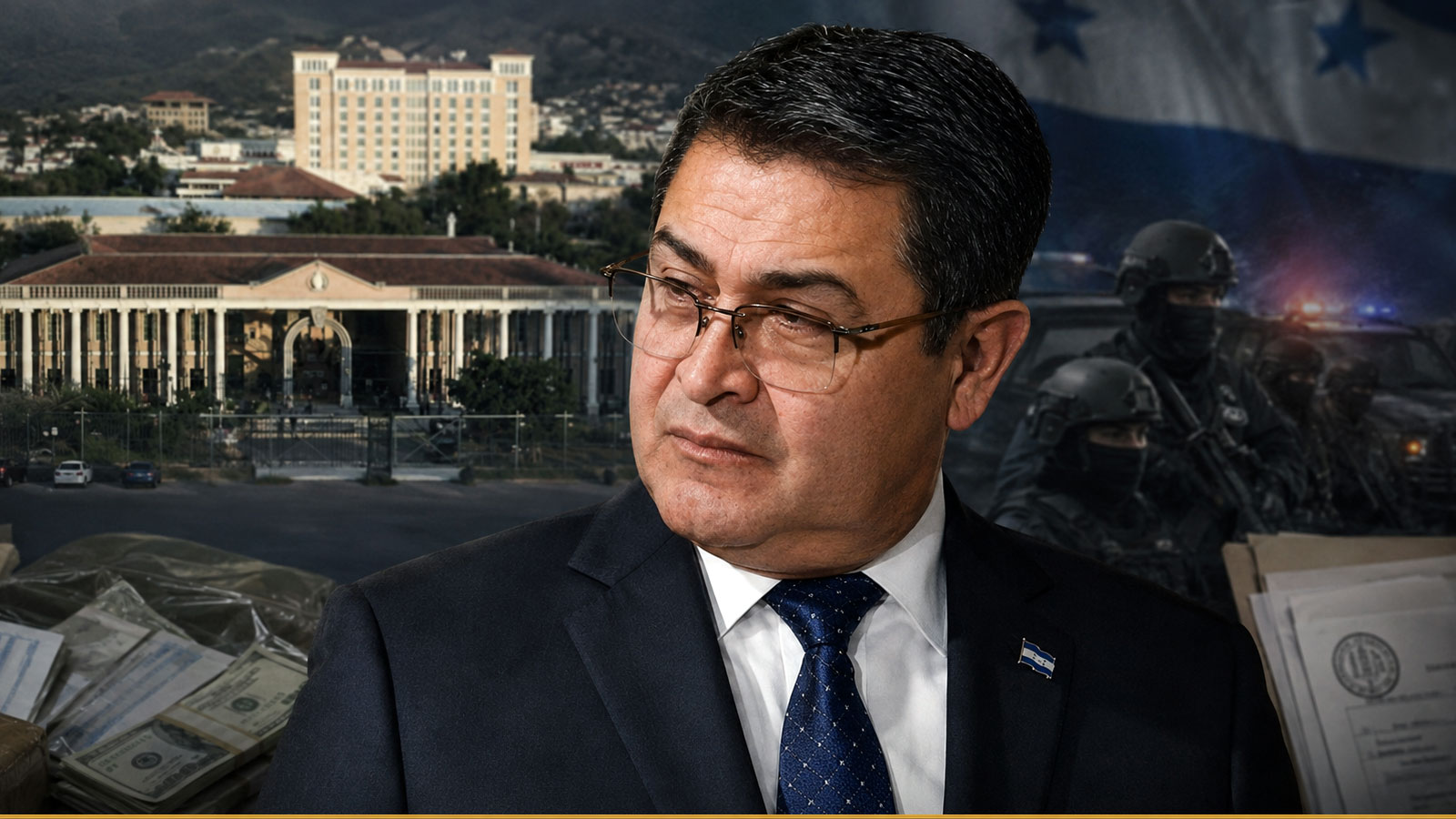
- On 26 June 2024, former Honduran President Juan Orlando Hernández was sentenced in Manhattan federal court to 45 years in prison for cocaine-importation and related machine-gun offences.
- He had been convicted on 8 March 2024 after a three-week jury trial.
- U.S. prosecutors said Hernández sat at the centre of one of the largest and most violent drug-trafficking conspiracies in the world.
- DOJ said Hernández and his co-conspirators moved more than 400 tons of U.S.-bound cocaine through Honduras during his tenure in government.
- His sentence included five years of supervised release and an $8 million fine.
EXECUTIVE FINDING
On 26 June 2024, former Honduran President Juan Orlando Hernández was sentenced in Manhattan federal court to 45 years in prison for cocaine-importation and related machine-gun offences.
He had been convicted on 8 March 2024 after a three-week jury trial.
The jury found Hernández guilty on all three counts: conspiracy to import cocaine into the United States; using and carrying machine guns and destructive devices during, and possessing machine guns in furtherance of, the cocaine conspiracy; and conspiracy to use and carry those weapons in furtherance of the same trafficking operation.
U.S. prosecutors said Hernández sat at the centre of one of the largest and most violent drug-trafficking conspiracies in the world.
During his political career, prosecutors proved that he received millions of dollars in drug money from major traffickers in Honduras, Mexico and elsewhere, using those bribes to fuel his rise in Honduran politics.
In return, the government proved that he used public institutions — including the Honduran National Police and military — to protect cocaine shipments, traffickers and the money generated by the trade.
DOJ said Hernández and his co-conspirators moved more than 400 tons of U.S.-bound cocaine through Honduras during his tenure in government.
His sentence included five years of supervised release and an $8 million fine.
The most consequential fact is not the volume of cocaine.
It is the institutional architecture that allowed the cocaine to move.
THE STATE DID NOT MERELY FAIL TO STOP THE TRAFFICKERS. THE PROSECUTION PROVED THAT PARTS OF THE STATE PROTECTED THEM.
The central Kleptik question is therefore:
WHEN DRUG MONEY HELPS BUILD POLITICAL POWER, AND POLITICAL POWER THEN PROTECTS THE DRUG MONEY, WHERE DOES CORRUPTION END AND STATE CAPTURE BEGIN?
THE FINDING
Honduras was not simply a country through which cocaine passed.
According to the evidence accepted by the federal jury, political and security institutions became part of the trafficking infrastructure.
Drug traffickers supplied money.
Political actors supplied protection.
Police and soldiers supplied armed security.
Public authority reduced the risk of interception and extradition.
The result was a feedback loop in which criminal money strengthened political power and political power strengthened the criminal enterprise.
COCAINE TRAFFICKING ORGANISATIONS
↓
DRUG MONEY
↓
POLITICAL CAMPAIGNS AND POWER
↓
PRESIDENTIAL / STATE AUTHORITY
↓
POLICE + MILITARY PROTECTION
↓
SAFE TRANSIT THROUGH HONDURAS
↓
MORE COCAINE
↓
MORE DRUG MONEY
JUAN ORLANDO HERNÁNDEZ
Hernández rose from congressman to President of the Honduran National Congress and ultimately to two-term President of Honduras.
He served as president from 2014 until January 2022.
That progression matters because the prosecution’s theory was cumulative.
As Hernández gained political power, the value he could provide to traffickers increased.
POLITICAL POWER AS CRIMINAL INFRASTRUCTURE
A trafficker does not only need a route.
He needs the route to remain open.
That requires intelligence, non-enforcement, protection from rivals, protection from police and sometimes protection from extradition.
A politically captured state can provide all of those services.
THE 400-TON FIGURE
DOJ said Hernández and his co-conspirators trafficked more than 400 tons of cocaine bound for the United States through Honduras during his tenure in government.
That is not a retail narcotics case.
It is industrial-scale logistics.
At that scale, trafficking cannot be understood only as clandestine movement by small criminal groups.
THE LOGISTICS STATE
Hundreds of tons require aircraft, boats, landing sites, roads, warehouses, weapons, intelligence and territorial control.
Each stage creates an opportunity for state interdiction.
When the state instead supplies protection, the logistical economics of the drug trade change fundamentally.
THE BRIBE-TO-POWER CYCLE
DOJ said Hernández received millions of dollars from violent trafficking organisations and used those bribes to fuel his political rise.
The money therefore did more than reward an official already in office.
It helped finance the acquisition and retention of political power itself.
CAMPAIGN MONEY AS CRIMINAL CAPITAL
A political campaign converts money into office.
Office converts political authority into control over institutions.
If criminal proceeds finance the campaign, criminal money may acquire a claim on the future power of the state.
That is what makes narco-financing more dangerous than an ordinary post-election bribe.
THE ALLEGED EL CHAPO PAYMENT
The 2022 indictment alleged that Joaquín 'El Chapo' Guzmán supplied approximately $1 million in drug proceeds during Hernández’s 2013 presidential campaign.
According to the indictment, Hernández’s brother Tony Hernández and an associate, armed with machine guns, collected the money.
The alleged exchange was protection for Sinaloa Cartel trafficking in Honduras.
Because this specific transaction was originally charged as an allegation, Kleptik should distinguish the charging account from the broader conduct established through the 2024 conviction and sentencing record.
TONY HERNÁNDEZ
Juan Antonio 'Tony' Hernández, the former president’s brother and a former Honduran congressman, was convicted in Manhattan in October 2019 and later sentenced to life imprisonment.
His case became one of the most important building blocks in the investigation that ultimately reached the president.
A politically connected family member can function simultaneously as trusted intermediary, criminal operator and buffer between public office and illicit commerce.
THE FAMILY-NETWORK PROBLEM
PEP risk is rarely confined to the officeholder.
Brothers, cousins, business partners and political allies may hold the relationships that cannot safely appear in the official’s own name.
Family access can therefore become criminal infrastructure.
Kinship is not evidence of guilt by itself. Operational conduct is.
GEOVANNY FUENTES RAMIREZ
Geovanny Fuentes Ramirez was a large-scale Honduran cocaine trafficker who met Hernández multiple times, according to DOJ.
He was convicted after trial in March 2021 and sentenced to life imprisonment.
Prosecutors said those meetings concerned protection and partnership in drug trafficking.
THE TRAFFICKER AS POLITICAL CLIENT
The ordinary political client seeks a licence, contract or favour.
The narco-political client seeks protection from the law itself.
That is a qualitatively different exchange.
The official is no longer bending one rule. The official may be selling the selective absence of the state.
SELECTIVE EXTRADITION
DOJ said Hernández publicly supported extradition and anti-narcotics measures while selectively protecting traffickers who bribed him and followed his instructions.
Certain traffickers who threatened his grip on power could be extradited.
Others were allegedly assured safety.
Law enforcement therefore became selective rather than neutral.
LAW ENFORCEMENT AS A POLITICAL WEAPON
Selective enforcement can serve two purposes at once.
It protects allies.
It removes rivals.
A state that prosecutes some traffickers while shielding others can still look publicly committed to anti-narcotics enforcement.
THE ANTI-DRUG FACADE
Hernández publicly promoted anti-narcotics legislation and presented himself as a partner in combating trafficking.
At the same time, the trial record established that he protected traffickers in his inner circle.
This duality is central to sophisticated state capture.
Public policy and private conduct can point in opposite directions.
COMPLIANCE THEATRE AT STATE SCALE
A corporation can possess policies that look strong on paper while management undermines them.
A state can do the same.
Extradition agreements, police operations and anti-drug speeches do not prove neutral enforcement if political leadership decides who remains protected.
THE NATIONAL POLICE
DOJ said members of the conspiracy used heavily armed Honduran National Police officers to protect cocaine loads as they crossed the country.
This converts the police from an interdiction threat into an armed security service for the trafficker.
The coercive monopoly of the state becomes a commercial asset.
THE MILITARY
The prosecution also established abuse of Honduran military resources in support of the conspiracy.
Military capability creates access to weapons, intelligence, transport, checkpoints and state authority.
When that capacity is diverted to protect organised crime, the criminal organisation effectively rents sovereignty.
RENTING SOVEREIGNTY
Kleptik defines 'renting sovereignty' as the use of state powers for private criminal logistics.
Police protection.
Military information.
Border access.
Non-extradition.
These are public powers converted into private services.
THE MACHINE-GUN COUNTS
Hernández was not convicted only of drug conspiracy.
He was also convicted of weapons offences involving machine guns and destructive devices used in furtherance of the cocaine conspiracy.
DOJ described AK-47s, AR-15s and grenade launchers used to guard shipments, proceeds and territory.
The weapons count connects political corruption with organised violence.
VIOLENCE AS MARKET CONTROL
Drug trafficking is a commercial enterprise enforced by violence.
Rivals threaten routes.
Witnesses threaten secrecy.
Police threaten shipments unless captured.
Machine guns become instruments of economic governance.
PUBLIC OFFICE
↓
SENSITIVE INTELLIGENCE
↓
ARMED POLICE / MILITARY
↓
PROTECTED COCAINE LOADS
↓
TRAFFICKER PROFITS
↓
BRIBES
↓
POLITICAL SURVIVAL
THE INFORMATION ADVANTAGE
DOJ alleged and later proved the broader conspiracy involved sensitive law-enforcement and military information being supplied to traffickers.
Information can be as valuable as armed protection.
Knowing that an interdiction is coming can save an entire shipment.
INFORMATION IS A PUBLIC ASSET
Governments possess intelligence because citizens give them lawful coercive authority.
When confidential information is redirected to criminals, the state transfers value without spending a dollar.
This is corruption through information leakage.
THE BORDER ROUTE
Cocaine arrived in Honduras from countries including Colombia and Venezuela by maritime and air routes, according to the indictment.
Traffickers moved it west toward Guatemala and then north toward the United States.
Honduras therefore functioned as a transit platform within a continental supply chain.
TRANSIT POWER
A transit country does not need to produce cocaine to become economically central to trafficking.
Geography creates value.
Political protection multiplies that value.
A protected transit corridor can become more valuable than an unprotected production zone.
THE NARCO-STATE LANGUAGE
DOJ described Hernández as having abused his presidency to operate Honduras as a 'narco-state.'
That is a strong prosecutorial characterisation.
Kleptik should use it as attributed language and then test the underlying institutional indicators rather than treating the label itself as analytical proof.
WHAT STATE CAPTURE LOOKS LIKE
State capture is more than bribery.
It appears when criminal interests influence appointments, enforcement, security resources, elections and institutional priorities.
The Hernández case contains multiple indicators associated with that deeper level of capture.
BRIBERY VERSUS STATE CAPTURE
Bribery asks: did an official take money for an act?
State capture asks: did a network gain durable influence over how the institution itself operates?
The second can persist after individual transactions end.
POLITICAL APPOINTMENTS
A president can influence who leads police, military and other institutions.
That makes appointments a high-value control point.
Organised crime does not need to bribe every officer if it can influence leadership.
THE 'EL TIGRE' NODE
Juan Carlos Bonilla Valladares, known as 'El Tigre,' was a former chief of the Honduran National Police.
He pleaded guilty to participation in the cocaine-importation conspiracy.
As of 26 June 2024, he had not yet been sentenced; his sentencing was scheduled for 1 August 2024.
His status demonstrates how the trafficking network reached senior law-enforcement leadership.
MAURICIO HERNÁNDEZ PINEDA
Mauricio Hernández Pineda, a former Honduran National Police member and Hernández’s cousin, also pleaded guilty to participation in the conspiracy.
As of the archive date, his sentencing was still pending.
Again, family relationship and police access overlapped.
A NETWORK OF PUBLIC OFFICIALS
The prosecution was not built around a single corrupt president.
It developed through cases involving a congressman brother, traffickers, a former national police chief and a police-officer cousin.
The network therefore combined political office, family trust, criminal logistics and state coercion.
THE CRIMINAL ECOSYSTEM MODEL
Cartel leadership.
Regional traffickers.
Political patrons.
Police commanders.
Military actors.
Family intermediaries.
Every node performs a different function.
THE POLITICAL RETURN ON DRUG MONEY
Drug money can fund campaigns, voter mobilisation, bribery of officials and patronage.
Political victory then creates access to budgets, appointments, intelligence and security institutions.
The return on illicit campaign finance can therefore be enormous.
THE 2013 AND 2017 ELECTIONS
The 2022 indictment alleged that drug proceeds were used around both the 2013 and 2017 elections, including bribery of politicians and election officials.
At sentencing, DOJ stated more broadly that drug money fueled Hernández’s rise and ability to remain in power.
For historical accuracy, Kleptik should distinguish the specific election allegations in the indictment from the conduct described as established in the sentencing record.
VOTER FRAUD ALLEGATIONS
The indictment alleged use of drug proceeds in voter-fraud and political bribery schemes.
The existence of those allegations is relevant to the architecture of political financing.
They should not be expanded beyond what the judicial record established.
THE POLITICAL MACHINE
Campaign finance can buy advertising.
It can also buy local political loyalty, transport, mobilisation, jobs and influence over election administration.
In weak institutions, illicit campaign finance can create a political machine that later protects the criminal investor.
THE CYCLE OF DEPENDENCE
The trafficker needs the politician.
The politician needs money.
Once elected, the politician becomes more valuable.
The trafficker therefore has an incentive to keep financing the politician.
The relationship can become self-reinforcing.
THE $8 MILLION FINE
The court imposed an $8 million fine in addition to the 45-year sentence and supervised release.
The fine is not the same as forfeiture of every bribe payment.
Financial penalties, forfeiture and asset recovery should be tracked separately.
WHERE DID THE MONEY GO?
The sentencing record establishes receipt of millions in drug money and its use in political ascent.
A separate financial investigation should still identify bank accounts, property, businesses, nominees and any assets traceable to corrupt proceeds.
Criminal guilt does not automatically produce a complete asset map.
THE ASSET-RECOVERY GAP
A prison sentence punishes the individual.
Asset recovery removes economic benefit.
Where political corruption involves millions in proceeds, the public should know how much has been restrained, forfeited or returned.
THE SOURCE-OF-WEALTH TEST
A president has legitimate salary and potentially legitimate private assets.
Investigators should construct a lawful wealth baseline.
Property or business holdings become probative only when acquisition cannot be reconciled with legitimate sources.
PEP HOUSEHOLD AND ASSOCIATES
Politically exposed person monitoring should extend to close family and known associates where law permits.
Not because relatives are presumed complicit.
Because nominees and intermediaries can hold assets the official cannot safely hold personally.
THE PRISON MURDER
The 2022 indictment alleged that a co-conspirator identified as CC-2 was murdered in a Honduran prison about a week after Tony Hernández’s conviction, to prevent potential cooperation against Hernández and others.
This allegation illustrates the witness-risk environment surrounding the network.
Because it remained part of the charging narrative, Kleptik should preserve its procedural status unless separately adjudicated.
WITNESS INTIMIDATION AS SYSTEM PROTECTION
Large criminal-political networks survive by controlling information.
Threats, violence and murder can protect the secrecy of the network.
That makes witness security central to any state-capture investigation.
THE EXTRADITION PARADOX
Hernández publicly supported some extraditions while later being extradited himself.
He left office in January 2022.
He was arrested by Honduran authorities on 15 February 2022 at the request of the United States and extradited on 21 April 2022 after unsuccessful appeals.
POWER ENDS. JURISDICTION REMAINS.
A head of state may appear insulated while in office.
Once political control ends, domestic and foreign institutions may act differently.
The Hernández timeline shows how quickly formal immunity of power can collapse after transition.
THE HONDURAN STATE AFTER HERNÁNDEZ
The Government of Honduras assisted in the extradition.
That fact matters.
The same state whose institutions had been abused during the conspiracy later cooperated in surrendering the former president.
Institutional capture can therefore be temporary rather than permanent.
STATE RECOVERY
A captured institution can recover if leadership changes and independent actors regain authority.
The important question is whether reforms remove the structural pathways that enabled capture.
Punishing one former president does not automatically repair police, military, procurement or campaign-finance systems.
THE POLICE REFORM TEST
- Who appoints senior police leadership?
- How are officers vetted?
- How are unexplained assets investigated?
- Can internal affairs investigate politically protected officials?
These are the controls that determine whether the network can regenerate.
THE MILITARY REFORM TEST
Military involvement in domestic trafficking protection creates a special accountability problem.
Command structures are hierarchical.
Orders and intelligence flows can be audited.
Independent civilian oversight is essential.
THE CAMPAIGN-FINANCE REFORM TEST
Anonymous or poorly documented campaign funding creates a direct vulnerability to organised crime.
Political parties should identify donors, beneficial owners and intermediaries.
Cash-intensive campaign finance is particularly dangerous.
KNOW YOUR DONOR
Banks perform KYC because financial relationships create risk.
Political parties should apply a parallel principle to large donors.
- Who is providing the money?
- What is the source?
- What does the donor need from government?
NARCO-MONEY AS POLITICAL INVESTMENT
A cartel payment to a campaign is not charity.
It is an investment in future protection.
The expected return may be non-enforcement, intelligence, appointments or safe passage.
THE CORRUPTION LEVERAGE RATIO
A political bribe can protect drug shipments worth vastly more than the payment itself.
The private cost of corrupting one official may be small relative to the revenue preserved.
That is why deterrence must target both people and institutional access.
THE PUBLIC COST
The human cost of trafficking cannot be reduced to financial loss.
DOJ linked the conspiracy to violence, murder and dangerous conditions inside Honduras as well as the movement of cocaine to the United States.
State capture therefore creates security, public-health and governance harms simultaneously.
THE TWO VICTIM COUNTRIES
Hondurans paid through institutional corruption, violence and weakened law enforcement.
Americans paid through narcotics distribution and associated harms.
Transnational corruption creates victims on both sides of the route.
THE INTERNATIONAL-PARTNERSHIP PROBLEM
Hernández publicly positioned Honduras as a partner in anti-drug efforts.
Foreign governments therefore faced the risk that a security partner could itself be compromised.
International assistance requires partner-integrity due diligence, not only operational metrics.
SECURITY AID AND CAPTURE RISK
Equipment, training and intelligence supplied to a compromised institution can potentially strengthen the very network donors intend to fight.
This dossier does not allege misuse of any specific foreign assistance without evidence.
It identifies the structural risk.
THE METRIC TRAP
A government can report arrests, seizures and extraditions.
Those outputs may look strong.
If enforcement selectively targets rivals while protecting allies, headline metrics can conceal capture.
OUTPUT VERSUS NEUTRALITY
- How many traffickers were arrested?
- Which traffickers were not?
- Who received warning?
- Who was extradited?
- Who remained protected?
Neutrality is as important as volume.
THE STATE-CAPTURE MATRIX
| State function | Legitimate purpose | Criminal value if captured |
|---|---|---|
| Police | Investigate and interdict trafficking | Escort cocaine / suppress rivals |
| Military | National security and territorial defence | Protect routes / supply armed force |
| Intelligence | Identify threats | Warn traffickers of interdiction |
| Extradition policy | Transfer fugitives under law | Protect allies / remove rivals |
| Political finance | Fund democratic competition | Buy future protection |
| Appointments | Staff public institutions | Place loyal gatekeepers |
THE NARCO-POLITICAL LEDGER
Kleptik should build a two-sided ledger.
Benefits into politics.
State services out to traffickers.
Only when both are mapped can the exchange be understood.
BENEFITS IN
Campaign money.
Cash bribes.
Political financing.
Support for electoral operations.
STATE SERVICES OUT
Protection.
Police escorts.
Military support.
Information.
Selective extradition.
Political cover.
THE NETWORK BENEFICIAL OWNER
Who ultimately benefited from a police escort?
The trafficker.
Who benefited from drug money used in politics?
The political machine.
The exchange can therefore be analysed using beneficial-ownership logic even though the asset being transferred is state power.
BENEFICIAL OWNERSHIP OF STATE POWER
Kleptik defines this as the private person or criminal network that ultimately derives value from an official use of public authority.
The legal owner of the authority is the state.
The economic beneficiary may be a cartel.
THE CARTEL DOES NOT NEED TO OWN THE STATE
Organised crime need not control every institution.
It only needs enough reliable access to the institutions that affect its business.
A port.
A police unit.
A prosecutor.
A president.
Selective capture can be sufficient.
THE CHOKEPOINT MODEL
Trafficking routes contain choke points.
Border crossing.
Police checkpoint.
Airstrip.
Port.
Each choke point has an official gatekeeper.
Corruption converts the gatekeeper from risk into service.
FOLLOW THE COCAINE, THEN FOLLOW THE COMMAND CHAIN
Drug investigators follow shipments.
Corruption investigators should follow who ordered police and military actions around those shipments.
The command chain can reveal political protection.
FOLLOW THE BRIBE, THEN FOLLOW THE APPOINTMENT
Money may explain why a politician acts.
Appointments explain how the politician institutionalises that action.
A single protected trafficker may require multiple loyal officials.
THE INNER-CIRCLE MODEL
DOJ repeatedly referred to traffickers in Hernández’s inner circle.
Inner-circle analysis asks who had trusted access to the president, police, military and political finance.
Those relationships can explain how criminal requests bypass normal institutions.
THE PUBLIC-STATEMENT TEST
Compare public anti-narcotics claims with private actions established by evidence.
Where the two diverge sharply, the issue is not hypocrisy alone.
The public programme may itself become part of concealment.
THE EXTRADITION SCORECARD
- Which traffickers were extradited?
- Which were delayed?
- Which had known political relationships?
- Did outcomes correlate with political loyalty?
A data-based review could test selectivity.
THE SEIZURE SCORECARD
Which trafficking groups lost shipments?
Which routes remained unusually protected?
Patterns in interdiction can reveal whether enforcement was neutral.
THE POLICE-PROTECTION ECONOMICS
An armed escort reduces the probability of seizure and theft.
That creates direct economic value.
A police unit can therefore function as an illegal security contractor financed indirectly by bribes to political leadership.
THE STATE AS INSURER
Protection from arrest and seizure acts like insurance.
The cartel pays a premium in bribes.
The state-backed protection reduces expected loss.
This changes trafficking economics.
THE VIOLENCE MONOPOLY
Modern states claim a monopoly on legitimate force.
Narco-politics corrupts that monopoly.
State force can be redirected to a private criminal market.
THE FOREIGN-CORRUPTION DIMENSION
The case was prosecuted in the United States because the conspiracy targeted the U.S. cocaine market and used a transnational trafficking network.
A foreign head of state can therefore face U.S. criminal jurisdiction when the criminal objective reaches U.S. territory.
WHY NEW YORK?
Hernández did not govern the United States.
The prosecution was not about ordinary Honduran politics.
It was about a conspiracy to import cocaine into the United States and the firearms used to support that conspiracy.
TRANSNATIONAL POLITICAL LIABILITY
Domestic office does not confine criminal liability to the domestic state.
When political power is used to support transnational crime, foreign courts may acquire jurisdiction.
THE POST-OFFICE WINDOW
Hernández was extradited only weeks after leaving office.
That compressed timeline is a warning for politically protected actors.
Protection that depends on office can disappear almost immediately after transition.
THE FORMER-PRESIDENT RISK
Banks and counterparties should continue treating former heads of state as high-risk PEPs where influence, assets or legal exposure remain significant.
Leaving office does not erase source-of-wealth, corruption or sanctions risk.
THE SENTENCE AS SIGNAL
Forty-five years is not merely personal punishment.
It is an institutional message.
DOJ framed the case as proof that political status would not shield participation in international narcotics trafficking.
THE MONEY-AND-POWER MATRIX
- Flow
- What moves
- What the recipient provides
- Trafficker → politician
- Drug proceeds / campaign money
- Political protection
- President → police
- Authority / appointments / orders
- Operational protection
- Police → trafficker
- Escort / intelligence / non-enforcement
- Safe transit
- Military → network
- Armed capability / security
- Route protection
- Political system → allies
- Selective extradition / protection
- Reduced legal risk
- Cartel network → political machine
- Money and coercive support
- Political survival
CHRONOLOGY
2004
DOJ places the beginning of the conspiracy by approximately this year.
2000s
Hernández advances through Honduran politics, including service in the National Congress.
2010–2013
Hernández serves as President of the Honduran National Congress, increasing his institutional authority.
2013
Hernández campaigns for president. The 2022 indictment alleges that El Chapo supplied approximately $1 million in drug proceeds through Tony Hernández and an armed associate.
2014
Hernández assumes the presidency. Prosecutors later establish continuing relationships with traffickers including Geovanny Fuentes Ramirez.
2017
Hernández wins a second presidential term. The indictment alleges drug money was again used to influence the electoral process.
October 2019
Tony Hernández is convicted after trial in Manhattan federal court.
March 2021
Geovanny Fuentes Ramirez is convicted after trial.
January 2022
Hernández leaves office.
27 January 2022
A superseding indictment charges Hernández and an arrest warrant is issued.
15 February 2022
Honduran authorities arrest Hernández at the request of the United States.
28 March 2022
The Honduran Supreme Court denies his extradition appeal.
21 April 2022
Hernández is extradited to the United States.
February–March 2024
Hernández stands trial in Manhattan federal court.
8 March 2024
A federal jury convicts Hernández on all three counts.
26 June 2024
Judge P. Kevin Castel sentences Hernández to 45 years in prison, five years of supervised release and an $8 million fine.
DOCUMENTARY RECORD
DOJ / SOUTHERN DISTRICT OF NEW YORK — 26 JUNE 2024
The sentencing announcement establishes the 45-year prison term, five years of supervised release, $8 million fine, more-than-400-ton trafficking scale, use of police and military institutions, receipt of millions in drug money and the role of co-conspirators.
DOJ / SOUTHERN DISTRICT OF NEW YORK — 8 MARCH 2024
The conviction announcement establishes the guilty verdict on all three counts after a three-week trial and summarises the prosecution’s evidence concerning state protection, selective extradition and institutional abuse.
DOJ / OFFICE OF PUBLIC AFFAIRS — 21 APRIL 2022
The extradition and indictment record provides the original charging architecture, including the alleged El Chapo payment, campaign-finance allegations, sensitive-information transfers, political bribery and the extradition timeline.
RELATED FEDERAL CASES
Convictions and guilty pleas involving Tony Hernández, Geovanny Fuentes Ramirez, Juan Carlos Bonilla Valladares and Mauricio Hernández Pineda provide the surrounding criminal-network record.
WHAT THE JURY FOUND
The jury found Hernández guilty on all three federal counts.
The conviction established his participation in the cocaine-importation conspiracy and the weapons offences charged in connection with that conspiracy.
The sentencing record states that Hernández received millions of dollars in drug money and used his public power to protect traffickers and facilitate the movement of more than 400 tons of cocaine through Honduras.
WHAT HERNÁNDEZ SAID
Hernández denied the prosecution’s case and maintained that he had supported anti-narcotics efforts while president.
His defence challenged the credibility of cooperating traffickers and argued that convicted criminals had incentives to implicate him.
Those arguments were presented to the jury, which nevertheless returned guilty verdicts on all counts.
WHAT THIS DOSSIER DOES NOT ESTABLISH
This dossier does not establish that every Honduran police officer or soldier participated in trafficking.
It does not establish that every anti-narcotics initiative during Hernández’s presidency was fraudulent.
It does not treat every campaign contribution to Hernández as drug money.
It does not convert every allegation in the 2022 indictment into an adjudicated fact where the sentencing record does not separately establish it.
It does not state that Honduras as a country was criminal; the relevant findings concern Hernández and the proven conspiracy.
It does not incorporate later appeals, later sentences of co-conspirators or developments after 26 June 2024.
RIGHT OF REPLY
Before publication, Kleptik should seek current comment from Juan Orlando Hernández and his legal counsel.
Former Honduran officials or security personnel named in original reporting should receive transaction- or event-specific questions.
Any bank, company or family member identified through asset-tracing work should be asked about the exact account, property or payment before criticism is published.
The Government of Honduras should be offered an opportunity to address institutional reforms implemented after Hernández left office.
UNANSWERED QUESTIONS
1. THE FULL BRIBE LEDGER
How much money did Hernández personally receive from trafficking organisations over the entire conspiracy period?
2. THE POLITICAL ACCOUNTS
Which accounts, businesses or intermediaries received campaign-related drug proceeds?
3. THE $1 MILLION ALLEGATION
Can the alleged El Chapo payment be reconstructed through witnesses, ledgers or asset records beyond the charging narrative?
4. 2013 ELECTION
How much illicit money entered the presidential campaign and through which channels?
5. 2017 ELECTION
What evidence exists concerning drug-funded political operations in the second election?
6. APPOINTMENTS
Which police, military and civilian appointments most directly benefited the trafficking network?
7. POLICE ESCORTS
Which cocaine shipments received state-security protection and which units were involved?
8. MILITARY INTELLIGENCE
What sensitive military information was supplied to traffickers?
9. EXTRADITIONS
Which traffickers were protected, delayed or selectively targeted?
10. THE COMMAND CHAIN
Which officials transmitted protection orders from political leadership to police or military personnel?
11. ASSETS
What properties, businesses or investments are traceable to Hernández’s drug-money proceeds?
12. FAMILY NETWORK
Which relatives or close associates served as nominees, intermediaries or operators?
13. BANKS
Which financial institutions handled the largest politically linked cash flows and what did they know?
14. TRAFFICKER LEDGERS
What additional ledgers, notebooks or accounting records identify payments to political figures?
15. POLITICAL PARTY
What institutional controls existed over campaign finance and major donors?
16. FOREIGN AID
Were any foreign-funded security resources used by compromised units?
17. WITNESS PROTECTION
How many potential witnesses were threatened, killed or intimidated during the investigation period?
18. REFORM
Which Honduran institutions were materially restructured after Hernández’s departure?
19. RECOVERY
How much criminal wealth has been restrained or forfeited compared with the millions in bribes described by DOJ?
20. THE CENTRAL QUESTION
Did traffickers merely bribe a powerful president — or did the political network effectively convert parts of the Honduran state into a vertically integrated protection system for cocaine trafficking?
KLEPTIK INTELLIGENCE ASSESSMENT
ASSESSMENT: ESTABLISHED — JURY VERDICT
Juan Orlando Hernández was convicted on 8 March 2024 on all three federal counts arising from the cocaine-importation conspiracy and related weapons offences.
ASSESSMENT: ESTABLISHED — SENTENCE
On 26 June 2024, Hernández was sentenced to 45 years in prison, five years of supervised release and an $8 million fine.
ASSESSMENT: ESTABLISHED — TRAFFICKING SCALE
DOJ stated that Hernández and his co-conspirators moved more than 400 tons of U.S.-bound cocaine through Honduras during his tenure in government.
ASSESSMENT: ESTABLISHED — INSTITUTIONAL ABUSE
The sentencing record states that Hernández abused Honduran institutions, including police and military resources, to protect and grow the trafficking conspiracy.
ASSESSMENT: ESTABLISHED — DRUG MONEY AND POLITICS
DOJ stated that Hernández received millions in drug money and used those bribes to fuel his rise in Honduran politics.
ASSESSMENT: HIGH CONFIDENCE
The case shows a state-capture pattern rather than an isolated bribe: criminal money, political finance, security institutions and selective enforcement interacted in a reinforcing system.
ASSESSMENT: HIGH CONFIDENCE
PEP due diligence in narco-politics must map family members, security officials, campaign financiers and criminal patrons rather than screening the officeholder alone.
ASSESSMENT: OPEN
The complete asset-recovery picture and the full transaction-by-transaction bribe ledger were not established publicly in the sentencing release as of the archive date.
THE KLEPTIK VIEW
A trafficker can bribe a policeman.
That buys one checkpoint.
A trafficker can bribe a minister.
That may buy one decision.
But a trafficker who finances political power is buying something larger.
He is investing in the future behaviour of the state.
That is what makes the Hernández case different.
The prosecution proved that drug money helped fuel a political rise.
Once power was acquired, the value of the relationship increased.
Police could protect loads.
Military resources could reduce risk.
Sensitive information could warn traffickers.
Extradition could be selective.
Political institutions could protect allies and remove rivals.
The cartel no longer needed to evade the state at every step.
Parts of the state could become part of the route.
That is not ordinary corruption.
It is governance converted into logistics.
The public badge becomes private security.
The military weapon becomes commercial protection.
The extradition treaty becomes a competitive weapon.
The campaign becomes an investment vehicle for criminal capital.
And the presidency becomes the highest-value node in the network.
THE COCAINE WAS THE COMMODITY.
THE STATE WAS THE INFRASTRUCTURE.
That is why narco-politics must be investigated differently from ordinary drug trafficking.
Do not begin only with the shipment.
Begin with the institutions that made the shipment safe.
- Who appointed the police chief?
- Who controlled the intelligence?
- Who decided which trafficker was extradited?
- Who financed the campaign?
- Who benefited from remaining in power?
Those questions transform a narcotics case into a state-capture investigation.
FOLLOW THE DRUG MONEY INTO POLITICS.
FOLLOW POLITICAL POWER BACK INTO THE DRUG ROUTE.
THAT IS WHERE THE NARCO-STATE BECOMES VISIBLE.
KLEPTIK METHODOLOGY
This dossier is dated 26 June 2024 and is intentionally fixed to the legal and evidentiary position existing on that date.
The principal evidentiary sources are the U.S. Department of Justice sentencing announcement of 26 June 2024, the Southern District of New York conviction announcement of 8 March 2024, and the April 2022 indictment and extradition record.
Kleptik distinguishes among jury-established conduct, sentencing findings, guilty pleas by co-conspirators, indictment allegations and analytical assessments.
JURY-ESTABLISHED CONDUCT
Conduct encompassed by the guilty verdict against Hernández.
SENTENCING RECORD
Facts stated by DOJ as reflected in the indictment, trial evidence and court proceedings at sentencing.
INDICTMENT ALLEGATION
Specific allegation in the 2022 charging instrument not automatically described as independently adjudicated unless supported by the later record.
CO-CONSPIRATOR STATUS
Each associated individual is described according to their own conviction, guilty plea or pending sentencing status as of 26 June 2024.
For state-capture analysis, Kleptik maps both money and institutional authority.
MONEY MAP
Drug proceeds, bribes, campaign finance, assets and intermediaries.
POWER MAP
Appointments, police, military, intelligence, extradition and political protection.
Only when both maps are connected should Kleptik infer a state-capture mechanism.
For banks, family members and professionals, association alone is not evidence of knowing participation.
Later appellate decisions or later sentences are excluded from this historical dossier.
EVIDENTIARY LABELS
ESTABLISHED — JURY VERDICT
Conduct proven beyond a reasonable doubt at Hernández’s federal trial.
ESTABLISHED — SENTENCE
Sentence and financial penalties imposed on 26 June 2024.
SENTENCING-RECORD FACT
Fact described by DOJ as reflected in trial evidence and court proceedings.
GUILTY PLEA
Conduct admitted by a co-conspirator in their own criminal case.
INDICTMENT ALLEGATION
Claim charged before trial and not automatically converted into a separate adjudicated fact.
STATE-CAPTURE INDICATOR
Evidence that a private criminal network obtained durable access to public institutions or powers.
PEP-NETWORK INDICATOR
Family, political, security or financial relationship relevant to corruption-risk mapping.
KLEPTIK VERIFIED
Fact independently corroborated through primary official records.
KLEPTIK ASSESSMENT
Analytical conclusion derived from the identified evidence.
INVESTIGATIVE LEAD
Matter requiring additional financial, political, security or asset-level verification.
DOCUMENT STATUS
KLTK-2024-025
Subject: Juan Orlando Hernández / Honduras / Cocaine Trafficking / Political Corruption / State Capture
Archive date: 26 June 2024
Status at archive date: Convicted on all three federal counts; sentenced to 45 years, five years supervised release and $8 million fine
Historical treatment: Fixed to report date
© KLEPTIK — Investigations into Power, Money and the Systems Designed to Hide Both