THE PRIME MINISTER, THE £190 MILLION AND THE UNIVERSITY TRUST

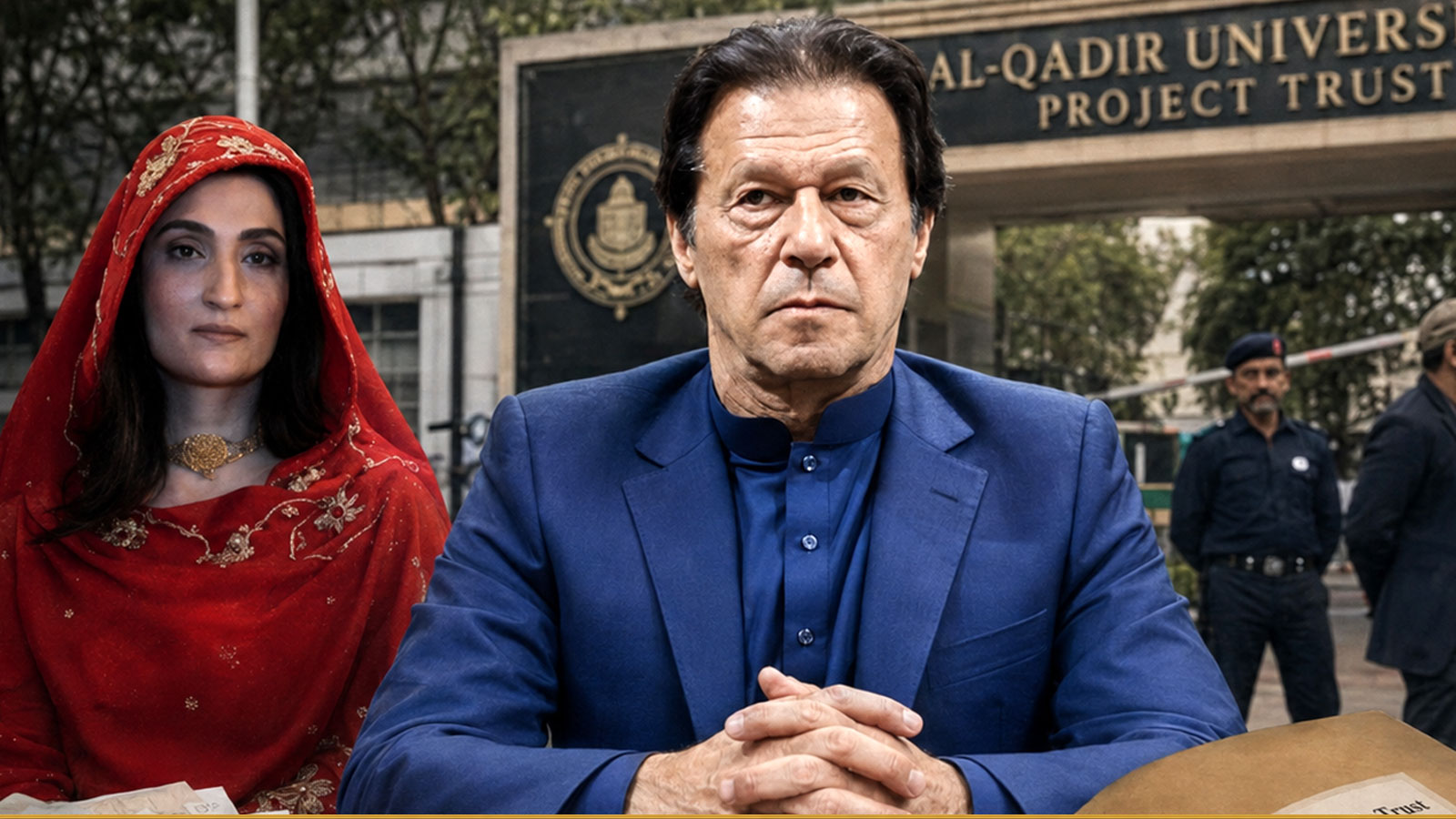
- On 17 January 2025, an Accountability Court in Rawalpindi convicted former Pakistani Prime Minister Imran Khan and his wife Bushra Bibi in the Al-Qadir Trust corruption case.
- Judge Nasir Javed Rana sentenced Khan to 14 years of rigorous imprisonment and imposed a Rs1 million fine.
- Bushra Bibi was sentenced to seven years of rigorous imprisonment and fined Rs500,000 for aiding, assisting and abetting.
- The court also ordered the property of the Al-Qadir University Project Trust forfeited to the Federal Government.
- The 148-page written judgment said the prosecution had proved its case through documentary evidence and testimony from 35 witnesses.
EXECUTIVE FINDING
On 17 January 2025, an Accountability Court in Rawalpindi convicted former Pakistani Prime Minister Imran Khan and his wife Bushra Bibi in the Al-Qadir Trust corruption case.
Judge Nasir Javed Rana sentenced Khan to 14 years of rigorous imprisonment and imposed a Rs1 million fine.
Bushra Bibi was sentenced to seven years of rigorous imprisonment and fined Rs500,000 for aiding, assisting and abetting.
The court also ordered the property of the Al-Qadir University Project Trust forfeited to the Federal Government.
The 148-page written judgment said the prosecution had proved its case through documentary evidence and testimony from 35 witnesses.
The court found that, in exchange for illegal favours extended to property developer Malik Riaz Hussain, Ahmed Ali Riaz and Bahria Town, Khan and Bibi obtained material benefits under the guise of the Al-Qadir University Project Trust.
The judgment identified approximately 458 kanals of land, Rs285 million in funds, a university building valued at Rs284.032 million and in-kind contributions as benefits obtained for the trust.
The case grew out of a separate 2019 UK National Crime Agency civil settlement worth £190 million involving Malik Riaz and his family.
That UK settlement must be understood precisely: the NCA described it as a civil matter and expressly said it did not represent a finding of guilt.
The UK assets were to be returned to Pakistan.
Pakistan’s later criminal case focused on what happened next: the manner in which the returned value was handled by the government and the material benefits subsequently provided to the Al-Qadir Trust.
The prosecution theory was that Khan’s government allowed the £190 million to be used in a manner benefiting Bahria Town in relation to a separate Supreme Court liability, while Khan and Bibi received land and other benefits for the trust.
Khan and Bibi denied wrongdoing and said the trust was a charitable educational project and the prosecution was politically motivated.
THE UK RECOVERED THE ASSETS. THE PAKISTANI CASE ASKED WHO REALLY BENEFITED WHEN THE MONEY CAME HOME.
The central Kleptik question is therefore:
WHEN RECOVERED FOREIGN ASSETS ARE RETURNED TO A STATE, CAN A CABINET DECISION QUIETLY CONVERT PUBLIC RECOVERY INTO PRIVATE LEVERAGE — AND CAN A CHARITABLE TRUST BECOME THE VEHICLE FOR THE RETURN FAVOUR?
THE FINDING
The Al-Qadir case is unusual because the alleged corrupt exchange did not begin with a conventional government contract.
It began with recovered assets.
The UK froze money and property.
A civil settlement returned value to Pakistan.
Pakistan’s executive then had to decide how that value would be treated.
That decision became the alleged public favour.
UK ASSET-RECOVERY SETTLEMENT
↓
£190 MILLION RETURNED TO PAKISTAN
↓
CONFIDENTIAL CABINET DECISION
↓
VALUE APPLIED TO BAHRIA TOWN / SUPREME COURT LIABILITY
↓
LAND + FUNDS + BUILDING TO AL-QADIR TRUST
↓
COURT-CONFIRMED CORRUPTION FINDING
THE 2019 NCA SETTLEMENT
In December 2019, the UK National Crime Agency reached a civil settlement worth approximately £190 million following an investigation into assets associated with Malik Riaz Hussain and his family.
The settlement included approximately £140 million previously frozen in UK bank accounts and a London property at 1 Hyde Park Place valued at about £50 million.
The assets were to be returned to Pakistan.
CIVIL SETTLEMENT ≠ FINDING OF GUILT
The NCA expressly stated that the settlement was civil and did not represent a finding of guilt.
That distinction is non-negotiable.
The later Pakistani conviction cannot be used to retroactively convert the UK NCA settlement itself into a criminal conviction of Malik Riaz.
THE CONFIDENTIALITY ISSUE
The NCA arrangement was confidential beyond the limited facts publicly announced.
Pakistan’s cabinet was asked to approve treatment of the returned assets without public disclosure of the underlying agreement in full.
Secrecy around a major asset-recovery decision created the governance vulnerability at the centre of the later prosecution.
THE CABINET DECISION
During Khan’s premiership, the cabinet approved the arrangement presented to it concerning the returned £190 million.
The accountability case alleged that the decision effectively allowed the returned value to be adjusted against a separate Supreme Court obligation of Bahria Town rather than becoming an unrestricted recovery for the State.
The prosecution treated that decision as an illegal favour.
THE SUPREME COURT BAHRIA TOWN LIABILITY
In 2019, Pakistan’s Supreme Court accepted a Rs460 billion settlement offer by Bahria Town in relation to its Karachi land matter.
The Al-Qadir prosecution alleged that the UK-returned assets were used in a way that benefited Malik Riaz and Bahria Town against that liability.
The legal and accounting treatment of the recovered funds therefore became the central public-asset question.
PUBLIC MONEY OR THIRD-PARTY MONEY?
A critical defence and analytical issue was the character of the £190 million once returned to Pakistan.
- Was it State money?
- Was it restricted by the settlement?
- Could it lawfully be applied against Bahria Town’s Supreme Court obligation?
The trial court resolved these issues against Khan and Bibi for purposes of the corruption conviction.
THE AL-QADIR TRUST
The Al-Qadir University Project Trust was established as an educational and charitable vehicle.
Khan was identified by the judgment as settler and founder; Bushra Bibi was closely connected to the trust and prosecuted as an accused.
The defence said the institution was for public benefit rather than private enrichment.
CHARITY DOES NOT END THE BENEFIT QUESTION
A benefit does not have to be cash in the politician’s personal bank account to create corruption risk.
Land, a building or funding directed to a trust controlled by or closely associated with a public official can have material value even if the stated purpose is charitable.
THE 458 KANALS
The written judgment identified a donation of approximately 458 kanals of land to the Al-Qadir University Project Trust as part of the material benefit obtained.
Contemporary reporting described the land as being worth billions of rupees.
Kleptik treats the court-established transfer and any media valuation separately.
THE RS285 MILLION
The judgment also identified funds amounting to approximately Rs285 million as part of the material monetary gain or pecuniary advantage received through the trust structure.
THE RS284.032 MILLION BUILDING
The court further identified the university building, valued in the judgment at Rs284.032 million, as part of the benefit structure.
THE BENEFIT WAS TO THE TRUST
This distinction is central.
The conviction theory did not require proving that the entire £190 million entered Khan’s personal bank account.
The alleged quid pro quo involved a governmental favour and benefits supplied through the trust.
THE QUID PRO QUO
The court said illegal favours were extended to Malik Riaz, Ahmed Ali Riaz and Bahria Town.
In exchange, material monetary gain, property and valuable things were obtained under the guise of the trust.
That reciprocal structure is the corruption finding.
THE CABINET AS CONTROL LAYER
Cabinet approval can legitimise an executive decision.
It can also diffuse responsibility.
A document approved collectively may still originate from a small number of officials who control what information colleagues receive.
DISCLOSURE TO CABINET
A key governance question is what cabinet members actually knew when they approved the confidential arrangement.
- Was the legal effect fully explained?
- Were conflicts disclosed?
- Did ministers understand how the assets would be credited?
THE INFORMATION-ASYMMETRY PROBLEM
Collective government decision-making is only as good as the information placed before the decision-makers.
Confidentiality can be legitimate.
It can also make scrutiny dependent on the official presenting the matter.
THE ASSET-RECOVERY PARADOX
Asset recovery is supposed to restore value to the public.
If returned property can be redirected through opaque executive decisions, the recovery process itself becomes a corruption risk.
RECOVERED ASSETS NEED GOVERNANCE
Incoming recovered funds should have a documented legal destination.
Treasury account.
court account.
victim fund.
specific statutory use.
Ambiguity creates discretion.
THE NCA WAS NOT THE PAKISTANI PROSECUTOR
The UK NCA did not prosecute Imran Khan in this case.
It recovered assets through civil proceedings involving Malik Riaz’s family.
Pakistan’s National Accountability Bureau later built a separate criminal case around the handling of those returned assets and subsequent benefits.
FOREIGN RECOVERY
↓
STATE RECEIVES VALUE
↓
EXECUTIVE DECIDES TREATMENT
↓
PRIVATE COUNTERPARTY BENEFITS
↓
OFFICIAL-LINKED TRUST RECEIVES ASSETS
↓
CORRUPTION RISK
THE UK-PAKISTAN HANDOFF
The NCA said assets would be returned to Pakistan.
Cross-border recovery normally ends one investigation and begins another governance responsibility.
The receiving state must document custody, destination and public benefit.
THE REPATRIATION CONTROL
- Who receives recovered money?
- Which account?
- under what legal authority?
- who can redirect it?
These are asset-recovery controls, not clerical details.
THE COURT ACCOUNT QUESTION
Public reporting said the returned value was applied toward the Supreme Court account connected to Bahria Town’s Rs460 billion settlement.
The prosecution characterised that treatment as a benefit to the developer.
The defence disputed the prosecution’s corruption theory.
THE DEVELOPER BENEFIT
If a private party owes a court-ordered liability, any external value credited against that liability has economic value to the private party.
The key question is whether the State was entitled to keep the recovered assets separately and whether the crediting mechanism was lawful.
THE TRUST TIMING
The trust and its property arrangements followed closely after the 2019 asset-recovery decision.
Timing alone does not prove quid pro quo.
The court relied on documentary and testimonial evidence to find the exchange proved.
THE TIMELINE TEST
NCA settlement.
cabinet approval.
trust formation.
land transfer.
funding.
building.
Investigators should align each event against communications and official decisions.
THE 35 WITNESSES
The prosecution presented 35 witnesses.
The judgment said extensive cross-examination did not discredit the core prosecution evidence.
The court described the documentary record as coherent and reliable.
DOCUMENTS BEAT RHETORIC
Politically charged cases produce competing narratives.
The strongest analysis focuses on cabinet records, trust deeds, land records, bank transfers, valuations and court documents.
THE SHAM-TRUST FINDING
The written order referred to the Al-Qadir University Project Trust as a sham trust for purposes of forfeiture.
That is the trial court’s legal characterisation.
Kleptik attributes it to the judgment rather than using it as editorial shorthand independent of the conviction.
FORFEITURE OF THE TRUST PROPERTY
The court ordered property of the Al-Qadir University Project Trust forfeited to the Federal Government under the National Accountability Ordinance.
Forfeiture transformed the alleged benefit into recoverable State property.
BUSHRA BIBI
Bushra Bibi was convicted of aiding, assisting and abetting.
She received seven years of rigorous imprisonment and a Rs500,000 fine.
Her liability was distinct from Khan’s principal corruption conviction.
AIDING AND ABETTING ≠ PRINCIPAL OFFENCE
The court differentiated roles.
Khan was convicted of corruption and corrupt practices.
Bibi was convicted for aiding, assisting and abetting.
THE FINES
Khan was fined Rs1 million with additional simple imprisonment in default.
Bibi was fined Rs500,000 with additional imprisonment in default.
These are punishment amounts, not measures of the alleged benefit.
THE 14-YEAR SENTENCE
Khan received the maximum 14-year term imposed under the relevant accountability provision used by the court.
The judgment said there were no mitigating circumstances sufficient to reduce the sentence.
THE SEVEN-YEAR SENTENCE
Bibi’s seven-year sentence reflected the court’s finding of aiding and abetting rather than the principal public-office offence.
THE POLITICAL CONTEXT
Khan had been removed from office through a parliamentary no-confidence vote in April 2022 and later faced numerous criminal proceedings.
His party remained a major political force.
That context made claims of selective or politically motivated prosecution inevitable and important to report.
THE POLITICAL-MOTIVATION DEFENCE
Khan and PTI repeatedly described the case as fabricated or politically motivated.
The defence said Al-Qadir was a charitable university and that neither Khan nor Bibi personally benefited in the manner alleged.
POLITICAL CONTEXT ≠ EXONERATION
A prosecution can occur in a political environment and still be supported by evidence.
Political motive is a separate analytical question from whether the legal elements were proved at trial.
POLITICAL CONTEXT ≠ PROOF OF GUILT
Conversely, public hostility toward a defendant does not prove corruption.
Kleptik relies on the judgment and underlying records, while preserving the fact that appeals remained available.
FIRST-INSTANCE STATUS
The conviction was an Accountability Court judgment.
It was subject to appeal.
As of 17 January 2025, Kleptik therefore labels it ESTABLISHED — FIRST-INSTANCE JUDGMENT, not a final appellate conviction.
THE APPEAL
Khan’s legal team announced that the verdict would be challenged.
This dossier does not incorporate later appellate rulings.
MALIK RIAZ
Malik Riaz was not convicted by the UK NCA settlement.
The Pakistani judgment described illegal favours extended to him, Ahmed Ali Riaz and Bahria Town as part of Khan and Bibi’s corruption case.
Any separate liability of those parties must be described according to their own proceedings.
DO NOT CONVERT A COUNTERPARTY INTO A CONVICT
A court finding that a defendant favoured another person does not automatically amount to a criminal conviction of that other person.
Association and benefit must not be confused with adjudicated guilt.
THE CHARITY SHIELD RISK
Charitable institutions can create public benefit.
They can also create reputational insulation around valuable transfers.
The compliance test should focus on control, valuation, donor motive and reciprocal official action.
BENEFICIAL CONTROL OF A CHARITY
A trust may have no shareholders.
That does not mean no one controls it.
Settlors, trustees, founders, management and related parties can exercise practical control.
THE LAND-VALUATION QUESTION
Land value can vary dramatically depending on zoning, development potential and timing.
Any claim that the 458 kanals were worth a specific amount should identify the valuation source and date.
THE BUILDING VALUATION
The court judgment identified a building value of Rs284.032 million.
That figure should be distinguished from land value and from cash contributions.
THE TOTAL-BENEFIT PROBLEM
Land.
funds.
building.
in-kind contributions.
A complete benefit calculation must avoid double counting.
THE PUBLIC-LOSS QUESTION
The case is often called the £190 million case.
That does not mean the court found Khan personally stole £190 million.
The prosecution theory concerned misuse of the returned assets and reciprocal benefits to the trust.
£190 MILLION ≠ PERSONAL RECEIPT
This is one of the dossier’s most important evidentiary boundaries.
The headline figure describes the asset-recovery settlement that triggered the governmental decision.
It is not a personal cash deposit to Khan.
THE CABINET-MINUTES QUESTION
What exactly did cabinet documents say about the legal destination of the recovered assets?
The answer determines whether ministers knowingly approved the same economic outcome later challenged by NAB.
COLLECTIVE RESPONSIBILITY
Cabinet systems create collective political responsibility.
Criminal liability remains individual.
The court therefore focused on Khan’s conduct and the exchange it found proved.
THE ASSET-RECOVERY UNIT
Pakistan’s Assets Recovery Unit helped coordinate the return of the UK assets.
The unit’s involvement illustrates why anti-corruption agencies themselves need documented handoff procedures once assets are recovered.
THE CONFIDENTIAL-SETTLEMENT PROBLEM
Confidential settlements can be necessary to recover assets efficiently.
They also restrict public scrutiny.
Where a government later makes a major financial decision based on a confidential settlement, independent oversight becomes essential.
THE NCA PUBLIC-INTEREST TENSION
The NCA settlement produced a large recovery for Pakistan.
But public information about the underlying terms was intentionally limited.
That left room for later political dispute over what Pakistan was entitled or required to do with the assets.
THE FOREIGN-RECOVERY RULE
Every cross-border asset return should identify ultimate beneficiary, legal destination and conditions of use before the money moves.
If those questions remain ambiguous, repatriation can create a second corruption opportunity.
THE COURT-ORDER INTERACTION
The Supreme Court Bahria Town settlement created a separate legal obligation.
Combining or netting one recovery against another obligation should be transparent and legally documented because it changes who receives economic benefit.
THE NETTING PROBLEM
If A owes the State and B returns assets to the State, crediting B’s returned value against A’s liability may benefit A even if no cash is handed directly to A.
That is the economic logic underlying the prosecution theory.
THE ECONOMIC-SUBSTANCE TEST
Ignore labels.
- Who lost an obligation?
- who gained an asset?
- who controlled the trust?
- what happened immediately before and after the cabinet decision?
THE UNIVERSITY AS PUBLIC BENEFIT
The defence emphasised education and charity.
A genuine public benefit can exist alongside an unlawful procurement or corruption mechanism.
Beneficial outcome does not erase unlawful consideration if a quid pro quo is proved.
THE STUDENTS ARE NOT THE DEFENDANTS
Students and beneficiaries of a charitable institution should not be treated as participants in alleged corruption merely because the institution becomes subject to forfeiture.
THE FORFEITURE-GOVERNANCE QUESTION
Once trust property is forfeited, government must decide how to manage the institution and assets.
That creates a new governance responsibility distinct from the criminal case.
THE ANTI-CORRUPTION-CREDIBILITY TEST
Pakistan’s accountability institutions have themselves been accused across political eras of selective enforcement.
The best protection against that criticism is transparent evidence, consistent standards and independent appellate review.
THE TRANSACTION-AND-BENEFIT MATRIX
| Stage | Public / private mechanism | Integrity question |
|---|---|---|
| UK recovery | £190m civil NCA settlement | What legal rights did Pakistan receive? |
| Cabinet decision | Confidential executive approval | Was full economic effect disclosed? |
| Bahria Town liability | Credit / adjustment against court obligation | Who received the economic benefit? |
| Al-Qadir Trust | Land, funds, building, in-kind contributions | Was this reciprocal consideration? |
| Forfeiture | Trust property transferred to Federal Government | What public value is ultimately recovered? |
THE EVIDENTIARY-STATUS MATRIX
- Issue
- Status on 17 Jan 2025
- Kleptik treatment
- Khan corruption offence
- Accountability Court conviction
- ESTABLISHED — FIRST-INSTANCE JUDGMENT
- Bibi aiding / abetting
- Accountability Court conviction
- ESTABLISHED — FIRST-INSTANCE JUDGMENT
- NCA £190m settlement
- Civil settlement, no finding of guilt
- ESTABLISHED — CIVIL SETTLEMENT
- 458 kanals + Rs285m + building
- Identified in written judgment
- ESTABLISHED — COURT FINDING
- Political-motivation claim
- Defence / PTI position
- SUBJECT POSITION
- Final appellate guilt
- Not resolved
- OPEN
CHRONOLOGY
March 2019
Pakistan’s Supreme Court accepts Bahria Town’s Rs460 billion settlement offer in the Karachi land matter.
2019
UK NCA secures multiple account-freezing orders over funds associated with Malik Riaz and family.
3 December 2019
NCA announces a civil settlement worth approximately £190 million, including frozen cash and 1 Hyde Park Place; it states the settlement is civil and does not represent a finding of guilt.
December 2019
Pakistan’s cabinet approves the confidential arrangement governing treatment of the returned assets.
Late 2019–2020
Al-Qadir University Project Trust is established and land / funding arrangements are put in place.
2022–2023
Questions over the £190 million settlement and Al-Qadir Trust become part of NAB investigations.
May 2023
Imran Khan is arrested in connection with the Al-Qadir Trust investigation, triggering major political unrest.
December 2023
NAB files the Al-Qadir corruption reference against Khan, Bushra Bibi and others.
27 February 2024
Khan and Bibi are formally indicted in the accountability case.
2024
The prosecution presents 35 witnesses and extensive documentary evidence.
17 December 2024
Final arguments conclude.
23 December 2024 / 6 January 2025 / 13 January 2025
Pronouncement of judgment is postponed three times.
17 January 2025
Accountability Court convicts Khan and Bibi, imposes 14- and seven-year sentences, fines them and forfeits the Al-Qadir University Project Trust property to the Federal Government.
DOCUMENTARY RECORD
ACCOUNTABILITY COURT WRITTEN JUDGMENT — 17 JANUARY 2025
The 148-page judgment is the core primary legal record. It identifies the offences, sentences, forfeiture order, material benefits, prosecution evidence and court reasoning.
ASSOCIATED PRESS OF PAKISTAN — 17 JANUARY 2025
APP reproduced substantial portions of the written judgment, including the court’s findings on corruption, aiding and abetting, the 458-kanal land donation, Rs285 million funds, building valuation and documentary evidence.
UK NATIONAL CRIME AGENCY / UK GOVERNMENT RECORDS — 2019–2020
UK records establish the £190 million civil settlement, the £140 million frozen-bank-account component, the approximately £50 million London property and the fact that the settlement did not represent a finding of guilt.
REUTERS / CONTEMPORANEOUS REPORTING — 17 JANUARY 2025
Contemporary reporting records the sentences, the land-corruption theory, PTI’s denial and the broader political context.
WHAT THE COURT FOUND
The court found Imran Khan guilty of corruption and corrupt practices under the National Accountability Ordinance.
It found Bushra Bibi guilty of aiding, assisting and abetting.
It concluded that illegal favours were extended to Malik Riaz, Ahmed Ali Riaz and Bahria Town and that material benefits were obtained through the Al-Qadir University Project Trust.
It ordered forfeiture of the trust’s property to the Federal Government.
WHAT KHAN, BIBI AND PTI SAY
Khan and his party have denied corruption and described the case as politically motivated.
The defence position is that Al-Qadir was a charitable educational project and that Khan did not personally appropriate the £190 million.
PTI announced that the verdict would be appealed.
Those positions must remain part of any fair historical account.
WHAT THIS DOSSIER DOES NOT ESTABLISH
This dossier does not state that the UK NCA found Malik Riaz guilty of a crime; the NCA settlement expressly did not represent a finding of guilt.
It does not state that Imran Khan personally received £190 million in cash.
It does not equate the £190 million settlement value with the value of land, funds and building transferred to the Al-Qadir Trust.
It does not state that every trustee, student, donor or employee of Al-Qadir University participated in corruption.
It does not treat the first-instance conviction as final appellate adjudication.
It does not incorporate later appeal decisions or later criminal proceedings after 17 January 2025.
RIGHT OF REPLY
Before publication, Kleptik should seek current comment from Imran Khan’s legal team and from Bushra Bibi or counsel.
Malik Riaz, Ahmed Ali Riaz and Bahria Town should be asked about the court’s finding that illegal favours were extended to them and about the trust-related benefits, while preserving the fact that the UK NCA settlement itself was civil.
Any cabinet member or former official criticised beyond the judgment should receive questions about what information was presented during the 2019 cabinet decision.
Al-Qadir University administrators should be invited to address the institution’s funding, governance and public-benefit role.
UNANSWERED QUESTIONS
1. THE NCA AGREEMENT
What were the full confidential terms governing how Pakistan could use the returned £190 million?
2. THE BENEFICIAL DESTINATION
Was Pakistan legally required or merely permitted to credit any portion toward Bahria Town’s Supreme Court liability?
3. THE CABINET PAPER
What exactly did ministers receive before approving the arrangement?
4. THE CABINET KNOWLEDGE
Did cabinet members understand the economic benefit to Bahria Town?
5. THE 458 KANALS
What was the independently verified market value of the land at transfer date?
6. THE LAND DONOR
Which legal entity transferred each parcel and under what deed?
7. THE RS285 MILLION
Who paid these funds, when, and through which bank accounts?
8. THE BUILDING
Who financed and constructed the building valued at Rs284.032 million?
9. IN-KIND CONTRIBUTIONS
What additional non-cash benefits did the trust receive?
10. TRUST CONTROL
Who exercised practical control over Al-Qadir University Project Trust at each stage?
11. STUDENT BENEFIT
How much genuine educational activity occurred before the criminal judgment?
12. THE SUPREME COURT ACCOUNT
How was the £190 million recorded against Bahria Town’s Rs460 billion obligation?
13. STATE LOSS
What precise financial loss did Pakistan suffer as a result of the cabinet decision?
14. MALIK RIAZ LIABILITY
What separate proceedings, if any, adjudicated his criminal liability on the exchange alleged in Al-Qadir?
15. THE ASSET RECOVERY UNIT
Who designed the Pakistan-side structure for the repatriated assets?
16. CONFLICT DISCLOSURE
Were relationships between the trust and Bahria Town disclosed before the cabinet decision?
17. DOCUMENT ACCESS
Which parts of the NCA agreement can lawfully be made public without breaching settlement confidentiality?
18. FORFEITURE
How will the Federal Government manage the university property after forfeiture?
19. APPEAL
Which factual and legal findings are most vulnerable to appellate review?
20. THE CENTRAL QUESTION
Did Pakistan recover £190 million from abroad only to allow the executive branch to convert that recovery into a private favour whose reciprocal benefit was routed through a charitable trust?
KLEPTIK INTELLIGENCE ASSESSMENT
ASSESSMENT: ESTABLISHED — FIRST-INSTANCE JUDGMENT
On 17 January 2025, Imran Khan was convicted of corruption and corrupt practices and sentenced to 14 years.
ASSESSMENT: ESTABLISHED — FIRST-INSTANCE JUDGMENT
Bushra Bibi was convicted of aiding, assisting and abetting and sentenced to seven years.
ASSESSMENT: ESTABLISHED — COURT FINDING
The judgment identified approximately 458 kanals of land, Rs285 million in funds, a building valued at Rs284.032 million and in-kind benefits associated with the Al-Qadir University Project Trust.
ASSESSMENT: ESTABLISHED — CIVIL SETTLEMENT
The UK NCA’s approximately £190 million settlement with Malik Riaz’s family was civil and expressly did not represent a finding of guilt.
ASSESSMENT: ESTABLISHED — FORFEITURE
The Accountability Court ordered property of the Al-Qadir University Project Trust forfeited to the Federal Government.
ASSESSMENT: HIGH CONFIDENCE
The case demonstrates that cross-border asset recovery creates a second-stage corruption risk in the receiving country unless custody, permitted use and beneficial destination are transparent.
ASSESSMENT: HIGH CONFIDENCE
A charitable or educational vehicle can constitute a material benefit for corruption analysis when it is controlled by or closely associated with a public official and linked to reciprocal official conduct.
ASSESSMENT: OPEN
The conviction remained subject to appeal on the archive date and was not yet final appellate adjudication.
THE KLEPTIK VIEW
Asset recovery is usually written as the happy ending.
Money is found abroad.
Frozen.
settled.
returned.
The State gets its money back.
Case closed.
Al-Qadir shows why that is too simple.
Recovered money can be stolen twice.
First in the country where the suspicious wealth originated.
Then again in the governance process that decides what happens when it returns.
The UK settlement was civil.
That matters.
The NCA did not convict Malik Riaz.
But once the assets were returned to Pakistan, the question changed.
- Who owned the benefit now?
- The public?
- the treasury?
- a court account?
- Bahria Town?
The answer should never depend on a confidential cabinet paper that citizens cannot test.
And then came the trust.
Land.
funds.
a building.
education.
charity.
Every word sounds legitimate.
That is why economic substance matters more than labels.
If a private developer receives an official financial advantage and an official-linked trust receives major assets in return, the public-interest label cannot end the inquiry.
THE £190 MILLION WAS NOT THE BRIBE.
IT WAS THE LEVER.
The alleged corrupt value was created by deciding what the recovered assets would do once they reached Pakistan.
That is a more sophisticated form of public corruption than simply taking cash from a contractor.
It monetises government control over recovered assets.
And it reminds every anti-corruption agency of a simple rule:
recovering the money is only half the job.
You still have to protect it when it comes home.
FOLLOW THE RECOVERY.
FOLLOW THE CABINET DECISION.
THEN FOLLOW THE ASSET THAT APPEARS ON THE OTHER SIDE OF THE FAVOUR.
KLEPTIK METHODOLOGY
This dossier is dated 17 January 2025 and is intentionally fixed to the legal and evidentiary position existing on that date.
The principal sources are the Accountability Court judgment as reproduced by Associated Press of Pakistan, UK National Crime Agency and UK government records concerning the £190 million civil settlement, and contemporaneous Reuters and Pakistani reporting on the verdict and defence position.
Kleptik separates five legal and evidentiary categories.
FIRST-INSTANCE CRIMINAL JUDGMENT
The Accountability Court conviction against Khan and Bibi, subject to appeal.
UK CIVIL SETTLEMENT
The NCA asset-recovery agreement involving Malik Riaz and family; expressly not a finding of guilt.
COURT-IDENTIFIED MATERIAL BENEFIT
Land, funds, building and in-kind advantages identified in the Al-Qadir judgment.
SUBJECT POSITION
Denial of wrongdoing, charitable-purpose explanation and political-motivation claim.
OPEN APPELLATE ISSUE
Any question that remained subject to appeal or later adjudication after the archive date.
For recovered-asset analysis, Kleptik distinguishes ownership, custody, permitted use, beneficiary and accounting destination.
For trust analysis, legal charitable form does not by itself resolve control or economic-benefit questions.
For amount reporting, £190 million, land value, Rs285 million funds and Rs284.032 million building value are treated as different categories and are not added without a defensible basis.
Later appellate outcomes or later proceedings are excluded from the historical status of this dossier.
EVIDENTIARY LABELS
ESTABLISHED — FIRST-INSTANCE JUDGMENT
Finding entered by the Accountability Court on 17 January 2025 and subject to appeal.
ESTABLISHED — CIVIL SETTLEMENT
Fact established by the UK NCA civil asset-recovery settlement; not a criminal finding of guilt.
ESTABLISHED — COURT FINDING
Specific factual conclusion or benefit identified in the written judgment.
ESTABLISHED — FORFEITURE
Property forfeiture ordered by the Accountability Court.
SUBJECT POSITION
Defence explanation, denial or political-motivation claim.
ASSET-RECOVERY INDICATOR
Fact relevant to custody, destination or use of recovered foreign assets.
TRUST-BENEFIT INDICATOR
Benefit routed through a charitable or trust structure requiring control and quid-pro-quo analysis.
KLEPTIK VERIFIED
Fact independently corroborated through authoritative official or court-linked records.
KLEPTIK ASSESSMENT
Analytical conclusion derived from identified evidence.
INVESTIGATIVE LEAD
Matter requiring further cabinet, banking, land, trust or appellate verification.
DOCUMENT STATUS
KLTK-2025-039
Subject: Imran Khan / Bushra Bibi / Al-Qadir University Project Trust / £190 Million NCA Settlement / Bahria Town
Archive date: 17 January 2025
Status at archive date: First-instance convictions entered; Khan sentenced to 14 years, Bibi to seven years; Al-Qadir Trust property forfeited; appeals announced
Historical treatment: Fixed to report date
© KLEPTIK — Investigations into Power, Money and the Systems Designed to Hide Both