THE SANCTIONS WAR, THE SHADOW FLEET AND THE PRICE PAID BY THE WORLD

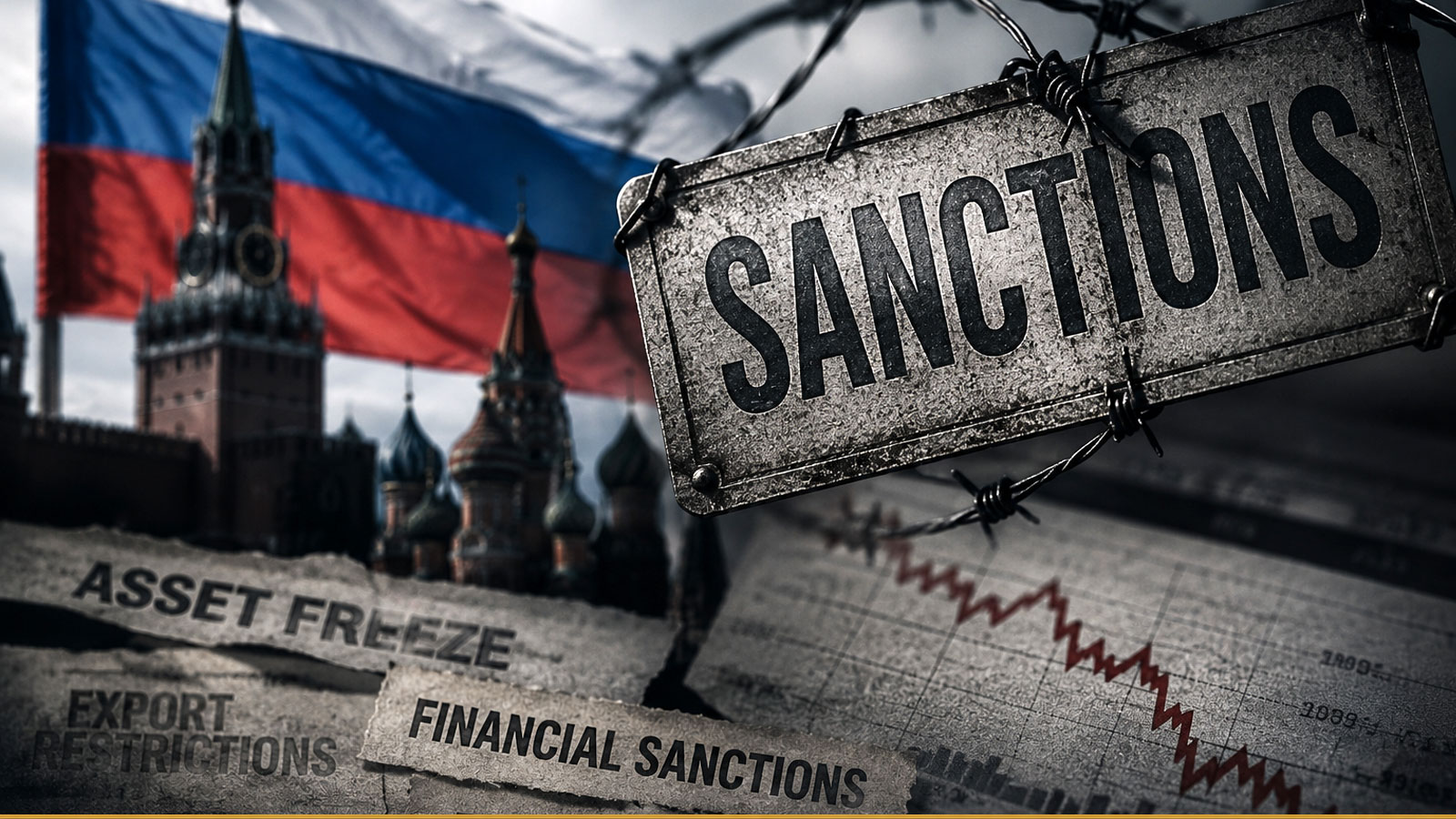
- By August 2026, the sanctions campaign against Russia had become one of the largest experiments in economic coercion ever applied to a major G20 economy.
- The European Union had adopted twenty-one packages of Russia sanctions since the full-scale invasion of Ukraine.
- The EU had immobilised around €210 billion in Russian Central Bank assets and frozen more than €28 billion in private assets.
- reduce Russia’s capacity to finance war, restrict access to Western technology, compress energy revenues, isolate financial institutions and raise the cost of circumvention.
- Russia lost much of its direct trade with Europe, Western financing and high-end technology access.
EXECUTIVE FINDING
By August 2026, the sanctions campaign against Russia had become one of the largest experiments in economic coercion ever applied to a major G20 economy.
The European Union had adopted twenty-one packages of Russia sanctions since the full-scale invasion of Ukraine.
The United Kingdom had sanctioned more than 3,400 individuals, entities and ships under its Russia regime and on 6 August added a new package targeting six Russian banks, six shadow-fleet tankers, four companies importing strategic rare metals and other war-economy actors.
The United States had moved beyond oligarch and financial restrictions to direct blocking sanctions on Russia’s two largest oil companies, Rosneft and Lukoil, together with major subsidiaries.
The EU had immobilised around €210 billion in Russian Central Bank assets and frozen more than €28 billion in private assets.
The objective was clear:
reduce Russia’s capacity to finance war, restrict access to Western technology, compress energy revenues, isolate financial institutions and raise the cost of circumvention.
The result was substantial economic damage.
Russia lost much of its direct trade with Europe, Western financing and high-end technology access.
Its budget became more exposed to oil prices.
The European Commission said more than two-thirds of the liquid assets of Russia’s sovereign wealth fund had been depleted since the war began.
The IMF projected Russian real GDP growth at only 1.1% in 2026, with consumer-price inflation around 5.6%.
But sanctions did not produce economic collapse.
Russia redirected oil to China, India, Türkiye and other buyers.
Chinese goods replaced Western imports in automobiles, machinery and electronics.
Russian and intermediary firms built a shadow fleet, alternative payment systems, crypto channels, trading companies and third-country routing networks.
The economic geography changed.
Europe reduced its dependence on Russia.
Russia increased dependence on Asia.
India, China, Türkiye and Gulf-based trading hubs gained bargaining power. Shipping distances grew. Insurance risk increased. Financial compliance became more expensive.
The world paid part of the adjustment cost through higher transaction friction.
And by 2026 an even larger energy shock complicated the sanctions equation.
The war in the Middle East and disruption around the Strait of Hormuz drove global oil-market volatility so severe that the EU’s 21st Russia sanctions package paused the automatic adjustment of the Russian oil-price-cap mechanism until 15 July 2027.
That decision is the clearest admission of the policy trade-off:
pressure Russian revenue too aggressively during a global supply emergency and the sanctioning coalition can raise oil prices enough to hurt itself, vulnerable importers — and potentially increase the value of every Russian barrel that still reaches the market.
SANCTIONS DID NOT REMOVE RUSSIAN COMMODITIES FROM THE WORLD ECONOMY. THEY CHANGED WHO BUYS THEM, WHO SHIPS THEM, WHO FINANCES THEM — AND WHAT EVERYONE PAYS FOR THE DETOUR.
The central Kleptik question is therefore:
ARE RUSSIA SANCTIONS NOW WEAKENING MOSCOW FASTER THAN THEY ARE REWIRING THE GLOBAL ECONOMY AROUND WESTERN FINANCE — OR HAS THE WORLD ENTERED A PERMANENTLY MORE EXPENSIVE, FRAGMENTED AND OPAQUE TRADING SYSTEM?
THE FINDING
Sanctions work through friction. Block the bank. Restrict the technology. Cap the oil price. Deny the tanker service. Freeze the reserve. Each measure raises cost. The target responds by rerouting. The global economic effect is the difference between those two forces.
THE 21ST EU PACKAGE
On 23 July 2026, the EU adopted its 21st sanctions package against Russia. It was one of the broadest packages of the war and included 218 new individual and entity listings.
THE 218 LISTINGS
The package added 48 individuals and 170 entities. The EU described it as the largest batch of individual listings in four years.
THE BANKING STRIKE
The EU imposed asset freezes and restrictions involving 94 banks and major financial institutions and expanded transaction bans to 33 additional Russian credit and financial institutions.
It also targeted four non-Russian banks for alleged circumvention.
THE THIRD-COUNTRY BANK RULE
The sanctions architecture increasingly reaches beyond Russia. A Kyrgyz bank linked to Russia’s SPFS messaging system and other non-Russian banks were targeted. The message is that sanctions compliance is becoming extraterritorial in economic effect even where legal jurisdiction remains territorial.
THE CRYPTO FRONT
The 21st package extended transaction bans to 14 crypto-related service platforms in jurisdictions including Georgia, Panama, the UAE, the Marshall Islands, Kyrgyzstan and Belarus. For the first time, the EU created a tool enabling a full third-country ban on crypto-asset services used to facilitate Russian sanctions evasion.
WHY CRYPTO MATTERS
Crypto does not replace the global banking system at Russian trade scale. It can help settle smaller transactions, layer payments, move value across sanctioned counterparties or support parallel networks.
THE A7 NETWORK
The EU added designations related to the A7 cross-border payments network and its links to Africa. The strategic concern is not one platform. It is the emergence of a sanctions-resistant payments ecosystem.
THE SHADOW FLEET
The EU listed 41 more vessels in July 2026 on top of 632 already sanctioned. The UK had specified more than 600 vessels by July, including over 580 oil tankers.
THE AUGUST UK PACKAGE
On 6 August 2026, the UK added 19 targets. These included six Russian banks, six newly acquired shadow-fleet tankers, four Russian companies importing tantalum and niobium, and other entities supporting the war economy.
THE SHADOW FLEET IS AN INDUSTRY
The shadow fleet is not simply a list of old tankers. It requires shipowners, managers, flags, insurers, crewing agents, bunkering, trading companies, ship-to-ship transfers and payment channels.
AGE AND RISK
The UK said more than 72% of shadow tankers were over 15 years old and that more than 50 incidents had involved the fleet. Older vessels and opaque insurance arrangements create environmental and maritime risks beyond sanctions policy.
THE FIRST UK INTERDICTION
In June 2026, UK forces boarded the sanctioned tanker SMYRTOS in the English Channel. That moved shadow-fleet enforcement from financial restriction toward physical maritime interdiction.
FROM PAPER SANCTIONS TO PHYSICAL ENFORCEMENT
A designation can be ignored by a tanker owner outside the sanctioning jurisdiction. A ship physically intercepted in a strategic waterway creates a different deterrent.
THE OIL PRICE CAP
The G7/EU oil-price-cap architecture was designed to keep Russian oil flowing while reducing Russia’s revenue per barrel. That is unusual. Traditional sanctions aim to stop trade. The price cap aims to permit trade at a lower Russian margin.
THE ECONOMIC LOGIC OF THE CAP
If Russian oil disappears completely, global prices can rise. Russia may sell fewer barrels but earn more per remaining barrel. The cap therefore tries to separate volume from revenue.
THE HORMUZ EXCEPTION
The 21st package paused automatic adjustment of the oil-price cap until 15 July 2027 because of exceptional market conditions caused by closure of the Strait of Hormuz. That is a sanctions-policy stress signal.
SANCTIONS MEET ENERGY SECURITY
The EU was effectively acknowledging that oil-market tightness can make a mechanically lower Russian cap counterproductive. Energy coercion cannot be designed in isolation from global supply.
THE 2026 GLOBAL OIL SHOCK
The IMF’s July 2026 update projected global growth of 3.0% for 2026 and headline inflation of 4.7% after the Middle East war shock disrupted energy markets. The IMF explicitly said energy-importing and vulnerable economies were hit hardest.
DO NOT BLAME SANCTIONS FOR HORMUZ
The 2026 global energy shock was driven primarily by Middle East conflict, Strait of Hormuz disruption and damage to production infrastructure. Russia sanctions interacted with that shock. They did not cause it.
ATTRIBUTION DISCIPLINE
War. Sanctions. Ukrainian strikes on Russian refineries. Hormuz disruption. OPEC decisions. Global demand. All affect energy prices. A serious economic dossier must separate them.
RUSSIAN GDP
The IMF’s July 2026 outlook projected Russian real GDP growth of 1.1% in 2026. That is slow growth, not economic collapse.
RUSSIAN INFLATION
The IMF projected Russian consumer-price inflation at 5.6% in 2026. Domestic inflation reflects war spending, labour constraints, monetary policy, sanctions and supply limitations rather than sanctions alone.
WAR-ECONOMY GROWTH
Military production can raise measured GDP while reducing civilian welfare. A tank contributes to industrial output. It does not raise household consumption.
GDP ≠ ECONOMIC HEALTH
Sanctions effectiveness cannot be judged only by whether GDP is positive or negative. Budget quality, productivity, investment, technology access, inflation and civilian consumption matter.
THE SOVEREIGN-WEALTH BUFFER
The European Commission said more than two-thirds of the liquid assets of Russia’s sovereign wealth fund had been depleted since the start of the war. That indicates shrinking fiscal shock absorbers even where current revenue continues.
THE €210 BILLION FREEZE
Around €210 billion in Russian Central Bank assets remain immobilised in the EU. This is one of the largest sovereign reserve immobilisations in modern history.
WINDALL PROFITS
By August 2026, the EU said immobilised Russian assets had generated about €8 billion in windfall profits, with another €1.4 billion transferred in August for Ukraine support. The principal assets remained frozen rather than confiscated.
FREEZE ≠ CONFISCATE
Immobilisation prevents use. Confiscation transfers ownership. The legal distinction is central to sovereign-reserve policy.
THE ROSNEFT / LUKOIL ESCALATION
In October 2025, the United States imposed blocking sanctions on Rosneft and Lukoil, Russia’s two largest oil companies, together with major subsidiaries. The move targeted the corporate centre of Russia’s oil-export system rather than only tankers and service providers.
WHY COMPANY SANCTIONS MATTER
A tanker can be replaced. A trader can be renamed. Sanctioning the producer complicates financing, insurance, contracts and counterparties across the entire chain.
THE INDIA EFFECT
IEA data showed Indian imports of Russian crude fell sharply in January 2026 after new sanctions pressure, before later recovering and reaching new highs amid the Middle East supply crisis. That reversal shows price and physical supply can overpower sanctions pressure.
INDIA AS SWING BUYER
India became one of the world’s most important balancing markets for discounted Russian crude after 2022. Its refiners gained negotiating leverage from Western rejection of Russian barrels.
THE REFINED-PRODUCT LOOP
Russian crude can be shipped to a third-country refinery, transformed into diesel or jet fuel and then sold elsewhere. Sanctions regimes increasingly target this refining loophole.
THE UK END-DATE
The UK set 1 January 2027 as the final date for phasing out imports of diesel and jet fuel made from Russian crude in third countries. The rule demonstrates how sanctions must follow the molecule through processing.
CHINA
China became Russia’s largest economic partner and a major destination for Russian oil, gas, coal and other commodities. It also became the dominant source of many manufactured goods Russia previously imported from Europe.
THE 2025 CHINA SLOWDOWN
China-Russia trade fell in 2025 for the first time in five years, according to Chinese customs data reported by Reuters. The decline reflected lower oil values and weaker Russian demand for Chinese cars.
THE 2026 REBOUND
By the first half of 2026, Reuters reported bilateral trade rising sharply again, supported by growing cross-border flows and deeper logistical integration. The long-term direction remains eastward even when annual trade fluctuates.
RUSSIA BECOMES MORE DEPENDENT ON CHINA
Sanctions reduced Russia’s supplier diversity. China gained negotiating leverage because Russian buyers had fewer alternatives.
DEPENDENCE CHANGED DIRECTION
Europe reduced dependence on Russian energy. Russia increased dependence on Chinese manufacturing and Asian energy demand. Sanctions did not eliminate dependence. They redistributed it.
TÜRKIYE
Türkiye became a major buyer, trader and transit market for Russian hydrocarbons and goods. Its position between sanctioning and non-sanctioning systems increased its economic leverage.
THE GULF
The UAE and other Gulf jurisdictions emerged as important trading, finance, shipping and corporate hubs used by legitimate Russian-linked business and, according to Western sanctions authorities, some circumvention networks.
UAE ENTITY LISTINGS
EU and U.S. packages repeatedly listed entities in the UAE accused of supplying controlled technology, trading Russian oil or supporting circumvention. The listing of a UAE company is an official sanctions action, not proof that the jurisdiction itself supports sanctions evasion.
THIRD-COUNTRY COMPLIANCE PRESSURE
The sanctions frontier is moving outward. A bank in Kyrgyzstan. A crypto platform in the UAE. A trader in Hong Kong. A machine-tool supplier in China. The target is increasingly the network rather than Russia’s border.
SECONDARY EFFECT WITHOUT FORMAL SECONDARY SANCTIONS
Even when the EU does not impose U.S.-style secondary sanctions, transaction bans and entity listings can create similar commercial pressure. Global banks avoid counterparties that could threaten access to Western markets.
THE DE-RISKING PROBLEM
Financial institutions may refuse lawful Russia-adjacent business because the compliance cost is too high. That can disrupt humanitarian, agricultural or unsanctioned trade.
OVERCOMPLIANCE
Sanctions policy often produces a wider private-sector exclusion zone than the law itself. Banks price legal uncertainty as risk.
THE COST OF COMPLIANCE
Screening software. Legal opinions. Shipping due diligence. Beneficial-ownership checks. Origin certification. Sanctions create a global compliance industry.
TRADE FRICTION
Every extra document, intermediary and rerouted payment raises cost. Those costs are borne by exporters, importers and ultimately consumers.
THE SHIPPING DETOUR
Russian crude that once travelled short distances to Europe increasingly travels longer distances to Asia. Longer voyages require more tankers, more fuel and more financing.
TON-MILES
A barrel shipped from the Baltic to India occupies a tanker much longer than a barrel shipped to Rotterdam. Trade diversion therefore increases global tanker demand even if oil volume is unchanged.
THE INSURANCE PREMIUM
Shadow-fleet vessels often rely on non-Western or opaque insurance arrangements. This can increase accident and liability risk around major sea lanes.
THE ENVIRONMENTAL EXTERNALITY
A sanctions-evading tanker casualty could impose cleanup costs on coastal states that had no role in the underlying trade. This is a hidden global cost of circumvention.
THE FLAG-STATE PROBLEM
Frequent flag changes and opaque ownership make enforcement harder. Sanctions pressure can push shipping toward weaker regulatory environments.
THE FREIGHT WINNERS
Shipowners, traders, brokers and intermediary jurisdictions can earn higher margins from complexity. Sanctions create rents for circumvention as well as costs for Russia.
THE DISCOUNT
Russian crude often trades at a discount to global benchmarks to compensate buyers for sanctions, payment and logistics risk. That discount is one of the clearest channels through which sanctions reduce Russian revenue.
THE DISCOUNT CAN SHRINK
When global oil supply tightens, buyers have less leverage and Russian discounts can narrow. The same sanction may therefore be more effective in a loose oil market than a tight one.
THE PARADOX OF HIGH OIL PRICES
Sanctions can reduce Russia’s margin per barrel. A global oil shock can raise the benchmark enough to offset part of that loss.
THE EU ENERGY DIVORCE
Europe’s direct dependence on Russian fossil fuels fell dramatically after 2022. This improved strategic resilience but required expensive diversification, LNG infrastructure, alternative suppliers and demand adjustment.
EU TRADE COLLAPSE WITH RUSSIA
The UK says its own goods trade with Russia fell by roughly 98% from 2021 levels by late 2025. EU trade patterns similarly shifted away from direct Russian commerce.
THE EUROPEAN ENERGY BILL
Europe paid a large transition cost through higher energy prices, industrial pressure and infrastructure investment. Those costs were driven by the war and supply break as well as sanctions.
ENERGY-INTENSIVE INDUSTRY
Chemicals, fertilisers, metals, glass and other energy-intensive sectors faced higher costs after Russian pipeline gas disappeared from much of Europe. Some production shifted or contracted.
THE LONG-TERM EUROPEAN BENEFIT
Diversification reduces vulnerability to Russian supply coercion. The short-term cost can therefore produce long-term strategic insurance.
GERMANY
Germany’s pre-war industrial model was unusually exposed to cheap Russian pipeline gas. The sanctions-and-war break forced rapid energy substitution and accelerated structural debate over competitiveness.
CENTRAL EUROPE
Landlocked countries with refinery or pipeline dependence faced a slower adjustment and often sought exemptions. Sanctions are economically uneven even within the EU.
THE GLOBAL SOUTH
Many emerging markets did not join Western sanctions. They continued buying Russian energy or trading with Russia while also maintaining Western financial ties.
THE NON-ALIGNMENT PREMIUM
Countries able to transact with both sides gained bargaining power. They could buy discounted Russian commodities and sell goods into markets abandoned by Western firms.
THE MORAL-ECONOMIC DIVIDE
Sanctioning states framed restrictions as a response to aggression. Many non-sanctioning states viewed them through food, fuel, financing and sovereignty concerns. Economic alignment did not map neatly onto political condemnation.
FOOD AND FERTILISER
Russian food and fertiliser exports were generally not comprehensively banned by Western sanctions. Nevertheless, banking and shipping restrictions sometimes complicated trade and increased transaction costs.
SANCTIONS CARVE-OUTS MATTER
A legal exemption is useful only if banks and shippers are willing to process the trade. Overcompliance can make nominally exempt trade difficult.
TECHNOLOGY SANCTIONS
Export controls on semiconductors, machine tools, aviation parts, industrial software and dual-use technology attack Russia’s productive capacity more slowly than financial sanctions. The effect accumulates through maintenance and replacement cycles.
THE MACHINE-TOOL FRONT
The EU’s 21st package added third-country entities involved in microelectronics, CNC machine tools and semiconductor-processing equipment. This shows the campaign moving upstream into production capability.
CHINESE SUBSTITUTION
Russia has replaced many Western technologies with Chinese alternatives. Substitution reduces sanctions effectiveness but can increase cost, reduce performance or deepen dependence.
PARALLEL IMPORTS
Russia legalised and expanded parallel-import channels for many Western-origin goods. Products can reach Russia through third countries even after manufacturers exit.
EXPORT CONTROL LEAKAGE
Small high-value items are particularly hard to police. Microchips can move through distributors and re-export hubs more easily than aircraft engines.
THE MILITARY-INDUSTRIAL TARGET
The 21st package added 56 listings tied to Russia’s military-industrial complex, including 37 directly connected to long-range drones. The objective is not simply macroeconomic pain. It is degradation of specific battlefield supply chains.
THE DUAL-USE PROBLEM
A CNC machine or microcontroller can have civilian and military applications. Controls therefore impose costs on legitimate industrial trade.
THE FINANCIAL FRAGMENTATION
Russia expanded domestic payment systems, SPFS messaging, yuan settlement and alternative arrangements after losing access to much of the Western financial system.
THE DOLLAR IS STILL CENTRAL
Sanctions encouraged diversification away from dollars and euros. They have not displaced the central role of Western currencies and correspondent banking in global finance.
THE YUANISATION OF RUSSIA
A larger share of Russian trade and reserves moved toward the Chinese yuan. That reduces Western leverage but increases China’s.
THE CRYPTO LIMIT
Crypto can help evade specific payment barriers. It cannot easily replace the liquidity, credit creation and trade-finance capacity of the global banking system for an economy Russia’s size.
THE COST OF CAPITAL
Sanctions reduce access to Western capital markets and increase financing cost. Domestic banks and the State must absorb more of the burden.
THE BUDGET PRESSURE
Russia’s war budget depends heavily on energy revenue and domestic borrowing. Lower export prices, higher military spending and weaker fiscal buffers squeeze non-military spending.
THE CIVILIAN CROWD-OUT
A war economy can preserve headline output by diverting labour, credit and State spending toward defence. Civilian investment and productivity can suffer even when factories are busy.
THE LABOUR SHORTAGE
Mobilisation, emigration and defence-sector demand tighten labour markets. Wages rise in some sectors while inflation and shortages reduce household purchasing power.
THE CENTRAL-BANK TRADE-OFF
High interest rates can suppress inflation but make civilian investment more expensive. Sanctions amplify this trade-off by reducing external financing and import competition.
THE GLOBAL GROWTH EFFECT
The IMF’s 3.0% global-growth forecast for 2026 is not a sanctions estimate. It reflects the combined global environment, including Middle East war, technology investment, trade policy and financial conditions.
NO CLEAN COUNTERFACTUAL
There is no observable world in which the Ukraine war occurred without sanctions. Economic attribution therefore relies on models and sector evidence rather than a perfect control group.
SANCTIONS EFFECTIVENESS TEST
A sanction can be economically costly without achieving its political objective. Effectiveness requires two separate questions: Did it impose cost? Did that cost change behaviour?
THE RUSSIA CASE
The first answer is yes. The second remained unresolved by August 2026. Russia had not ended the war.
ECONOMIC PRESSURE ≠ POLITICAL CAPITULATION
Large authoritarian states can absorb extraordinary economic cost when leadership prioritises strategic objectives over household welfare.
THE TIME HORIZON
Technology denial and capital depletion operate slowly. The sanctions campaign may have greater long-run than short-run effects.
THE ADAPTATION HORIZON
Circumvention also improves over time. Every year under sanctions teaches target networks which routes, banks and intermediaries still work.
THE SANCTIONS ARMS RACE
Package. Circumvention. New designation. New intermediary. New compliance rule. The system evolves continuously.
THE 21-PACKAGE QUESTION
Twenty-one EU packages show persistence. They also show that each round leaves loopholes for the next round to close.
SANCTIONS COMPLEXITY
The more complex the regime becomes, the harder it is for ordinary businesses to distinguish prohibited from permitted trade. Complexity can improve targeting while increasing administrative burden.
THE SMALL-BUSINESS EFFECT
Large multinationals can hire sanctions lawyers and compliance teams. Smaller exporters may simply avoid the market.
THE GLOBAL BANK EFFECT
Banks with U.S., EU and UK exposure generally comply to the most restrictive standard relevant to a transaction. This magnifies coalition sanctions beyond national borders.
THE SOVEREIGN-RESERVE PRECEDENT
Freezing a major central bank’s reserves has implications beyond Russia. Other states may diversify reserve custody because they now understand that sovereign assets can become geopolitical leverage.
RESERVE DIVERSIFICATION
Gold. Yuan. Domestic custody. Non-Western infrastructure. The long-term response to the Russia freeze could gradually reduce Western financial leverage.
THE EUROCLEAR QUESTION
A large share of immobilised Russian sovereign assets is held through European financial infrastructure. Using windfall profits while leaving principal frozen attempts to balance Ukraine support with sovereign-immunity concerns.
THE LEGAL-RISK PREMIUM
Confiscating sovereign principal could generate litigation and alter how states assess reserve safety. Sanctions policy therefore affects the architecture of international reserves.
THE PRICE OF FRAGMENTATION
Two payment systems. Two technology stacks. Duplicated supply chains. Regional finance. Geopolitical fragmentation reduces efficiency even where it increases resilience.
THE WINNERS
Alternative energy exporters. Commodity traders. Shipowners. Asian refiners. Intermediary jurisdictions. Compliance providers. Some actors profit from the sanctions economy.
THE LOSERS
Russian consumers. Sanctioned firms. European energy-intensive industry. Businesses dependent on pre-war trade routes. Vulnerable fuel-importing economies. Costs are distributed unevenly.
THE UAE POSITION
The UAE sits at an important intersection of Russian trade, Western finance and global logistics. Western authorities have listed specific UAE-based entities for alleged circumvention while the UAE maintains broad commercial relations and compliance obligations. The relevant unit of analysis is the transaction and entity, not the jurisdiction as a whole.
GULF ENERGY ARBITRAGE
Russian fuel oil and products have increasingly moved to Gulf and Asian buyers after European bans. The Gulf can consume discounted Russian products while exporting other barrels into world markets.
THE SAUDI FUEL-OIL EXAMPLE
By July 2026, Saudi Arabia remained a major buyer of Russian seaborne fuel oil for power generation. This allows higher-value crude to be preserved for export while discounted Russian fuel meets domestic seasonal demand.
SANCTIONS DO NOT STOP ARBITRAGE
They change the price and route at which arbitrage occurs.
THE WORLD ECONOMY AFTER FOUR YEARS
Russia is poorer in access to Western technology and finance. Europe is less dependent on Russian energy. Asia is more central to Russian trade. The shadow fleet is larger. Sanctions compliance is permanent infrastructure. The global economy is more fragmented.
THE 2026 SANCTIONS SCORECARD
| Channel | Observed effect by Aug 2026 | Kleptik assessment |
|---|---|---|
| Western finance | Major Russian banks isolated; €210bn CBR assets immobilised in EU | HIGH IMPACT |
| Energy revenue | Discounts, company sanctions, shadow-fleet pressure; exports continue | MATERIAL BUT LEAKY |
| Technology | Restricted Western dual-use and industrial inputs; third-country substitution | CUMULATIVE / LONG-TERM |
| Trade geography | Europe down; China/India/Türkiye/Gulf up | STRUCTURAL REROUTING |
| Russian macroeconomy | IMF 2026 GDP +1.1%; inflation 5.6% | SLOWING, NOT COLLAPSED |
| Political objective | War not ended by archive date | UNRESOLVED |
THE GLOBAL-SPILLOVER MATRIX
| Region / market | Benefit | Cost / risk |
|---|---|---|
| European Union | Lower Russia dependence; strategic resilience | Energy transition cost; industrial pressure; compliance burden |
| Russia | Alternative buyers; war-economy demand | Lower margins; tech isolation; fiscal-buffer depletion |
| China | Cheap commodities; greater leverage over Russia | Sanctions exposure; trade-payment friction |
| India | Discounted crude; refinery margin opportunities | Secondary compliance risk; changing import rules |
| Türkiye / Gulf | Trading and energy-arbitrage opportunities | Sanctions scrutiny; banking and reputational risk |
| Global shipping | Higher ton-miles and freight demand | Older shadow fleet; insurance and environmental risk |
CHRONOLOGY
2014
EU and U.S. sectoral sanctions begin after Russia’s annexation of Crimea.
24 February 2022
Russia launches its full-scale invasion of Ukraine; Western sanctions expand rapidly across finance, trade, technology and individuals.
28 February 2022
EU immobilises Russian Central Bank reserves under its sanctions framework.
2022
Major Russian banks lose access to Western financial infrastructure; Western companies accelerate exits; Russian trade begins redirecting toward Asia.
December 2022
G7/EU oil-price cap begins, designed to keep Russian oil on the market while limiting revenue.
2023
EU embargoes on seaborne Russian crude and products reshape trade routes; shadow-fleet activity expands.
2024
EU bans use of Russia’s SPFS messaging service by EU operators and broadens anti-circumvention tools.
2024–2025
Western sanctions increasingly target third-country traders, ship managers, technology suppliers and payment networks.
22 October 2025
U.S. Treasury imposes blocking sanctions on Rosneft and Lukoil and major subsidiaries.
23 October 2025
EU adopts its 19th package.
24 February 2026
UK announces its largest Russia sanctions package since early 2022, targeting nearly 300 targets.
23 April 2026
EU adopts 20th package, including 120 listings, energy, finance, crypto and shadow-fleet measures.
14 June 2026
UK forces board sanctioned tanker SMYRTOS in the English Channel, marking a new enforcement phase.
16 June 2026
UK imposes 70 additional Russia-related sanctions targeting shadow fleet, procurement and illicit-finance networks.
25 June 2026
EU extends core economic sanctions until 31 July 2027.
23 July 2026
EU adopts 21st package: 218 listings, expanded bank and crypto restrictions, 41 more shadow-fleet vessels, refinery measures and a pause of automatic oil-cap adjustment due to the Hormuz shock.
5 August 2026
EU announces receipt of another €1.4 billion in windfall profits from immobilised Russian Central Bank assets, bringing total windfall profits generated to about €8 billion.
6 August 2026
UK imposes its latest major package: 19 targets including six Russian banks, six shadow-fleet tankers and four strategic-metals importers.
DOCUMENTARY RECORD
COUNCIL OF THE EUROPEAN UNION — 23 JULY 2026
The 21st package records the latest major EU economic sanctions, including 218 listings, bank and crypto restrictions, 41 additional vessels, refinery measures, third-country targets and the temporary pause in automatic oil-price-cap adjustment.
UK FOREIGN, COMMONWEALTH & DEVELOPMENT OFFICE — 6 AUGUST 2026
The latest UK package identifies 19 targets, including six Russian banks, six shadow-fleet vessels and four companies importing tantalum and niobium.
U.S. TREASURY — 22 OCTOBER 2025
OFAC’s Rosneft and Lukoil action marks the U.S. shift toward direct blocking sanctions on Russia’s largest oil producers and major subsidiaries.
IMF WORLD ECONOMIC OUTLOOK UPDATE — JULY 2026
The IMF projects 3.0% global growth in 2026, 4.7% global headline inflation and 1.1% Russian GDP growth. The IMF attributes the 2026 global energy shock primarily to the Middle East conflict, not Russia sanctions alone.
IEA OIL MARKET REPORTS — 2026
IEA reporting documents severe global supply disruption, rerouting, Russian export adaptation, refinery constraints and the interaction between Russian energy flows and the wider 2026 oil shock.
EU RUSSIAN-ASSET RECORD
The EU reports around €210 billion in immobilised Russian Central Bank assets and more than €28 billion in frozen private assets, with windfall profits used to support Ukraine.
WHAT IS ESTABLISHED
Western sanctions have materially reduced Russia’s access to Western financial institutions, capital, reserves, technology and direct European trade.
Russia continues to export large volumes of energy and commodities through reoriented routes and buyers.
The shadow fleet and third-country intermediary networks expanded in response to sanctions.
Russia’s economy continued to grow modestly in 2026 according to the IMF, while inflation and fiscal pressure remained elevated.
The sanctioning coalition continues to add measures because circumvention and substitution reduce the effect of earlier rounds.
WHAT IS NOT ESTABLISHED
It is not established that sanctions alone caused Russia’s 2026 slowdown.
It is not established that sanctions alone caused global inflation or the 2026 energy shock.
It is not established that every shadow-fleet vessel carries sanctioned oil in violation of law on every voyage.
It is not established that every third-country company trading with Russia is engaged in sanctions evasion.
It is not established that positive Russian GDP growth proves sanctions have failed.
It is not established that economic pain will automatically produce a change in Kremlin policy.
UNANSWERED QUESTIONS
1. RUSSIAN REVENUE
What is the true cumulative reduction in Russia’s oil and gas revenue caused specifically by sanctions rather than market prices?
2. THE PRICE CAP
How much lower is Russia’s realised export price because of the cap and associated services restrictions?
3. THE SHADOW FLEET
How many vessels remain commercially usable after EU, UK and U.S. designations?
4. INSURANCE
What share of Russian seaborne trade now relies on insurance outside the traditional International Group P&I system?
5. THIRD-COUNTRY BANKS
Which banks have become the primary settlement gateways after 21 packages of EU sanctions?
6. CRYPTO
How large is crypto settlement relative to Russia’s total external trade?
7. CHINA
How much additional pricing leverage has China gained over Russian commodity exports and manufactured imports?
8. INDIA
How durable is India’s role as a Russian oil buyer if U.S. and EU restrictions on Russian producers tighten further?
9. THE UAE
Which UAE trading and finance channels are legitimate adaptation and which are sanctions-evasion structures?
10. TÜRKIYE
How much Russian-origin energy is transformed or re-exported through Türkiye into sanctioning markets?
11. REFINING LOOPHOLES
Can origin rules reliably identify products refined from Russian crude?
12. TECHNOLOGY
Which military-industrial bottlenecks cannot be solved through Chinese or third-country substitution?
13. CIVILIAN ECONOMY
How much productive capacity has shifted from civilian to defence use inside Russia?
14. SOVEREIGN FUND
How long can Russia maintain current fiscal commitments if liquid reserve buffers continue shrinking?
15. CENTRAL-BANK ASSETS
Will the EU ever move from immobilising Russian sovereign principal to confiscating it?
16. RESERVE DIVERSIFICATION
Are non-Western central banks materially changing reserve custody because of the Russia precedent?
17. EUROPEAN INDUSTRY
What portion of Europe’s post-2022 industrial competitiveness problem is attributable to the Russia energy break?
18. GLOBAL SOUTH
How much sanctions-related freight, financing and food/fertiliser friction has been passed to poorer importers?
19. POLITICAL EFFECT
What economic threshold would actually change Russian strategic decision-making?
20. THE CENTRAL QUESTION
After twenty-one EU packages, thousands of designations and four years of adaptation, are sanctions becoming more effective through tighter network enforcement — or more expensive for the world because the remaining Russian trade increasingly travels through opaque, longer and less efficient channels?
KLEPTIK INTELLIGENCE ASSESSMENT
ASSESSMENT: ESTABLISHED
The EU’s 21st package of 23 July 2026 materially expanded sanctions on Russian energy, banking, crypto, trade, military industry and shadow-fleet networks.
ASSESSMENT: ESTABLISHED
The UK’s 6 August 2026 package added 19 targets including six banks and six shadow-fleet vessels.
ASSESSMENT: ESTABLISHED
Around €210 billion of Russian Central Bank assets remain immobilised in the EU; windfall profits, rather than principal, are being transferred for Ukraine support.
ASSESSMENT: HIGH CONFIDENCE
Sanctions have imposed substantial cost on Russia by reducing access to Western finance, technology, shipping services and high-value markets.
ASSESSMENT: HIGH CONFIDENCE
Sanctions have not isolated Russia from the global economy; they have redirected trade toward China, India, Türkiye and other non-Western markets.
ASSESSMENT: HIGH CONFIDENCE
The shadow fleet, third-country banking and intermediary-company structures are not side effects but core adaptation mechanisms.
ASSESSMENT: HIGH CONFIDENCE
The global cost of sanctions is mainly transmitted through trade friction, rerouting, compliance, insurance, freight and the interaction with already tight energy markets.
ASSESSMENT: HIGH CONFIDENCE
The EU’s decision to pause automatic oil-cap adjustment during the Hormuz crisis demonstrates that sanctions policy is constrained by global energy-security realities.
ASSESSMENT: MODERATE CONFIDENCE
Technology restrictions and declining fiscal buffers are likely to impose larger long-term costs on Russian productive capacity than headline GDP figures reveal.
ASSESSMENT: OPEN
Whether economic pressure will materially alter Russian war policy remained unresolved on 6 August 2026.
THE KLEPTIK VIEW
Sanctions were supposed to isolate Russia. They did something more complicated. They divided the world economy. Russian oil still moves. But not to the same buyer. Not on the same tanker. Not through the same insurer. Not through the same bank. Not at the same price. That difference is the sanction. The mistake is to ask whether Russia still trades. Of course it does. A commodity economy of Russia’s scale cannot simply disappear from global demand. The better question is how much economic value is lost in the detour. Discount. Freight. Insurance. Finance. Technology. Intermediary margin. Those costs compound. But so do the costs imposed on everyone else. Europe builds new energy infrastructure. India changes refinery sourcing. China becomes Russia’s dominant supplier. Gulf traders absorb new flows. Banks hire more compliance staff. Old tankers sail longer routes. The world becomes less efficient in exchange for geopolitical pressure.
THE SANCTIONS ARE WORKING IF THE QUESTION IS COST.
THEY ARE UNFINISHED IF THE QUESTION IS BEHAVIOUR.
Russia is paying more to trade. It is receiving less for some exports. It has fewer suppliers. Less Western capital. Less Western technology. And thinner fiscal buffers. But it is still fighting. That is the dividing line between economic impact and political success.
FOLLOW THE BARREL.
FOLLOW THE TANKER.
FOLLOW THE BANK THAT STILL CLEARS THE PAYMENT.
THEN CALCULATE WHO ACTUALLY PAID FOR THE DETOUR.
KLEPTIK METHODOLOGY
This dossier is dated 6 August 2026 and is intentionally fixed to the sanctions, macroeconomic and market position existing on that date.
The principal sources are the Council of the European Union’s 21st sanctions package of 23 July 2026, the UK Foreign Office package of 6 August 2026, U.S. Treasury sanctions on Rosneft and Lukoil, IMF July 2026 World Economic Outlook data, IEA 2026 Oil Market Reports, Eurostat, and EU records on immobilised Russian assets.
This is a Kleptik original analytical dossier. 'Exclusive' refers to the synthesis, causal framework, sanctions-network mapping and economic analysis, not exclusive ownership of public government data.
DIRECT SANCTIONS EFFECT
A change traceable to a restriction itself: blocked access, frozen assets, prohibited services, transaction bans or export controls.
MARKET EFFECT
A price, trade or financing change caused by sanctions together with supply, demand, war or other market forces.
ADAPTATION EFFECT
A Russian or third-country response designed to preserve trade despite sanctions.
GLOBAL SPILLOVER
A cost or benefit borne outside Russia, including freight, insurance, energy-price, compliance or trade-diversion effects.
ATTRIBUTION LIMIT
Acknowledgment that the Ukraine war, Middle East war, Hormuz disruption, Ukrainian strikes, OPEC policy and global demand interact with sanctions and cannot always be separated statistically.
For economic claims, Kleptik distinguishes official government estimates from independent multilateral forecasts.
For Russia’s economy, positive GDP growth is not treated as proof of sanctions failure, and fiscal/technology pressure is not treated as proof of imminent collapse.
For third-country jurisdictions, entity-specific sanctions findings are not generalised into accusations against the country.
For the oil market, the 2026 Hormuz shock is treated separately from Russia sanctions even where the two interact.
Later sanctions after 6 August 2026 are excluded from the archive-date status and should be incorporated in a subsequent update.
EVIDENTIARY LABELS
ESTABLISHED — SANCTIONS ACTION
Measure formally adopted by the EU, UK, U.S. or another competent sanctions authority.
ESTABLISHED — OFFICIAL DATA
Published government or multilateral statistic.
OFFICIAL ESTIMATE
Impact estimate issued by a government or sanctions authority; attributed as such.
MULTILATERAL FORECAST
IMF, IEA or similar forecast rather than observed final outcome.
KLEPTIK VERIFIED
Fact independently corroborated through authoritative sources.
KLEPTIK ASSESSMENT
Analytical conclusion derived from multiple identified sources.
CAUSALITY LIMITED
Relationship where sanctions are one of several material drivers.
SANCTIONS-EVASION INDICATOR
Structure or route identified by authorities as potentially facilitating circumvention; not guilt absent case-specific finding.
GLOBAL-SPILLOVER INDICATOR
Observed or likely cost transferred outside the target economy.
INVESTIGATIVE LEAD
Issue requiring additional shipping, banking, trade, commodity or corporate data.
DOCUMENT STATUS
KLTK-2026-046
Subject: Russia / EU 21st Sanctions Package / UK August 2026 Sanctions / Oil Price Cap / Shadow Fleet / Global Economy
Archive date: 6 August 2026
Status at archive date: EU 21st package in force; latest UK package adopted; U.S. energy-sector designations operative; Russian economy slowing but not collapsed; global energy market materially distorted by separate 2026 Middle East/Hormuz shock
Historical treatment: Fixed to report date
© KLEPTIK — Investigations into Power, Money, and the Systems Designed to Hide Both