How Trump’s FBI Purge Saved Lindsey Graham and James Clyburn From a Bribery Investigation
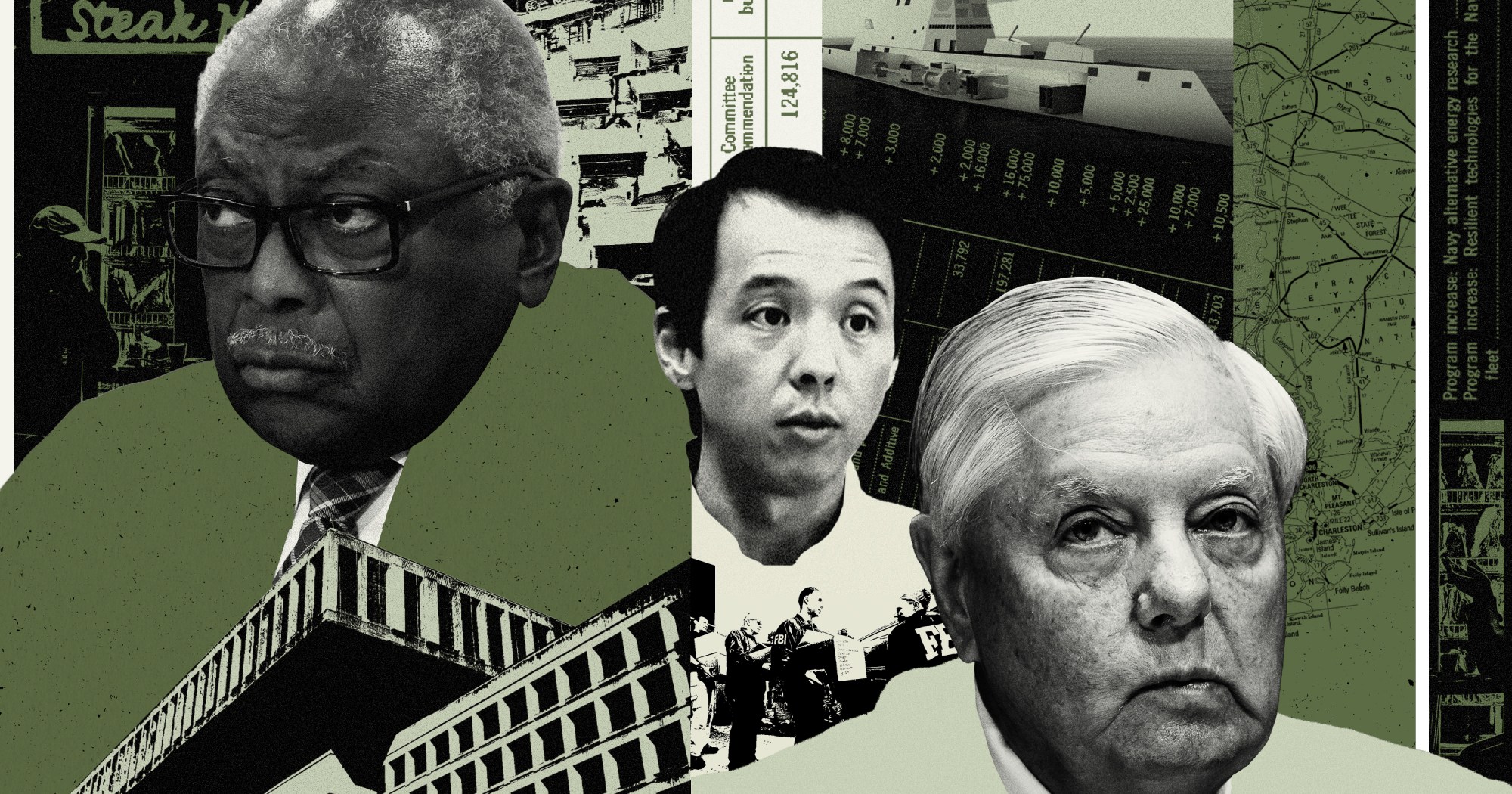
On March 3, 2020, Sen. Lindsey Graham walked into a private dining room at Charlie Palmer Steak in Washington, D.C. Graham’s time was expensive. He was meeting with two executives and a lobbyist from a Hawaiian naval defense contractor called Navatek. And he had required them to commit to $40,000 in campaign contributions for a 45-minute meeting.
Navatek’s CEO, Martin Kao, was confident that was all the time he needed.
“Shoot all he has to really do is stop by and say ‘yes,’” Kao wrote to a Navatek lobbyist and a fellow executive the day before, in an email seen by ProPublica. “That should only take a minute and he’s on his way. We don’t need to pretend we give a shit about each other.”
At the dinner, Graham ate little and talked a lot. But Kao got the “yes” he was hoping for: Graham agreed to steer a $10 million government contract Navatek’s way in his native South Carolina, Kao later recounted to the FBI. In exchange, he said, Graham asked Kao to pledge a total of $100,000 to his reelection campaign.
Hear the reporters discuss their reporting on the FBI on ”Paper Trail.”
In early 2025, the FBI opened a sweeping investigation into bribery on Capitol Hill with Graham’s steakhouse dinner at the center. Kao confessed to federal agents that his business model consisted of bribing public officials in exchange for government contracts, and that the research Navatek was providing to the government was often worthless.
The scheme involved some of the most powerful figures in Congress, he said — in both parties. In South Carolina, Kao told agents, Navatek made a campaign cash-for-contracts deal not only with Graham, but also with the state’s top Democrat, Rep. James Clyburn, and another influential Republican, Rep. Joe Wilson.
Kao told agents that Graham in particular left little room for ambiguity: “This is how much I want, and how much I am going to give you,” Kao remembered Graham saying, according to notes one agent took during their debrief in late 2024.
Kao’s admissions would constitute a vast criminal bribery scheme if they could be proved in court — a challenge, given recent Supreme Court rulings that have made it more difficult to win corruption cases. Kao himself posed another hurdle. He was facing prison for fraud and campaign finance violations and was speaking to the FBI in the hopes of reducing his sentence.
But the FBI agents who took Kao’s confession — two experienced anti-corruption investigators — could see that much of it lined up with a trove of records they had seized from Navatek. They forged ahead. The FBI took the formal step of naming two former Navatek executives who had worked with Kao as subjects of a bribery investigation. The agency did not designate Graham, Clyburn and Wilson that way, but the agents were actively investigating their interactions with Kao. The agents indicated to their superiors that the lawmakers could become subjects in the future, according to records viewed by ProPublica.
The details of this investigation have not previously been reported.
President Donald Trump returned to the White House and almost immediately gutted the specialized FBI and Department of Justice teams dedicated to taking on public corruption — an act of revenge for having previously investigated him. The two experienced agents on the case were swept up in the purge, and the career prosecutor assisting them quit after Trump appointees forbid the DOJ’s anti-corruption section from filing any new cases . Today, there is no one left to look into Kao’s explosive allegations, as the Trump administration has abandoned any pretense of prosecuting public corruption. The case is dead.
ProPublica has unearthed the investigation by reviewing thousands of pages of legal documents, internal company emails, evidence the FBI used to vet Kao’s claims and dozens of interviews with people who saw how Navatek operated, including an eyewitness to Graham and Kao’s secret steakhouse dinner.
This story is part of a series based on our reporting. Last month, ProPublica reported that the FBI had probed the conduct of Maine Sen. Susan Collins, who steered millions in government funding toward Navatek while Kao gave her illegal campaign donations. Collins denied wrongdoing and dismissed Kao as a “convicted liar.”
Kao is indeed the only person involved to serve prison time. He pleaded guilty to making illegal campaign donations and a loan fraud scheme in 2022. In 2025, he was sentenced to 87 months in prison.
Graham died at 71 earlier this year. His sister, Darline Graham, who was appointed to fill his seat, retained most of his senior staff, including those who dealt with Navatek. She even took up some of his committee assignments, including appropriations. Darline Graham is running for a full term in office this November.
Clyburn, 86, is one of the most powerful Democrats in Washington. He is widely credited with tipping the scales for Joe Biden during the 2020 Democratic presidential primary. Wilson remains influential on national defense spending from his senior perch on the Armed Services Committee.
“Whatever a donor may think or say, a donation would never cause Congressman Clyburn to increase his support for the donor’s request,” Jami LaRue, Clyburn’s communications director, wrote in response to detailed questions. “The Congressman has always striven to assist the University of South Carolina and all of the colleges and universities in his district when called upon to further their important missions. The crimes and lies of an imprisoned fraudster will not cause the Congressman to waver in his support for these fine institutions.”
David Snider, Wilson’s communications director, did not address a detailed list of questions sent by ProPublica. “Congressman Wilson does and has always abided by campaign donation regulations set forth by the Federal Election Commission,” Snider said in an email.
In an emailed statement, Taylor Reidy, who was Lindsey Graham’s communications director and now holds the same post for his sister, wrote that “any allegations of quid-pro-quo behavior or wrongdoing by the late Senator Lindsey Graham or his staff are simply false.” She said the accusations were the “ravings of a convicted felon” and that her office was never contacted by the FBI about the matter. After Kao’s arrest, they disgorged his donations, she added.
The two executives who were subjects of the FBI investigation, Duke Hartman and Joshua Knight, were never charged. Hartman, the other executive at the dinner meeting with Graham, is now the CEO of a new naval research company called Integer Technologies that he co-founded with Knight after Kao’s arrest. Integer was recently recognized as one of the fastest-growing government contractors in the country. It also became the ultimate beneficiary of the Graham dinner meeting, picking up the contract Graham allegedly agreed to facilitate that night.
Hartman and Knight did not respond to detailed requests for comment.
“[It’s] corruption at its best,” Kao wrote to ProPublica from federal detention in South Dakota, before cutting off contact. “But I am the only one rotting in prison.”
Kao’s dinner with Graham was part of his grandiose plan to make Navatek a major defense contractor.
He had become the CEO at an uncertain moment in the company’s history. Founded in Hawaii in the 1970s, the company originally thrived on a close relationship with the state’s powerful senior senator, Daniel Inouye. When Kao assumed ownership in 2019, it had been several years since Inouye had died, and Navatek was in need of a new patron in Washington.
At times, Kao hardly seemed the person to pull this off. He had started out as the company’s CFO and was openly uninterested in its technology. He told bombastic lies about his personal life. Former employees said he regaled them with tales of selling newspapers for members of the Bloods and Crips street gangs as a youth. In a deposition, Kao later admitted that wasn’t true.
But what he lacked in engineering chops he made up with ambition. Once, Kao held a company town hall using a map of the U.S. dotted with future Navatek offices as his backdrop, a former employee recalled. “He would talk about how we’re a $10 million company, and in the next three years, we’re going to be a billion-dollar company,” said a former engineer. “He was an absolute megalomaniac.”
Kao hatched a plan to expand Navatek’s presence across the country, making new friends in Congress along the way. He courted politicians using something he called “the method,” as ProPublica detailed in September .
Navatek would open an office in the state or district of a powerful member of Congress and partner with a local university to concoct a proposal for federally funded research. Then, aided by a well-connected lobbyist and the sheen of credibility from its association with the university, Navatek would approach the member for federal research funding.
Kao told the FBI he would strike deals in small, face-to-face meetings with the members or their trusted staff. Navatek — through executives, family members and lobbyists — would make generous campaign donations. In exchange, the member would add detailed language to the defense budget to fund the company’s work.