How Trump’s War on Offshore Wind Upended a “Limitless” Future for Thousands of New England Workers
On a hot July day in 2022, then-President Joe Biden gave a speech from the ruins of a coal-fired power plant on the southern coast of Massachusetts.
Standing where ships once delivered coal for combustion, he said the same dock would soon launch components for wind power out to sea.
He praised an Italian company’s plans to build a new factory there, set to create 250 jobs and supply American-made undersea power cables to what was then a line of offshore wind projects waiting to be built along the coast.
Four years later, weeds and tall grass have reclaimed the dirt lot on which Biden spoke.
A 20-minute drive east, in New Bedford, hundreds of workers who helped assemble wind turbine parts from Canada and Europe over the last three years have given way to seagulls and geese. The birds shuffle along the now-empty pier the state of Massachusetts spent $140 million to build for offshore wind development.
In nearby Providence, Rhode Island, a newly built factory that manufactured offshore wind turbine foundation platforms has emptied out.
Amid the Trump administration’s multifront war against offshore wind, the cost on the ground in New England, the launchpad of the country’s offshore wind industry, can be seen in empty warehouses, silent marine terminals and ledgers recording hundreds of millions of dollars of state investment that may not be recouped.
ProPublica partnered with Ocean State Media, The Connecticut Mirror and the New Bedford Light to document the consequences of the administration’s efforts.
Many offshore wind projects faced a precarious future before President Donald Trump retook office. Rising construction costs driven by inflation and supply chain shortages forced some developers to back out of contracts to build wind farms and supply electricity to states. Various groups have also fought construction of projects saying they disrupt marine ecosystems and mar coastal views.
But last year, the administration temporarily forced five projects to stop construction , further clouding the horizon. Courts allowed the developers to proceed, but that has not eliminated the threat. Last month, the U.S. Department of the Interior asked a court for permission to reconsider a key permit for one of those five projects, Revolution Wind, which is already up and running and can power more than 350,000 New England homes at maximum capacity.
The administration also has frozen future development on all offshore wind farms, including a cluster of projects that haven’t been built but proposed to power up to 1.7 million New England homes. It has blocked or is seeking review of the permits that would allow these to be built. Meanwhile, the administration is paying other wind developers billions of dollars to sell back their leases and walk away.
At a press conference Monday, Trump said he supports a bipartisan bill that would accelerate U.S. energy development. When a reporter pointed out that the bill includes wind energy, Trump said he would not approve “wind turbines ’cause wind turbines are a major loser.”
The upheaval has had ripple effects. The cable company Biden touted decided not to build its factory, citing “long-term trends in the U.S. market.”
Port cities like New Bedford, Massachusetts, and New London, Connecticut, are left trying to hold onto the economic gains they have made building wind farms.
The Connecticut Mirror: Offshore wind offered a ‘limitless’ future for Connecticut. Trump scuttled the plan.
The New Bedford Light: Fishermen’s offshore wind work drying up
Ocean State Media: Offshore wind saved a struggling New Bedford union. Now its future is uncertain.
As recently as last winter, New Bedford, a historic whaling and textile manufacturing center, had hotels, offices and piers buzzing with offshore wind workers. Local businesses from caterers to cleaners to fuel suppliers landed new contracts servicing the wind industry.
In New London — another port once central to the whaling industry — officials worked with one of the world’s largest wind developers to pump more than $300 million of public and private funds into a state-owned pier. Despite significant cost overruns and some early construction challenges, the effort transformed the pier into a staging area for the wind industry.
Over the last four years, the pier has been a hive of activity. Hundreds of workers were employed loading and offloading turbine parts — with blades the length of a football field — from specially designed ships, some with names drawn from Greek mythology. Local companies also found work supporting the industry, including one that offered water rescue training for people working on construction sites offshore.
“I think the future just looked limitless, ” said New London Mayor Michael Passero.
Before wind, Passero said that officials tried for years to attract different industries to the pier, which is overshadowed by larger port facilities in New York and Boston. It was often used to import and store large piles of road salt.
The most recent wind project based at the pier is scheduled to finish work next year. Port officials have yet to find a tenant to occupy the space.
“They’ll be back to the old days of trying to lure cargo here,” Passero said.
Amid Trump’s war on wind, a frontline of union and nonunion workers watches opportunity disappear. One project alone, Vineyard Wind, directly employed a total of more than 3,700 full- and part-time workers — most of them from Massachusetts — over eight years of development and construction, according to the developer.
During peak construction activity, as many as 300 union members worked onshore in southeastern Massachusetts for the project, the first large offshore wind farm fully permitted by the federal government. The wind farm was completed this year.
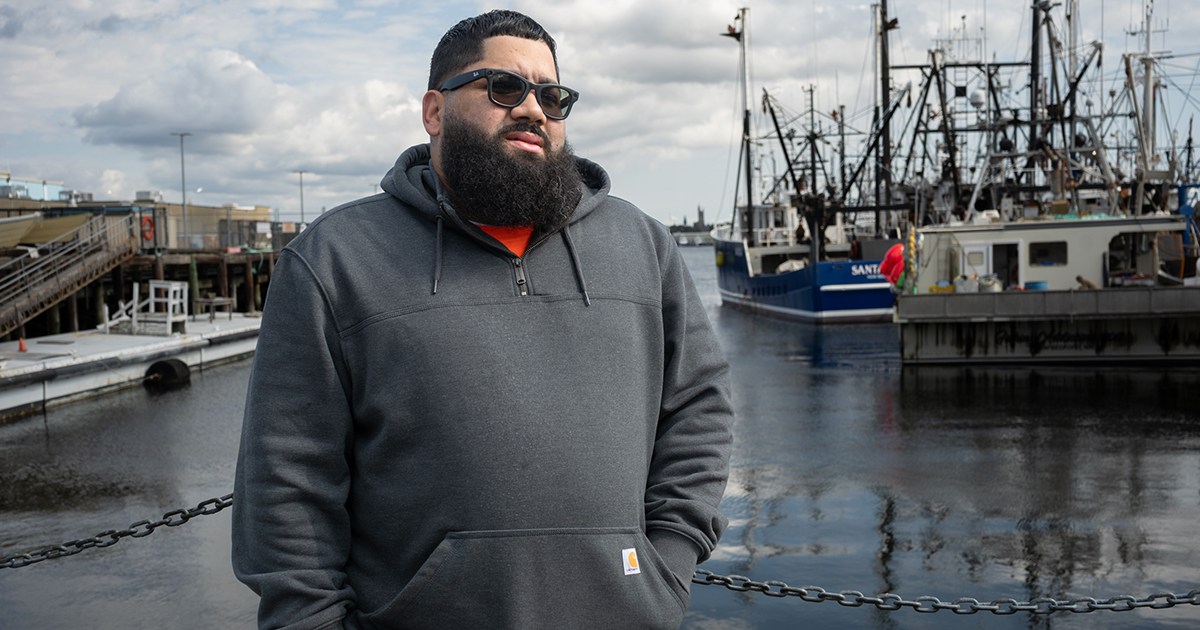
Longshoreman Onix Vazquez, 34, worked full-time tying up barges and moving turbine components on and off New Bedford’s wind pier. He grew up a few blocks away and said he had struggled to find lucrative work until Vineyard Wind began hiring from his union.
Vazquez’s hourly wage of $50 was nearly double what he previously earned unloading occasional shipments of tangerines and juice concentrate. It allowed him and other members of his historically Black union to make down payments on houses, pay off medical bills and for the first time take their families on out-of-state vacations.
“Most of us have to get other jobs for now or collect unemployment,” said Kevin Rose, president of New Bedford’s longshoremen union, which put about two dozen members to work on the project.
The union had been planning to rebuild its nearby meeting hall, which was demolished a decade earlier when work grew scarce. But the next developer to lease New Bedford’s wind pier has delayed its project indefinitely. The union members have put the plans for their new hall on hold.